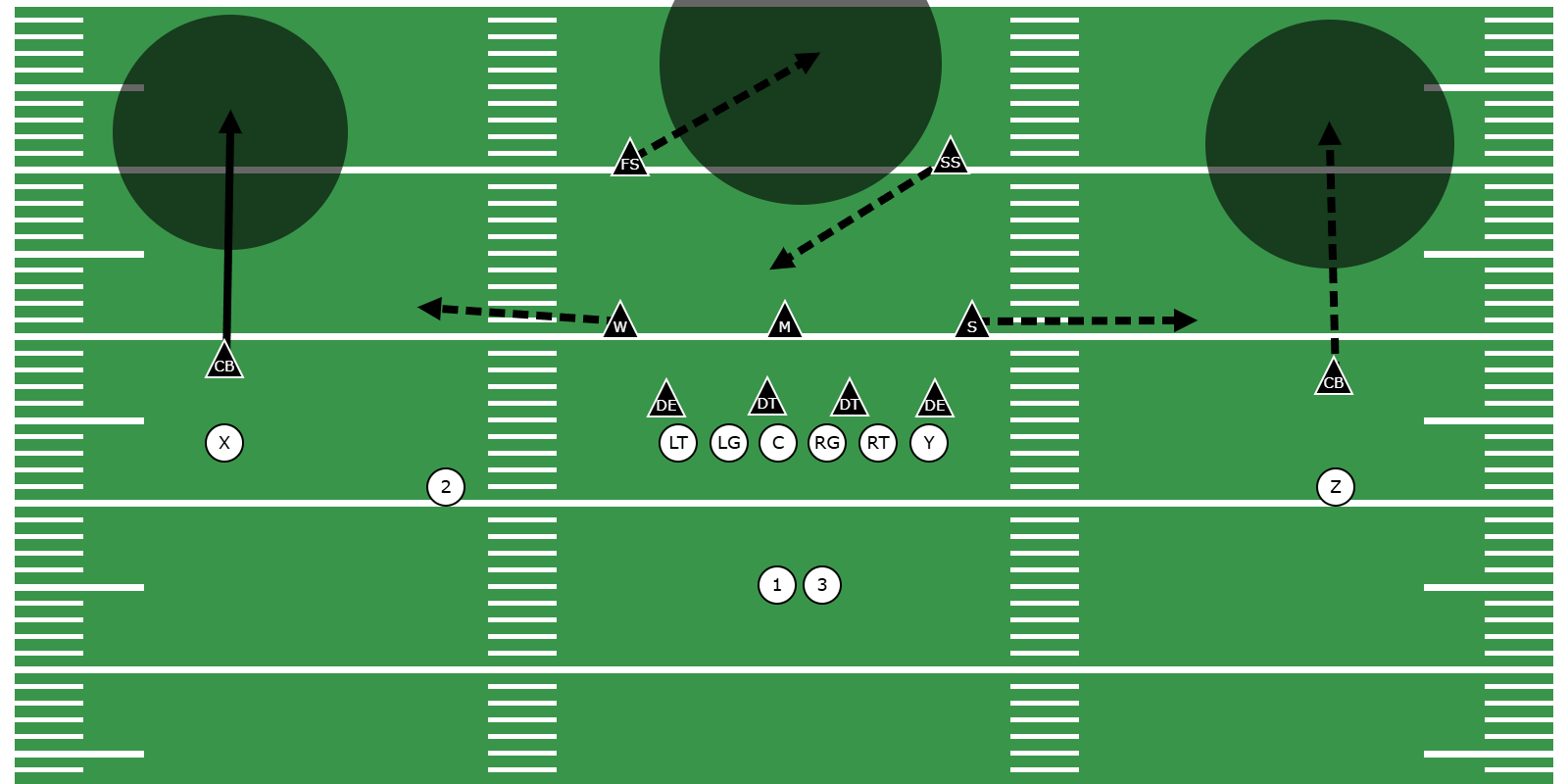
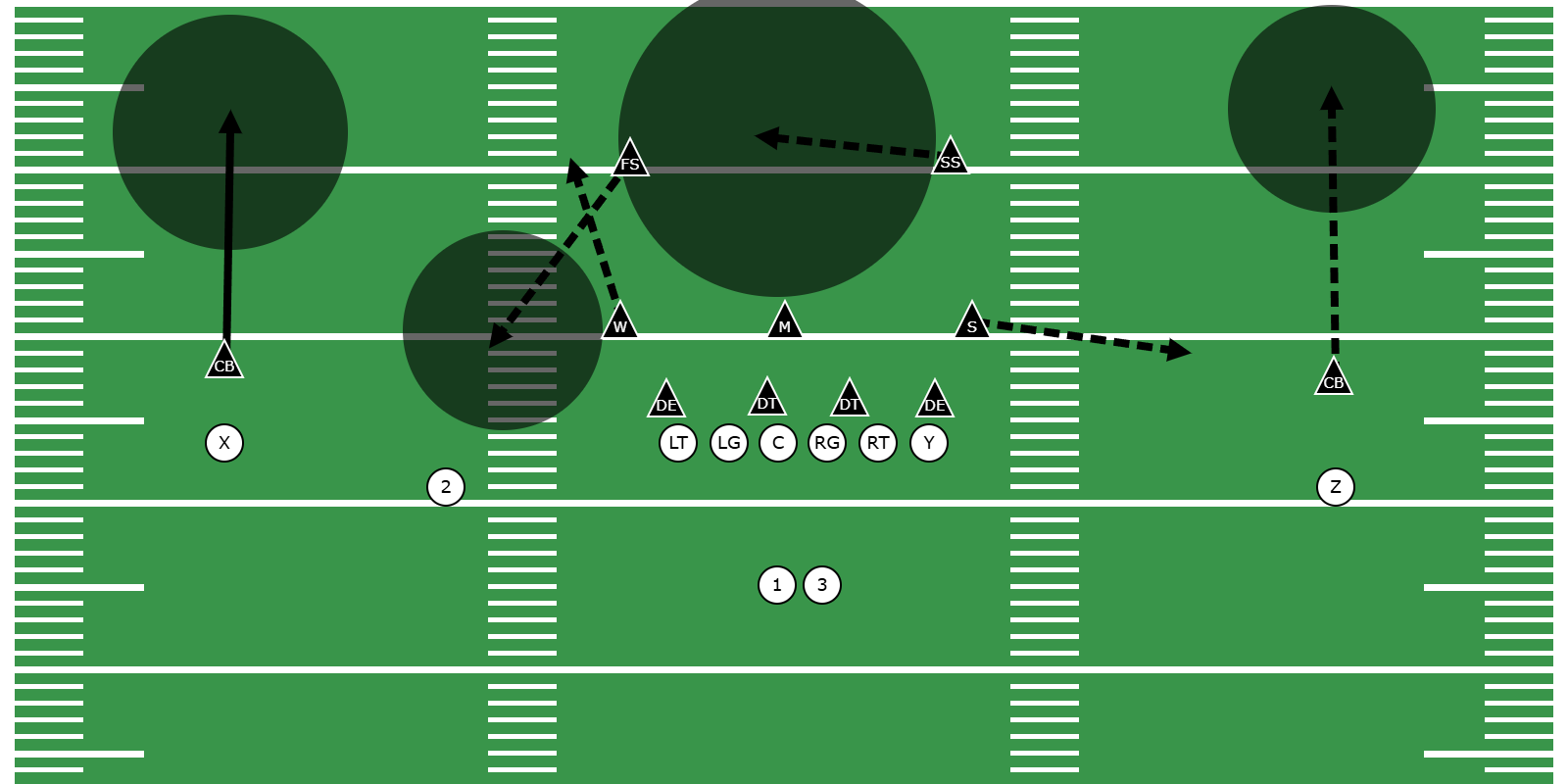
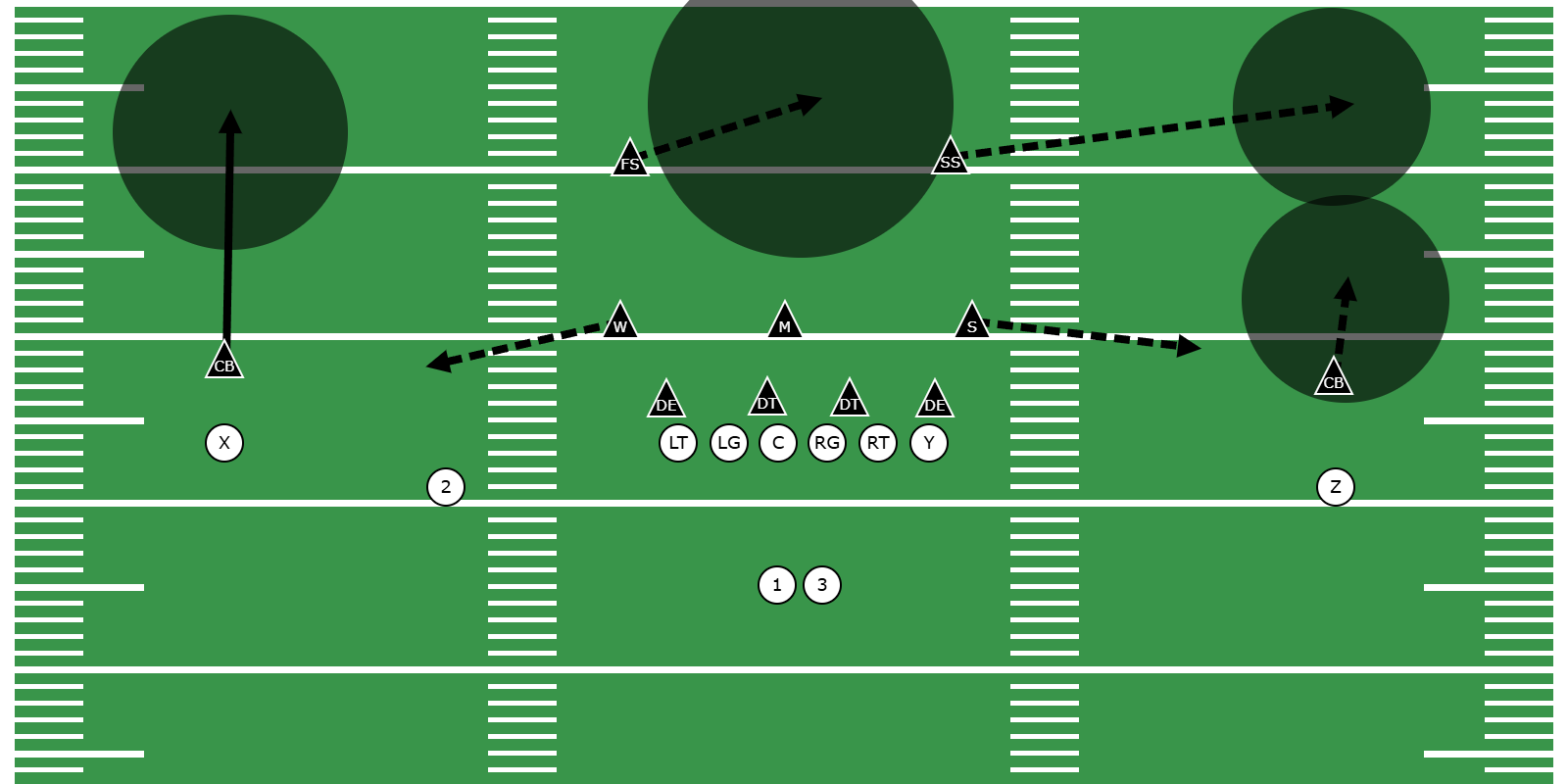
Cover 3 Match
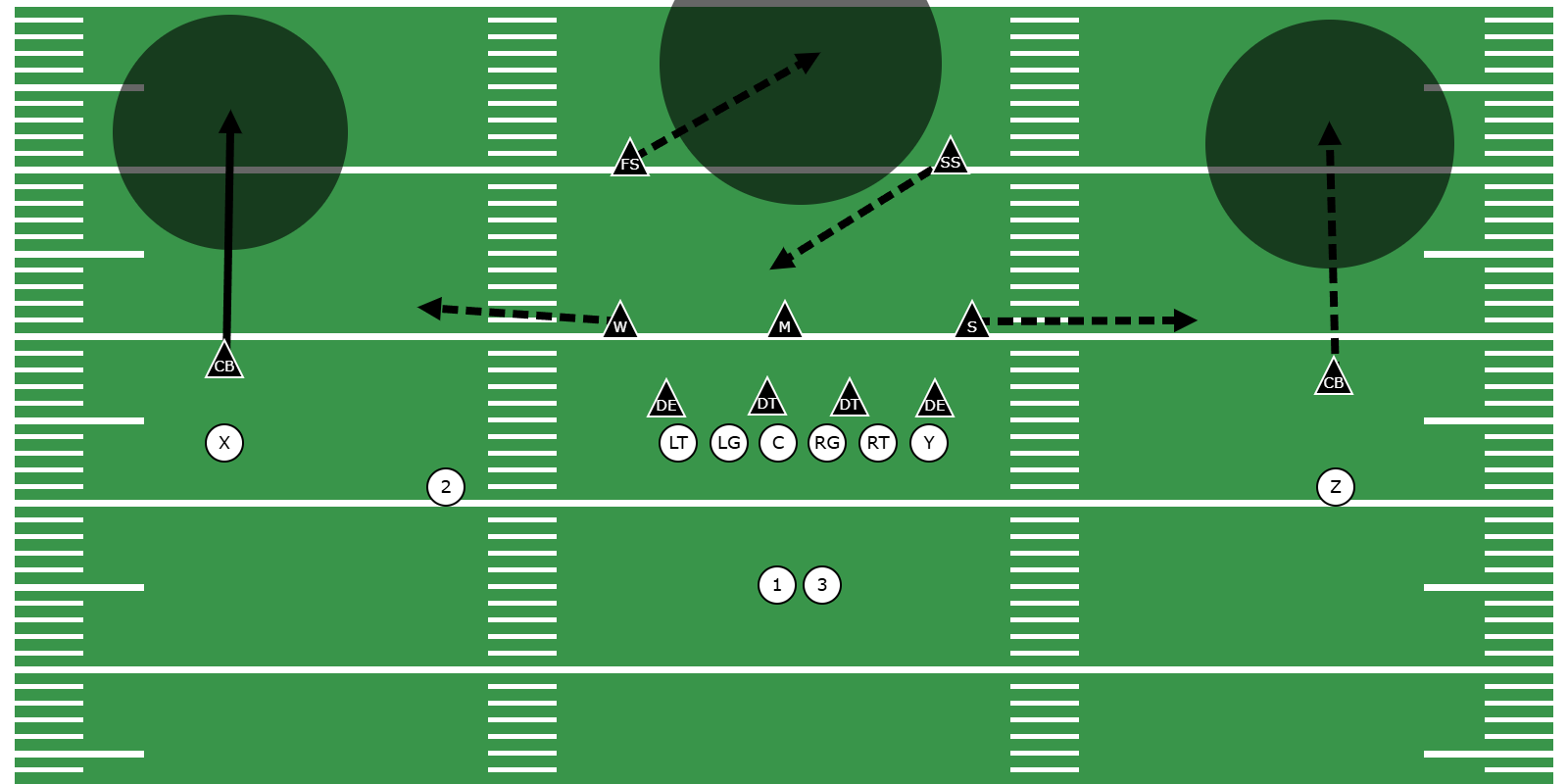
What Is Cover 3 Match?
Traditional Cover 3 commonly divides the defense into:
- Two outside deep-third defenders.
- One middle-third defender.
- Two curl/flat defenders.
- Two hook defenders.
In a simple spot-drop version, each defender moves toward a predetermined zone and reacts to receivers entering it.
Cover 3 Match begins from the same general structure but adds route-distribution rules.
Those rules tell defenders what to do when receivers:
- Release vertically.
- Break inside.
- Break outside.
- Cross the formation.
- Release to the flat.
- Switch positions after the snap.
The coverage therefore begins as zone but can look much more like man coverage once the route combination develops.
Why Use Pattern Matching?
Offenses know where the openings exist in static zone coverage.
Against basic Cover 3, common attacks include:
- Four Verticals.
- Flood.
- Curl/Flat.
- Seam routes.
- Switch releases.
- Intermediate routes settling between zones.
Pattern matching allows defenders to react to those routes instead of defending empty grass.
For example, an underneath defender may carry a slot receiver vertically rather than allowing him to run untouched through the seam.
A corner may match an outside vertical receiver rather than simply thinking about a painted third of the field.
The goal is to make the coverage respond to the offensive pattern while maintaining the overall Cover 3 structure.
Zone Coverage That Becomes Man-Like
Cover 3 Match is often described as a zone-match coverage because defenders begin with zone relationships but may end up covering receivers man-to-man.
That does not mean every defender simply chooses a receiver after the snap.
The matchups are determined by rules.
A defender might be told:
- If number two goes vertical, carry him.
- If number two goes immediately outside, pass him and look inside.
- If number one goes vertical, match him.
- If a receiver crosses away, communicate and replace him with the next threat.
The exact rules vary significantly among defensive systems.
There is no single universal version of Cover 3 Match.
What matters is that the rules collectively preserve the coverage structure while accounting for the routes the offense actually runs.
Numbering the Receivers
Pattern-match systems commonly identify receivers by their position relative to the sideline.
On each side of the formation:
- #1 is the widest eligible receiver.
- #2 is the next receiver inside.
- #3 is the next receiver inside when present.
This numbering gives defenders a consistent language for their reads.
For example, instead of telling a defender to “watch the slot,” the defense can teach him to read #2.
That remains useful when the offense changes personnel because the defender is reading a formation position rather than a specific offensive position label.
A tight end can be #2.
A slot receiver can be #2.
A running back can become part of the distribution depending on his release and the defensive system.
Basic Cover 3 Match Structure
A typical Cover 3 Match structure still includes:
- Two outside deep defenders.
- One middle-third safety.
- Two curl/flat defenders.
- Two inside underneath defenders.
- Four pass rushers.
The difference appears after the snap.
Instead of each coverage player immediately retreating to a fixed spot, defenders identify their route keys and execute the appropriate match rule.
The coverage can therefore look different against different route combinations even though the defense called the same coverage.
Outside Cornerback Responsibilities
The cornerbacks normally begin with responsibility for the outside receivers and deep thirds.
Against a vertical release by #1, the corner commonly carries or matches that receiver.
This prevents the offense from simply sending the outside receiver through the deep third while expecting the corner to remain detached from him.
Depending on the system, the corner may also have rules for:
- Short outside routes.
- Inside releases.
- Routes crossing completely out of his area.
- Switch releases involving #1 and #2.
- Reduced or condensed receiver splits.
The corner still needs to protect against the deep ball.
Pattern matching does not give him permission to abandon a vertical threat merely because another route appears underneath.
Middle Safety Responsibilities
The middle safety remains one of the most important players in the coverage.
He protects the deep middle while reading the route distribution developing around him.
He may need to account for:
- Posts.
- Seams.
- Crossing vertical routes.
- Multiple inside receivers pushing deep.
- Routes that change the initial distribution.
His rules should help determine which vertical threat requires his attention.
Unlike a pure spot-drop safety who might simply pedal toward the middle third, a match safety needs to understand how the routes are attempting to stretch him.
He must remain patient enough to avoid committing to the wrong receiver too early.
Curl/Flat Defender Responsibilities
The curl/flat defenders are often central to the match structure because the release of #2 can determine their responsibility.
A simplified teaching example might include:
- If #2 releases vertically, carry him.
- If #2 releases immediately to the flat, expand with him.
- If #2 releases inside, communicate and look for the next threat.
These are examples rather than universal rules.
The actual system may use different definitions for vertical, out, or inside releases.
The important coaching point is that the curl/flat defender is no longer simply running to a curl/flat landmark regardless of what #2 does.
He is reacting to the route distribution.
Hook Defender Responsibilities
Hook defenders commonly read inside receivers and help account for routes that move through the interior.
They may be responsible for:
- Inside releases by #2.
- #3 in Trips formations.
- Crossers.
- Hooks.
- Running back releases.
- Quarterback scrambles once coverage responsibilities allow.
Their rules must coordinate with the curl/flat defenders.
If one defender passes an inside-breaking route, another defender must know that route is entering his responsibility.
Pattern matching fails quickly when one defender believes he has passed a route but the next defender does not know he is receiving it.
What Counts as Vertical?
One of the most important definitions in any match system is vertical.
The defense must establish when a receiver has released far enough downfield that a defender should carry him.
That definition can be based on:
- Yardage.
- Receiver intent.
- Route stem.
- A combination of depth and direction.
The exact definition varies.
What matters is consistency.
If one defender considers a five-yard stem vertical while another expects eight yards, the offense can create confusion in the space between their rules.
Youth coaches should use a simple definition players can recognize at full speed.
Communication in Cover 3 Match
Communication is more important in Cover 3 Match than in basic spot-drop Cover 3.
Useful calls can identify:
- Receivers crossing zones.
- Switch releases.
- Routes being passed.
- Motion.
- Bunch or stack adjustments.
- Formation changes.
The exact terminology should be short and consistent.
Players should not need a long conversation after the snap.
A one-word call that every defender understands is more valuable than a complicated vocabulary that nobody can process while receivers are moving.
Why Defenses Use Cover 3 Match
The coverage attempts to combine several advantages.
Preserve Cover 3 Run Support
The defense can retain a single-high structure and an extra defender near the box.
Improve Vertical Coverage
Underneath defenders can carry seam routes instead of allowing clean releases through the zones.
Reduce Static Zone Windows
Defenders react to receivers rather than dropping blindly to grass.
Handle Modern Route Combinations
Match rules can provide answers to route concepts specifically designed to overload spot-drop zones.
Challenge Receivers
Although the defense begins in zone, routes can quickly become tightly matched.
Strengths of Cover 3 Match
When executed correctly, Cover 3 Match can provide:
- Three-deep structural protection.
- Strong run support from a single-high shell.
- Better answers against seam routes.
- Improved defense against Four Verticals.
- Tighter coverage than basic spot-drop zones.
- Ability to adapt to route distribution after the snap.
- Zone eyes before match responsibilities declare.
- Useful disguise with Cover 1 and standard Cover 3.
The coverage can force the quarterback to identify post-snap matchups instead of simply throwing to a predetermined zone opening.
Weaknesses of Cover 3 Match
The added flexibility comes with added complexity.
Communication Errors
One missed exchange can leave a receiver completely uncovered.
Rule Conflicts
If defenders interpret a route differently, both may take the same receiver or neither may take him.
Bunch and Stack Releases
Condensed formations can make receiver identification and route distribution more difficult.
Motion
Motion can change receiver numbering and defensive responsibilities immediately before the snap.
Play Action
Defenders involved in the run fit may lose valuable time before recognizing their match responsibility.
Athletic Matchups
Once the coverage converts to man-like responsibilities, defenders still need enough athletic ability to stay with the receivers they match.
Practice Time
The system requires more repetitions than basic spot-drop Cover 3.
Try The Interactive Playbook Tool: Cover 3 Match
Draw your own Cover 3 Match concept based play diagram right here using our embedded interactive play designer demo:
GET STARTED: To get started simply click on any of the player icons in the diagram.
Start drawing your own plays like this and build your playbook with CoachYouths Playbook Designer.
Cover 3 Match Against Four Verticals
Four Verticals is one of the major reasons defenses use match principles.
Traditional Cover 3 has three deep defenders against four vertical threats.
Pattern matching allows underneath defenders to carry inside vertical routes.
A simplified distribution might involve:
- Corners matching #1 vertical.
- Curl/flat defenders carrying #2 vertical.
- The middle safety reading and helping the inside vertical threats.
The exact assignments depend on the system.
The important difference is that the offense does not receive two free seam runners against one middle safety.
The underneath defenders remain involved vertically.
Cover 3 Match Against Curl/Flat
Against Curl/Flat, the defender reading #2 may see him release to the flat.
That release can trigger the defender to expand outside.
Other defenders then adjust to the curl or inside route according to their rules.
Because responsibilities respond to the actual pattern, the defense can reduce the traditional high-low stress placed on a static curl/flat player.
However, the rules must clearly define who takes the curl once the underneath defender expands.
Cover 3 Match Against Flood
Flood attempts to place three receivers at different depths on one side.
Match rules can help the defense distribute those receivers rather than asking two zone defenders to cover three static levels.
The defense needs answers for:
- The deep route.
- The intermediate route.
- The flat route.
The corner normally protects the vertical threat.
The underneath defenders distribute the shorter routes according to their releases and match rules.
If the communication is correct, the offense may find fewer obvious windows than it would against basic spot-drop Cover 3.
Cover 3 Match Against Mesh
Mesh creates crossing traffic designed to beat man coverage and confuse zone exchanges.
Match defenders need clear rules for routes crossing the formation.
A defense may:
- Carry certain crossers.
- Pass shallow routes to another defender.
- Zone off routes below a defined depth.
- Match deeper crossing routes.
The exact solution varies.
What cannot happen is two defenders following one shallow receiver while another crosser runs uncovered through the middle.
Cover 3 Match Against Smash
Smash places a short outside route beneath a corner route.
The match rules need to distribute the high and low threats.
The outside corner must remain alert to the corner route entering his deep area.
The underneath defender handles the short route according to the release of his key.
Pattern matching can help prevent the deep defender from being manipulated by the short route, but only if he remains disciplined.
Cover 3 Match Against Switch Releases
Switch releases intentionally challenge match rules.
Two receivers cross or exchange their vertical paths shortly after the snap.
The defense must determine whether defenders:
- Stay with their original receiver.
- Exchange the receivers.
- Match based on which route enters their zone.
- Use a specific switch call.
This is one of the situations that separates a practiced match defense from a defense that simply tells players to “match routes.”
Switch releases need dedicated practice.
Cover 3 Match Against Trips
Trips creates one of the most important route-distribution problems.
The defense must account for:
- #1.
- #2.
- #3.
- The backside receiver.
- The running back.
The #3 receiver is especially important because he can:
- Release vertically.
- Cross the formation.
- Run to the flat.
- Settle underneath.
- Become part of a three-level stretch.
The defense needs explicit rules for who reads #3 and how his release changes other responsibilities.
Trips adjustments should be installed as part of the coverage, not improvised during a game.
Cover 3 Match Against Bunch
Bunch formations compress the receivers and make normal #1/#2/#3 relationships less obvious.
Defenses may use:
- Special bunch checks.
- Box techniques.
- Banjo principles.
- Modified receiver numbering.
- A different coverage entirely.
For youth teams, this is an important complexity checkpoint.
If the defense cannot communicate its bunch adjustment consistently, checking to a simpler coverage may be better than forcing the base match rules into a formation they do not handle cleanly.
Cover 3 Match Against Motion
Motion can change receiver numbering.
A player who was #2 can become #1.
A back can motion out and become part of the receiver distribution.
Trips can become a balanced formation or vice versa.
The defense needs rules for:
- Renumbering receivers.
- Adjusting leverage.
- Communicating the new distribution.
- Determining whether the coverage remains intact.
- Checking to another call if necessary.
Youth coaches should keep motion rules as simple as possible.
Complex match coverage becomes even more difficult when players are trying to recalculate multiple responsibilities seconds before the snap.
Cover 3 Match and the Run Game
One reason to use Cover 3 Match instead of a two-high match structure is the ability to preserve Cover 3’s run-support geometry.
A safety or hybrid defender can remain near the box.
The defense can maintain clear force, alley, and cutback responsibilities.
However, defenders who are both run fitters and match players face run-pass conflicts.
They must read their keys correctly.
If they attack the run too quickly, receivers can release behind them.
If they immediately retreat into coverage, the offense can gain an advantage in the run game.
The defensive front and coverage should therefore be taught together.
Cover 3 Match Against Play Action
Play-action directly attacks defenders responsible for both the run fit and route matching.
A defender who steps downhill may lose the receiver he is supposed to carry vertically.
Useful coaching principles include:
- Read the assigned run/pass key.
- Do not stare only at the running back.
- Recognize receiver releases.
- Maintain leverage during the transition from run read to pass coverage.
- Communicate when routes exchange.
The deep defenders must remain especially disciplined.
A deep-third corner or middle safety cannot abandon vertical protection because of a convincing run fake.
Cover 3 Match and the Quarterback
Pattern matching changes the quarterback’s picture after the snap.
A route that appears to be entering an open zone may suddenly be matched by a defender.
That can force the quarterback to:
- Hold the football.
- Move to another progression.
- Make tighter throws.
- Confirm coverage after the snap.
The defense benefits if the pass rush can take advantage of that additional decision time.
The goal is not simply to cover every receiver forever.
The goal is to eliminate easy answers long enough for the rush to affect the play.
Cover 3 Match and the Pass Rush
A standard four-man rush works naturally with the seven-man coverage structure.
The rush should:
- Maintain lane integrity.
- Keep the quarterback in the pocket.
- Collapse the edges.
- Create interior pressure.
- Force throws before receivers can work through extended routes.
Match coverage can become vulnerable when plays extend.
Defenders may have matched receivers across large portions of the field, and the original zone spacing can disappear.
A disciplined rush helps keep the play within the time frame the coverage is designed to defend.
Spot-Drop Cover 3 vs. Cover 3 Match
The distinction is important.
Spot-Drop Cover 3
Defenders primarily protect defined areas and react to receivers entering those areas.
Advantages include:
- Simpler installation.
- Easier communication.
- Fewer route-distribution rules.
Weaknesses include:
- Static zone windows.
- Greater vulnerability to carefully designed zone stretches.
Cover 3 Match
Defenders use route releases to determine who they carry or match.
Advantages include:
- Tighter coverage.
- Better answers against vertical route distributions.
- Fewer easy zone windows.
Weaknesses include:
- Greater complexity.
- More communication.
- More potential for assignment errors.
Neither version is automatically better for every team.
The best choice is the one the players can execute consistently.
Disguising Cover 3 Match
Cover 3 Match can be disguised from several structures.
The defense can show:
- Basic Cover 3.
- Cover 1.
- A two-high shell before rotating.
- Pressure.
- Off-man alignments.
Because the coverage can become man-like after the snap, the quarterback may initially believe he is seeing zone before realizing receivers are being matched.
For youth football, disguise should remain secondary.
The defense should first be able to identify receivers, communicate the rules, and execute the matches correctly.
Coaching Cover 3 Match in Youth Football
Cover 3 Match should generally be installed only after players understand basic Cover 3.
A practical progression is:
- Install spot-drop Cover 3.
- Teach receiver numbering.
- Define what counts as a vertical release.
- Identify which defender reads #1, #2, and #3.
- Add one match rule at a time.
- Practice two-receiver route combinations.
- Add Four Verticals.
- Add Curl/Flat.
- Add Flood.
- Add switch releases.
- Add Trips.
- Add bunch checks.
- Add motion.
- Add play-action.
- Practice full-team situations.
Do not install ten match rules at once.
Players need to recognize each rule at game speed before another layer is added.
A Simple Match Drill
Use one side of the formation with:
- One cornerback.
- One curl/flat defender.
- One inside defender.
- Two receivers.
- One quarterback.
Number the receivers #1 and #2.
Run combinations such as:
- #1 vertical / #2 vertical.
- #1 hitch / #2 vertical.
- #1 vertical / #2 flat.
- #1 slant / #2 out.
- Switch verticals.
Before each repetition, defenders should identify their keys.
After the snap, they execute the match rule.
Grade:
- Receiver identification.
- Communication.
- Route recognition.
- Correct match.
- Leverage.
- Transition from zone vision to man technique.
Only after players consistently handle two-receiver combinations should the drill expand to Trips.
Common Youth Football Mistakes
Players Do Not Know Their Read
A defender understands his final assignment only after the coach tells him which route was run.
Everyone Carries Vertical
Too many defenders chase vertical routes and leave underneath receivers uncovered.
Nobody Carries Vertical
Defenders remain attached to their zone landmarks while seam receivers run through the coverage.
Inconsistent Definition of Vertical
Two defenders interpret the same route differently and create a coverage bust.
Poor Communication on Crossers
One defender passes the route, but nobody receives it.
Confusion After Motion
Receiver numbering changes and the defense never resets the match responsibilities.
Deep Defenders Get Distracted
Corners or safeties abandon vertical threats because they become involved with underneath route distribution.
Too Many Rules
Players hesitate because they are trying to remember an oversized decision tree.
Personnel Considerations
Cover 3 Match requires more mental processing than basic Cover 3.
Useful traits include:
Corners
- Vertical coverage ability.
- Route recognition.
- Discipline.
- Communication.
Middle Safety
- Range.
- Pattern recognition.
- Patience.
- Ability to read multiple vertical threats.
Underneath Defenders
- Awareness.
- Ability to reroute receivers.
- Enough athletic ability to carry vertical routes.
- Communication.
- Understanding of run-pass keys.
A team may have enough athletic ability to play match coverage but not enough practice time to teach it.
That matters just as much as personnel.
When to Call Cover 3 Match
Cover 3 Match can be useful when:
- The offense repeatedly attacks spot-drop Cover 3.
- Four Verticals is a major concern.
- Seam routes are stressing the middle safety.
- The defense wants Cover 3 run support with tighter pass coverage.
- Defenders understand receiver numbering and route distribution.
- The team has enough practice time for match rules.
- The defense wants a single-high coverage that can become man-like after the snap.
A simpler Cover 3 may be preferable when defenders are struggling with communication, offensive motion is creating repeated confusion, or limited practice time prevents the rules from becoming automatic.
Cover 3 Match vs. Cover 3
Both begin from the same general three-deep structure.
Cover 3: Defenders primarily protect zones and react to receivers entering them.
Cover 3 Match: Defenders use route-distribution rules that may convert zone responsibilities into man-like matches.
Cover 3 is simpler.
Cover 3 Match can close more route windows but requires more recognition and communication.
Cover 3 Match vs. Cover 1
Both can eventually look like man coverage and can begin from a single-high safety structure.
Cover 1: Defenders are generally assigned specific receivers before the snap.
Cover 3 Match: Matchups develop according to receiver releases after the snap.
That distinction affects motion, crossing routes, and how defenders communicate responsibilities.
Cover 3 Match vs. Cover 4
Both coverages can use pattern-matching principles.
The major structural difference is the deep shell.
Cover 3 Match: Three-deep structure with a single-high middle safety.
Cover 4: Four deep defenders, commonly beginning from a two-high shell.
The run-support geometry and route-distribution rules therefore differ even when both defenses use matching techniques.
Key Coaching Points
- Install basic Cover 3 before adding match rules.
- Number eligible receivers consistently.
- Define vertical releases clearly.
- Give every defender a specific route key.
- Install one match rule at a time.
- Make route exchanges explicit.
- Practice Four Verticals extensively.
- Practice switch releases and crossing routes.
- Build dedicated Trips and bunch rules.
- Rehearse motion adjustments.
- Keep deep defenders disciplined against vertical threats.
- Connect match responsibilities to run fits.
- Avoid adding more rules than players can execute at full speed.
- Judge the coverage by assignment consistency, not theoretical sophistication.
Final Thoughts
Cover 3 Match takes the familiar three-deep structure of Cover 3 and makes it more responsive to the routes the offense actually runs.
Instead of asking defenders to drop into predetermined areas and wait, the defense identifies receiver releases and uses rules to determine who should carry, pass, or match each route. That can improve coverage against seams, Four Verticals, Flood concepts, and other combinations designed to attack static zones.
The price is complexity. Every additional match rule creates another decision defenders must make correctly and another opportunity for communication to fail.
For youth coaches, the best progression is straightforward: build a dependable Cover 3 first, teach receiver numbering, define a small number of clear match rules, and expand only when players execute those rules without hesitation.
Cover 3 Match is most effective when the defense still plays fast. If pattern matching makes defenders stop and think while receivers run past them, the additional sophistication has defeated its purpose.
Related Articles
Published by CoachYouths Staff on 08/25/2026
You are NOT currently logged in, you may login or signup for FREE at any time: