Cover 3
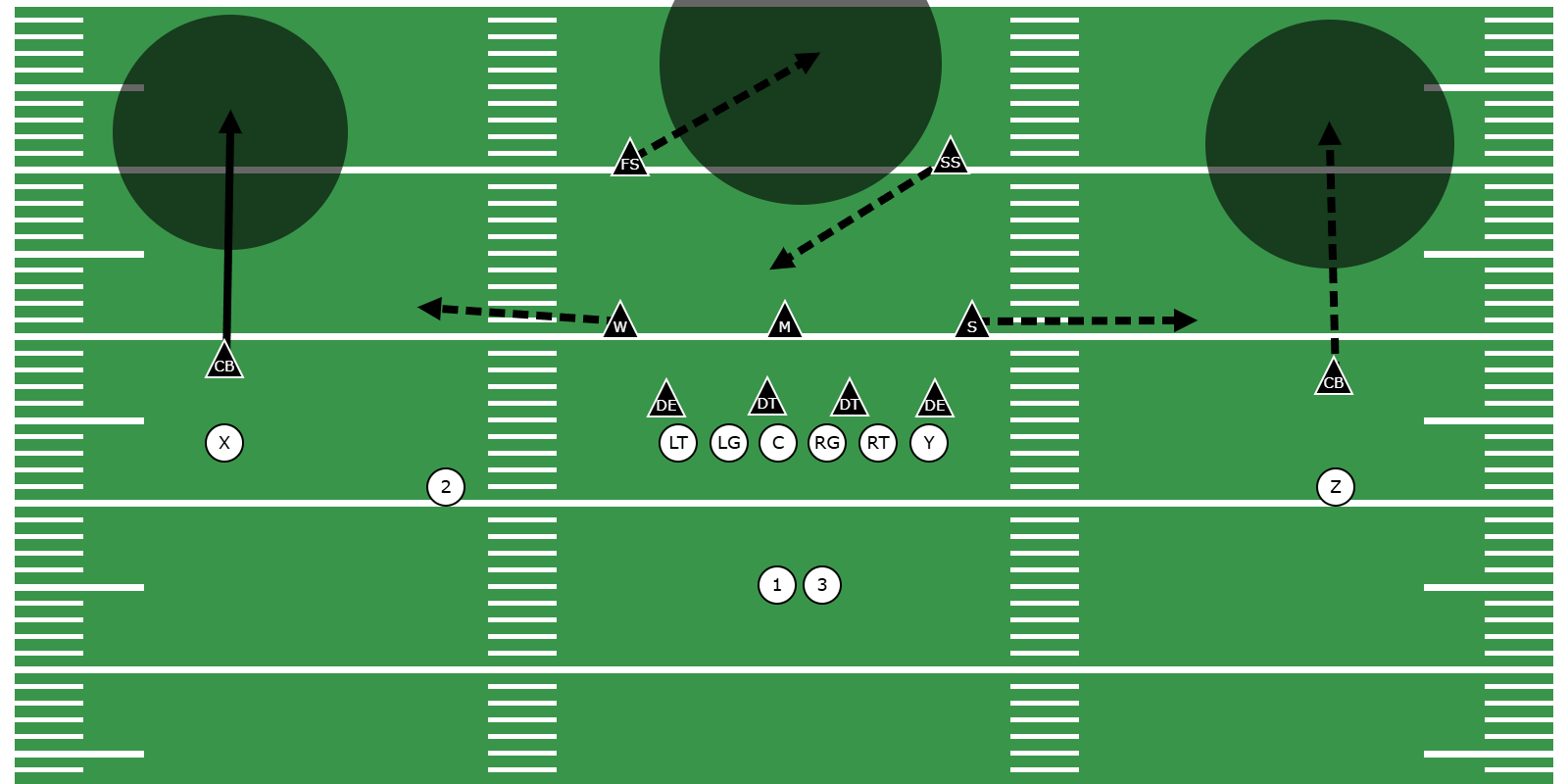
What Is Cover 3?
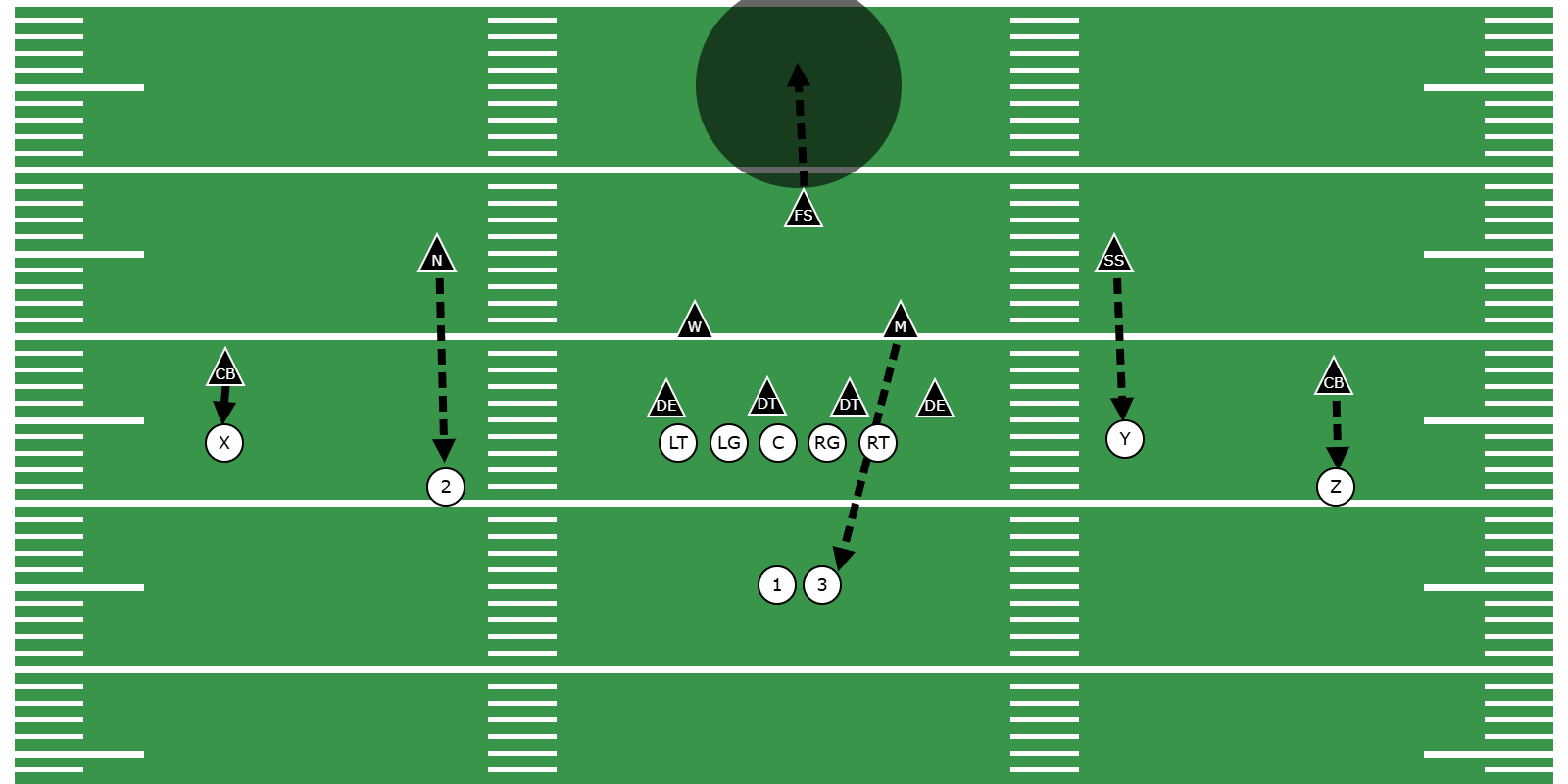
The “3” in Cover 3 refers to the three deep zones.
The deep field is normally divided into:
- One outside third to the defensive left.
- One middle third.
- One outside third to the defensive right.
Underneath those deep defenders, four players commonly divide the field into:
- Two curl/flat areas.
- Two hook areas.
Terminology varies by defensive system, but the basic structure is a three-deep, four-under zone.
A common Cover 3 call therefore includes:
- Two deep-third cornerbacks.
- One deep-middle safety.
- Four underneath zone defenders.
- Four pass rushers.
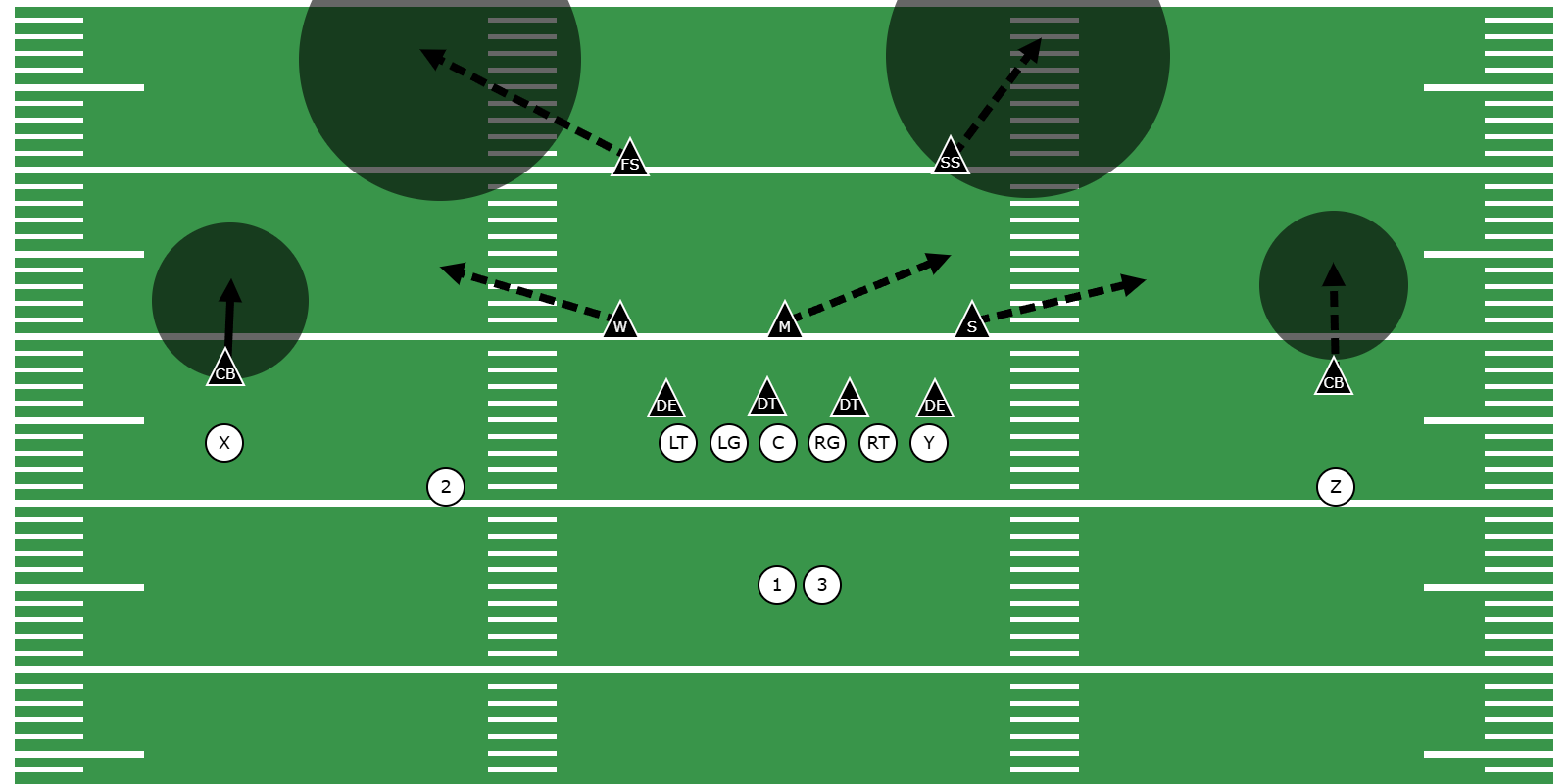
Basic Cover 3 Structure
The exact alignment depends on the defensive front and personnel.
A common structure includes:
- Cornerback: outside deep third.
- Free safety: deep middle third.
- Cornerback: outside deep third.
- Two curl/flat defenders.
- Two hook defenders.
- Four pass rushers.
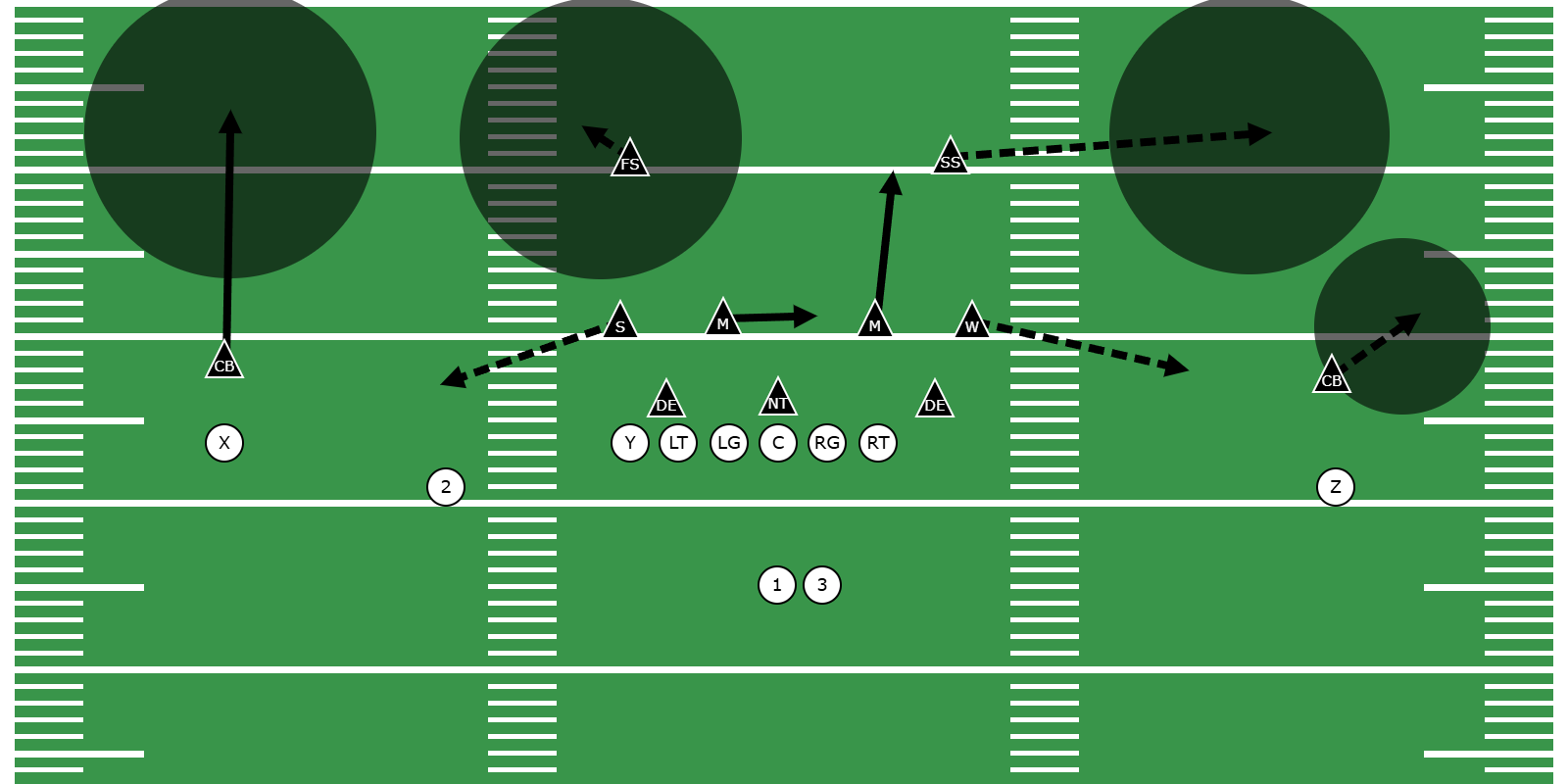
A defense can create this structure from several pre-snap looks.
One safety may begin deep while another defender aligns closer to the box, or the defense can begin with two safeties high and rotate after the snap.
That flexibility is one reason Cover 3 appears in many defensive systems.
Deep-Middle Safety Responsibility
The middle-third safety is responsible for preventing vertical throws through the center of the field.
His primary job is to stay deeper than receivers threatening the middle third.
He should:
- Maintain appropriate depth.
- Read the quarterback and route distribution.
- Stay on top of posts and seams entering the middle.
- Avoid chasing short routes.
- Maintain enough range to help either side.
- Break downhill once the throw declares.
The safety must be especially disciplined against play-action.
If he attacks downhill too quickly, the offense can throw a post or other vertical route into the space he vacates.
Deep-Third Cornerback Responsibilities
The cornerbacks normally protect the outside thirds.
Their first priority is to prevent receivers from getting behind them.
Depending on the defensive technique, a corner may use:
- Press-bail.
- Off coverage.
- Zone turn.
- Other deep-third techniques.
Regardless of technique, the corner should understand:
- He owns the deep outside portion of the field.
- He must stay deeper than vertical threats.
- He should recognize routes entering and leaving his zone.
- He can break downhill once the deep threat is controlled.
- He must communicate with underneath defenders.
A common youth mistake is for the corner to attack a short route immediately and allow an outside receiver to run behind him.
In Cover 3, the deep ball is the corner’s first concern.
Curl/Flat Defender Responsibilities
The curl/flat defenders protect the outside underneath areas.
Depending on personnel, these players may be:
- Outside linebackers.
- Nickel defenders.
- Safeties rotated down.
- Other hybrid defenders.
Their responsibilities commonly include:
- Protecting the curl area.
- Expanding toward the flat.
- Rerouting or carrying receivers according to the coverage rules.
- Reading the quarterback.
- Rallying to short outside throws.
- Supporting the run.
The curl/flat defender frequently experiences a high-low conflict.
A short route may threaten the flat while another receiver settles behind him in the curl area.
He must understand which route is more dangerous and how the deep-third corner behind him affects the coverage.
Hook Defender Responsibilities
The two hook defenders protect the interior underneath zones.
They may be linebackers or other underneath defenders.
Their responsibilities can include:
- Gaining appropriate depth.
- Closing inside passing windows.
- Rerouting seam threats.
- Protecting hooks, digs, and crossers.
- Reading the quarterback.
- Rallying to checkdowns.
- Reacting to quarterback scrambles.
Hook defenders should not simply run to a landmark and stand still.
Their positioning should respond to the receivers entering their areas.
Why Defenses Use Cover 3
Cover 3 provides a useful balance between deep protection and run support.
Three Deep Defenders
The defense protects both outside thirds and the deep middle.
Single-High Structure
Only one safety is normally required to remain in the deep middle, allowing another defender to align closer to the box.
Strong Run Support
The defense can create an eight-man run-support structure depending on personnel and formation.
Zone Eyes
Underneath defenders can keep vision on the quarterback and react to the football.
Flexible Adjustments
Cover 3 can be adapted to formations, motions, pressures, and different fronts.
Simple Foundation
The basic three-deep, four-under structure can be taught without an extensive pattern-matching system.
Strengths of Cover 3
Cover 3 offers several important advantages:
- Three defenders protect the deep field.
- Strong support against the run.
- A natural single-high safety structure.
- Zone defenders can keep vision on the quarterback.
- Useful against many vertical outside routes.
- Can be played from multiple defensive fronts.
- Can disguise with Cover 1 and other single-high concepts.
- Provides a foundation for more advanced Cover 3 variations.
It can be especially effective when the defense wants to protect against explosive outside passes without removing too many defenders from the box.
Weaknesses of Cover 3
The structure also creates identifiable areas the offense can attack.
Seams
The vertical seams between the outside thirds and middle third can be stressed by slot receivers and tight ends.
Flats
Deep-third corners begin with deep responsibility, so quick flat routes can create space underneath them.
Curl/Flat Conflict
Offenses can place one receiver in the flat and another in the curl, forcing the underneath defender to defend two levels.
Four Verticals
Four vertical routes can create four deep threats against three deep defenders.
Flood Concepts
Three-level route combinations can overload one side of the zone.
Intermediate Sideline Windows
Routes can settle between the curl/flat defender and deep-third corner.
Play Action
Aggressive run-support defenders can be manipulated, creating openings behind them.
Try The Interactive Playbook Tool: Cover 3
Draw your own Cover 3 concept based play diagram right here using our embedded interactive play designer demo:
GET STARTED: To get started simply click on any of the player icons in the diagram.
Start drawing your own plays like this and build your playbook with CoachYouths Playbook Designer.
Cover 3 Against Four Verticals
Four Verticals is one of the most important concepts for a Cover 3 defense to practice.
The offense sends four receivers deep against three deep zones.
The two outside receivers threaten the cornerbacks.
The two inside receivers attack the seams around the middle-third safety.
The safety cannot cover both seams simultaneously without help.
Underneath defenders therefore need rules for rerouting, carrying, or otherwise affecting inside vertical receivers.
If the seam receivers receive clean releases and the quarterback has time, Cover 3 can be placed under significant stress.
Cover 3 Against Flood
Flood attacks one side of the field at three different depths.
A typical Flood structure may include:
- A deep route.
- An intermediate out or crossing route.
- A flat route.
That can place three receivers into an area defended primarily by:
- The deep-third corner.
- The curl/flat defender.
- Help from an inside underneath defender.
Each defender must protect his level without chasing another defender’s route.
If the curl/flat player attacks the flat too aggressively, the intermediate route can open behind him.
If the deep-third corner drives down too quickly, the deep route can get behind him.
Cover 3 Against Curl/Flat Combinations
A common way to attack Cover 3 is to high-low the curl/flat defender.
The offense places:
- One receiver in the flat.
- Another receiver in the curl or intermediate sideline area.
The underneath defender cannot stand directly in both windows.
He must use:
- Proper depth.
- Route recognition.
- Quarterback vision.
- Help from the deep-third corner.
- Rally tackling.
The defense may willingly allow a short flat completion if it prevents a more dangerous intermediate throw.
Cover 3 Against Slant/Flat
Slant/Flat stresses the underneath defenders horizontally.
The curl/flat defender may widen with the flat route.
An inside hook defender then becomes important to closing the slant window.
If both underneath defenders widen too quickly, the slant can become an easy completion.
If nobody expands to the flat, the quarterback receives a simple outside throw.
The defenders must understand how their zones overlap.
Cover 3 Against Smash
Smash can stress the outside third and curl/flat relationship.
The short route occupies the underneath defender while a corner route attempts to enter the outside-third defender’s area from inside.
The cornerback needs to recognize the route distribution rather than staring only at the outside receiver.
The safety may also become involved depending on where the corner route enters the deep field.
Cover 3 Against Post Routes
The middle-third safety is primarily responsible for protecting against posts entering his area.
The corner should not chase a receiver across the entire field once that route clearly leaves his third unless the defensive system specifically uses matching rules.
The safety needs enough depth and range to close the route.
Play-action can make the post particularly dangerous if the safety steps downhill before recognizing the receiver.
Cover 3 Against Bunch Formations
Zone coverage can help against bunch formations because defenders do not necessarily have to chase receivers through traffic.
However, bunch can still overload zones.
The defense should practice:
- Fast flat releases.
- Corner routes.
- Vertical releases.
- Crossers.
- Switch releases.
- Multiple receivers entering one zone.
The curl/flat defender needs to identify which receiver is the most immediate threat to his area.
The deep-third corner must remain disciplined against vertical routes emerging from the bunch.
Cover 3 Against Trips
Trips formations create several challenges.
Three receivers to one side can threaten:
- The flat.
- The curl.
- The seam.
- The outside deep third.
The defense needs clear rules for the number-three receiver, especially if he releases vertically or crosses the formation.
The backside corner also needs to understand his responsibility against an isolated receiver.
Youth defenses should have a simple Trips adjustment rather than expecting base landmarks to solve every distribution automatically.
Cover 3 Against Motion
Motion can change receiver distribution and alter the run strength.
The defense needs rules for:
- Adjusting underneath alignments.
- Rotating safety support if necessary.
- Handling a receiver motioning into Trips.
- Handling a running back motioning out of the backfield.
- Maintaining the three deep zones.
Because Cover 3 is zone coverage, defenders do not always need to chase motion across the formation.
They do need to communicate how the motion changes which receivers can enter their zones.
Cover 3 and the Run Game
One of Cover 3’s major advantages is its ability to support the run.
A single-high structure can allow another safety or hybrid defender to align near the box.
Depending on the front, the defense may create an eight-man run-support structure.
The secondary still needs clear responsibilities for:
- Force.
- Alley.
- Cutback.
- Contain.
- Pursuit.
The curl/flat defender is often heavily involved in perimeter run support.
The deep-third corner must balance run support with his responsibility to prevent play-action passes behind him.
Cover 3 Against Play Action
Play-action can be particularly dangerous because Cover 3 often places a safety or other defender near the box.
The offense wants those defenders to attack the run and create passing windows behind them.
The deep-middle safety must remain disciplined.
The deep-third corners must not abandon their vertical responsibility.
Underneath defenders should read their assigned keys rather than simply following the running back.
Useful coaching principles include:
- Read offensive line behavior.
- Maintain zone depth until run is confirmed.
- Protect deep first from deep-zone positions.
- Rally downhill after the ball declares.
Cover 3 and Quarterback Scrambles
Zone coverage generally gives defenders more vision toward the quarterback than pure man coverage.
That can help against quarterback scrambles.
Hook defenders can react when the quarterback leaves the pocket.
Curl/flat defenders can close from outside.
The deep defenders provide pursuit from behind.
However, underneath defenders should not abandon their zones simply because the quarterback moves within the pocket.
The pass rush still needs disciplined lanes and edge contain.
Cover 3 and the Pass Rush
Cover 3 commonly pairs with a four-man rush, but it can also be incorporated into pressure packages.
With four rushers, the defense has seven coverage players.
If the defense sends five, the coverage may become a three-deep, three-under pressure variation rather than traditional Cover 3.
The pass rush should:
- Maintain contain.
- Collapse the pocket.
- Force the quarterback to throw on time.
- Prevent extended plays that stretch zone defenders.
Even well-played zones become vulnerable if the quarterback has unlimited time.
Rerouting Seam Receivers
Inside vertical routes are a major threat to Cover 3.
Underneath defenders can help by disrupting seam releases.
A legal reroute can:
- Delay the receiver.
- Alter his path.
- Give the middle safety time to gain position.
- Prevent two seam receivers from immediately stretching the safety.
- Disrupt quarterback timing.
Youth defenders should learn controlled contact and positioning rather than lunging at receivers and losing balance.
The goal is to affect the route while remaining able to play the zone.
Spot-Drop vs. Match Cover 3
Cover 3 can be taught in different ways.
Spot-Drop Cover 3
Defenders drop toward defined landmarks and defend receivers entering their zones.
This approach is simpler and often appropriate for youth teams.
Match Cover 3
Defenders use route-distribution rules that can turn certain zone responsibilities into man-like matches after the snap.
Match principles can improve coverage against modern route combinations, but they require more communication and practice.
Youth coaches do not need to begin with complex matching rules.
A disciplined spot-drop Cover 3 with good route awareness can provide a strong foundation.
Disguising Cover 3
Cover 3 can be shown from several pre-snap looks.
A defense may:
- Align directly in a single-high shell.
- Begin with two safeties deep and rotate one down.
- Show Cover 1.
- Show pressure.
- Rotate the safety after motion.
The similarity between Cover 1 and Cover 3 can be particularly useful because both can use a single-high safety appearance.
Again, disguise should come after execution.
If players cannot rotate without losing their assignments, the defense should align correctly and play fast.
Coaching Cover 3 in Youth Football
Cover 3 can be an excellent youth coverage when the installation remains clear.
A practical progression is:
- Divide the deep field into thirds.
- Teach the middle safety’s responsibility.
- Teach both cornerbacks their outside thirds.
- Install the curl/flat zones.
- Install the hook zones.
- Practice basic route distribution.
- Add Slant/Flat.
- Add Curl/Flat.
- Add Flood.
- Add Four Verticals.
- Add Trips and bunch formations.
- Add play-action.
- Connect the coverage to the run fits.
- Practice full-team situations.
Players should understand both their landmark and the routes that threaten it.
A Simple Cover 3 Zone Drill
Use a half-field setup with:
- One deep-third corner.
- One curl/flat defender.
- One hook defender.
- One safety if needed.
- Two or three receivers.
- One quarterback.
Run combinations such as:
- Curl/Flat.
- Slant/Flat.
- Vertical/Out.
- Corner/Flat.
- Seam/Out.
Teach defenders to:
- Maintain proper spacing.
- See the quarterback.
- Recognize route distribution.
- Communicate.
- Rally to the throw.
Then add the opposite side and middle-third safety for full coverage work.
Common Youth Football Mistakes
Corners Jump Short Routes
The corner attacks a hitch or flat route and allows a receiver to run behind him.
Middle Safety Gets Too Shallow
The safety reacts to play-action or an underneath route and gives up the post.
Middle Safety Chases One Seam
The safety commits completely to one inside vertical receiver and leaves the opposite seam open.
Curl/Flat Defenders Stay Too Shallow
Intermediate routes settle behind them.
Curl/Flat Defenders Widen Too Quickly
The flat route pulls them outside and opens a large curl window.
Hook Defenders Watch Only the Quarterback
They fail to recognize receivers crossing through their zones.
Defenders Guard Grass
Players run to landmarks and stop reacting to the route distribution.
Poor Communication Against Trips
Multiple defenders assume somebody else is handling the number-three receiver.
Personnel Considerations
Cover 3 can fit many types of defensive personnel, but several traits are valuable.
The middle safety needs:
- Range.
- Discipline.
- Route recognition.
- Reliable tackling.
The corners need:
- Ability to protect vertical routes.
- Confidence playing with depth.
- Good break angles.
- Tackling ability.
The underneath defenders need:
- Awareness.
- Zone spacing.
- Ability to reroute receivers.
- Run-support skills.
The coverage does not require every defender to be an elite man-cover player, which can make it practical for youth teams with mixed athletic ability.
When to Call Cover 3
Cover 3 can be useful when:
- The defense wants a single-high safety structure.
- The defense wants strong run support.
- The offense threatens outside vertical routes.
- The defense wants zone eyes on the quarterback.
- The offense uses formations that create traffic against man coverage.
- The defense wants a flexible base coverage.
- The defense wants to disguise between Cover 1 and Cover 3.
Coaches should be prepared with answers when the offense repeatedly attacks seams, Flood concepts, Curl/Flat combinations, and Four Verticals.
Cover 3 vs. Cover 1
Both can use a single-high safety appearance.
Cover 1: Generally uses man coverage underneath with one deep middle safety.
Cover 3: Uses three deep zones and four underneath zones.
The similar pre-snap structure can help disguise coverage.
Cover 1 challenges individual receivers more directly, while Cover 3 keeps more defenders facing the quarterback and distributes routes through zones.
Cover 3 vs. Cover 2
Cover 3: Three deep defenders and four underneath defenders.
Cover 2: Two deep defenders and five underneath defenders.
Cover 3 provides an additional deep defender and can place another safety closer to the box.
Cover 2 places an additional defender underneath and uses two deep halves rather than three deep thirds.
Each coverage creates different seam and sideline vulnerabilities.
Cover 3 vs. Cover 4
Cover 3: Three defenders divide the deep field.
Cover 4: Four defenders divide the deep field.
Cover 4 generally provides more deep defenders but begins with a two-high structure and distributes run support differently.
Cover 3 often provides a more natural extra defender near the box.
Key Coaching Points
- Protect the deep thirds before reacting underneath.
- Keep the middle safety deeper than vertical threats.
- Teach corners not to jump short routes prematurely.
- Establish clear curl/flat and hook landmarks.
- Teach underneath defenders to react to routes, not guard empty grass.
- Reroute seam receivers when the coverage rules require it.
- Practice Four Verticals extensively.
- Practice Flood and Curl/Flat combinations.
- Establish simple Trips and bunch adjustments.
- Connect zone responsibilities to the run fit.
- Maintain disciplined eyes against play-action.
- Keep pass-rush lanes sound against mobile quarterbacks.
- Add disguise only after the base coverage is dependable.
Final Thoughts
Cover 3 is one of football’s most useful zone structures because it combines three-deep protection with strong run support and four underneath defenders who can keep vision on the quarterback.
The coverage can protect outside vertical routes, keep a safety in the deep middle, and allow another defender to align closer to the box. Those strengths make it adaptable to many defensive fronts and personnel groups.
Its weaknesses are equally important to understand. Seams, Flood concepts, Curl/Flat combinations, and Four Verticals are designed to stretch the spaces between Cover 3 defenders. A defense that simply drops to landmarks without understanding those threats will eventually give the offense open windows.
For youth coaches, Cover 3 can serve as an excellent foundational zone coverage. Teach the deep defenders to protect against explosive passes first, give underneath defenders clear landmarks, connect those landmarks to actual route threats, and practice the offensive concepts most likely to stress the structure.
When all seven coverage defenders understand how their areas connect, Cover 3 becomes more than a simple three-deep zone. It becomes a flexible defensive framework that can support the run, defend the pass, and provide a foundation for numerous adjustments and variations.
Published by CoachYouths Staff on 08/25/2026
You are NOT currently logged in, you may login or signup for FREE at any time: