Cover 2
What Is Cover 2?
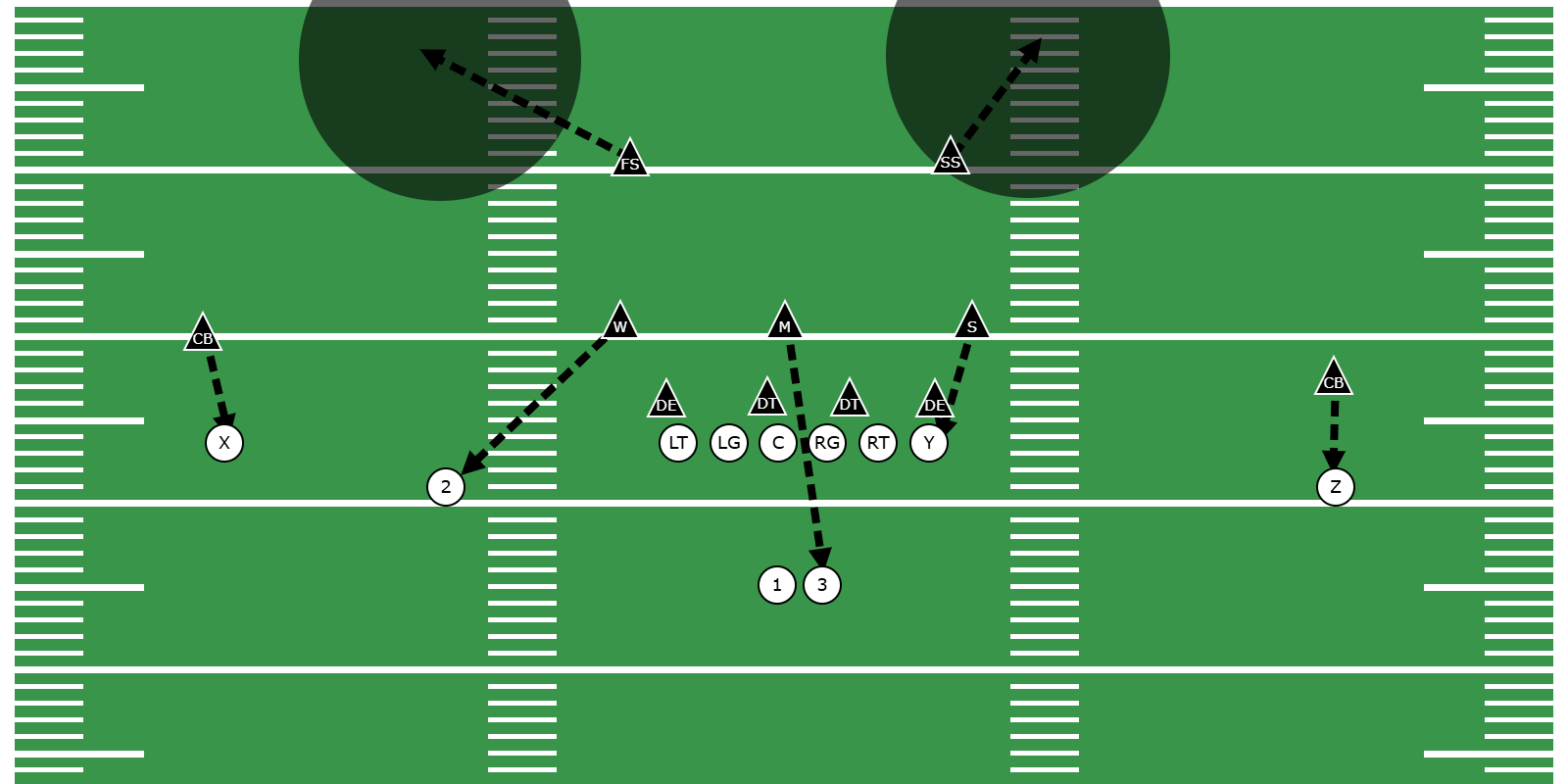
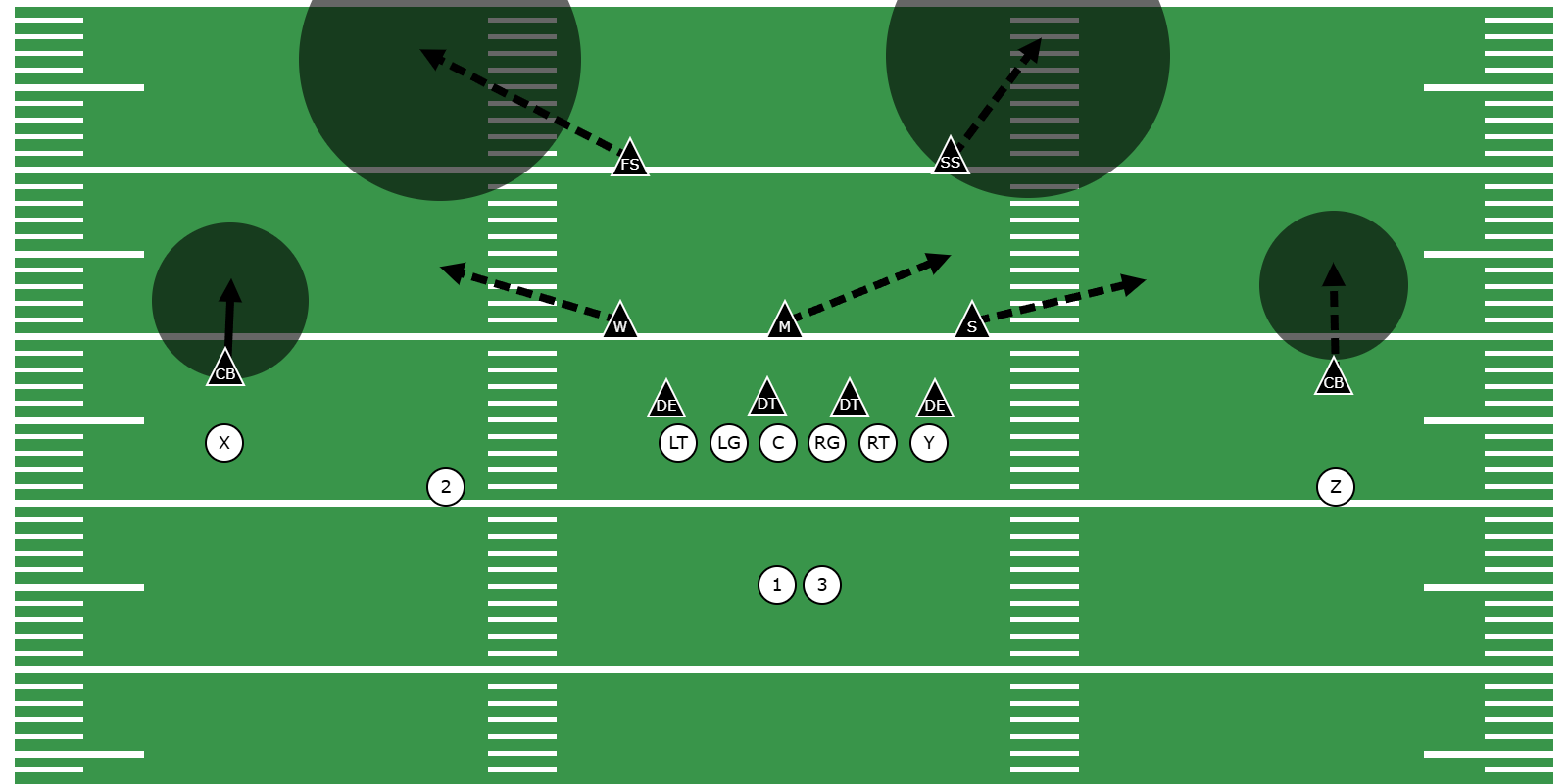
The “2” in Cover 2 refers to the two defenders responsible for the deep portion of the field.
Those defenders are usually safeties.
One safety protects the deep half to the defensive left.
The other safety protects the deep half to the defensive right.
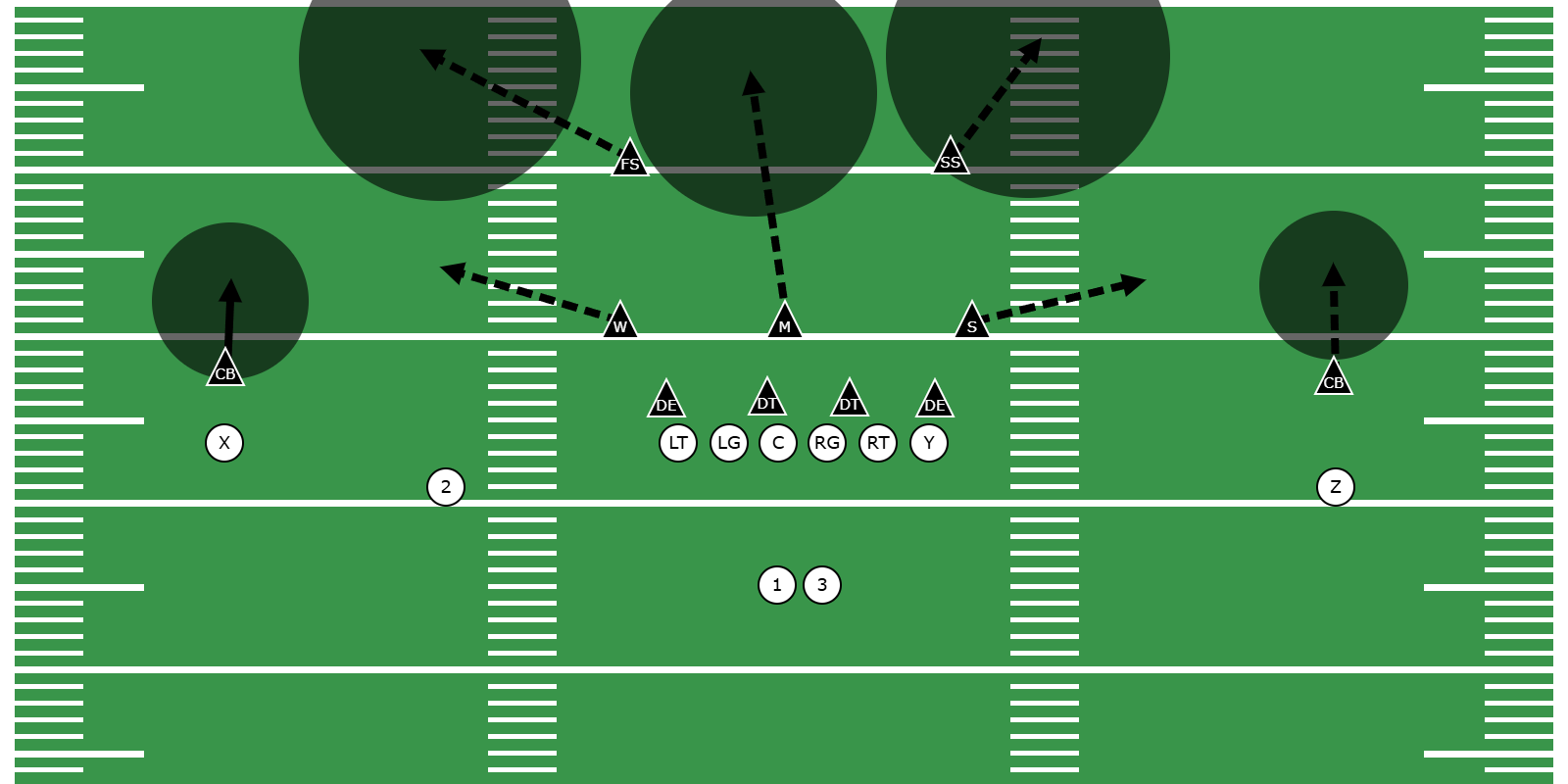
Underneath them, the defense commonly plays five short-to-intermediate zones:
- Two flat defenders.
- Two hook/curl defenders.
- One middle hook defender.
The exact terminology and landmarks vary by defensive system, but the basic principle remains the same: two defenders protect deep while the remaining coverage defenders control the underneath field.
Basic Cover 2 Structure
A traditional Cover 2 structure commonly includes:
- Two deep-half safeties.
- Two cornerbacks responsible for the flats.
- Two hook/curl defenders.
- One middle underneath defender.
- A four-man pass rush.
That gives the defense seven coverage players and four rushers.
The coverage can be played from several fronts and personnel groupings. A 4-3 defense is a natural teaching example because the four defensive linemen can rush while the three linebackers and four defensive backs create the seven-man coverage structure.
Cover 2 is a coverage concept, however, not a formation. It can be adapted to different defensive personnel.
Safety Responsibilities
The safeties are responsible for preventing deep completions in their halves of the field.
Each safety should:
- Align with enough depth to protect vertical routes.
- Stay deeper than receivers threatening his half.
- Read the quarterback and route distribution.
- Maintain proper width relative to the formation.
- Avoid being pulled too far toward the sideline unnecessarily.
- Break downhill once the throw declares.
A safety who becomes too aggressive underneath can expose the deep half.
A safety who stays unnecessarily deep and wide can create a large opening between the two safeties.
The position requires patience and an understanding of which routes are actually threatening the deep zone.
Cornerback Responsibilities
The cornerbacks normally play the flats in traditional Cover 2.
Unlike many deep-zone coverages, the corners are not primarily responsible for carrying outside receivers all the way downfield.
Their responsibilities often include:
- Disrupting or rerouting the outside receiver.
- Protecting the flat.
- Forcing quick outside throws to stay short.
- Sinking underneath deeper sideline routes when no immediate flat threat appears.
- Tackling receivers after short completions.
- Supporting the run from outside-in.
The corner’s ability to disrupt the outside receiver can be extremely important.
A clean vertical release can place immediate stress on the deep-half safety, especially if another receiver is also attacking the seam.
Hook/Curl Defender Responsibilities
The hook/curl defenders usually protect the intermediate areas inside the cornerbacks.
They may be linebackers, nickel defenders, or other underneath players depending on personnel.
Their jobs can include:
- Collisioning inside receivers.
- Gaining appropriate depth.
- Protecting hook and curl windows.
- Reading the quarterback.
- Passing vertical routes to deep defenders according to the coverage rules.
- Rallying to underneath throws.
- Reacting to the run after reading their keys.
Young defenders often struggle because they either stay too shallow or gain so much depth that easy completions develop underneath.
The correct depth should be defined by the defensive system and adjusted to the offensive route distribution.
Middle Underneath Defender
The middle underneath defender protects the interior beneath the two safeties.
In traditional Cover 2, this player generally does not run vertically down the deep middle in the same way the middle linebacker does in Tampa 2.
Instead, he controls underneath middle space and reacts to routes entering that area.
He can help against:
- Short crossers.
- Hooks.
- Checkdowns.
- Inside-breaking routes.
- Quarterback scrambles.
The distinction between traditional Cover 2 and Tampa 2 becomes important because asking the middle defender to carry deep changes the coverage significantly.
Why Defenses Use Cover 2
Cover 2 gives a defense several useful advantages.
Two Deep Defenders
The defense keeps two safeties behind the underneath coverage, reducing the risk of allowing uncontested deep throws.
Eyes on the Quarterback
Zone defenders can often keep vision toward the quarterback instead of turning and chasing receivers in man coverage.
Strong Flat Presence
Cornerbacks can react quickly to short outside throws.
Physical Receiver Disruption
Corners can reroute outside receivers and disrupt timing before settling into the flat.
Rally and Tackle
Because defenders occupy zones and can see the ball thrown, multiple defenders may rally toward a completion.
Strengths of Cover 2
Cover 2 can be effective against several common offensive strategies.
Its strengths include:
- Two-deep protection. Both sides of the deep field have a safety.
- Good support against quick outside throws. Corners begin close to the flats.
- Vision on the quarterback. Underneath defenders can react to the throw.
- Useful against short timing routes. Passing windows can close quickly when defenders maintain proper spacing.
- Strong perimeter run support. Corners can become force defenders depending on the run-fit structure.
- Potential to disguise with other two-high coverages. Cover 2, Cover 4, Cover 6, and Cover 2 Man can begin from similar shells.
Weaknesses of Cover 2
Every zone coverage has areas that can be stressed.
Deep Middle
The space between the two safeties can become vulnerable, particularly against a receiver who can attack vertically through the middle.
Sideline Hole
The area behind the flat corner and in front of the deep-half safety is a classic Cover 2 stress point.
A well-timed corner route, hole shot, or deep out can attack that window.
Seams
Slot receivers and tight ends can threaten the inside edges of the deep safeties.
High-Low Combinations
Offenses can place one receiver underneath a zone defender and another behind him, forcing the defender to choose which route to influence.
Four Verticals
Multiple vertical threats can stretch two deep safeties horizontally and force underneath defenders to carry routes effectively.
Run Numbers
Keeping two safeties deep can reduce the number of immediate defenders near the box compared with a single-high structure.
Try The Interactive Playbook Tool: Cover 2
Draw your own Cover 2 concept based play diagram right here using our embedded interactive play designer demo:
GET STARTED: To get started simply click on any of the player icons in the diagram.
Start drawing your own plays like this and build your playbook with CoachYouths Playbook Designer.
The Cover 2 Sideline Hole
One of the most important areas for coaches to understand is the space along the sideline between the cornerback and safety.
The corner is responsible for the flat.
The safety is responsible for the deep half.
An offense can attempt to place a receiver in the intermediate area between them.
The defense can reduce that window through:
- A physical reroute by the corner.
- Proper safety width and recognition.
- The corner sinking when no immediate flat threat exists.
- Pressure that prevents the quarterback from waiting for the route to develop.
The corner and safety must understand how their responsibilities work together.
If the corner immediately abandons all depth while the safety widens too slowly, the offense can repeatedly attack the hole.
Cover 2 Against Common Offensive Concepts
Smash
Smash is a classic Cover 2 beater.
The offense places a short hitch or flat route underneath a corner route. The cornerback is threatened low while the safety is threatened high.
The defense needs disciplined spacing and good communication to reduce the throwing window.
Four Verticals
Four vertical routes can put severe stress on Cover 2.
The safeties cannot easily cover four deep threats by themselves, so underneath defenders must reroute and carry seam receivers according to the defensive rules.
Flood
Flood places routes at multiple depths toward one sideline.
This can stretch the corner, hook/curl defender, and safety vertically.
Slant/Flat
The corner may be pulled toward the flat while an inside defender must close the slant window.
Good underneath spacing is essential.
Mesh
Zone defenders can pass crossing routes through their areas instead of chasing them across the field. Communication and disciplined eyes help prevent defenders from following receivers unnecessarily.
Post Routes
A post can attack the space between the safeties. Safety depth, quarterback recognition, and help from underneath defenders become important.
Cover 2 Against Trips
Trips formations can create an immediate numbers challenge because three receiving threats are aligned to one side.
The defense needs a specific adjustment for:
- The outside receiver.
- The slot receivers.
- Vertical releases.
- The backside receiver.
- The running back.
Coaches may adjust safety width, linebacker alignment, or underneath distribution based on the formation.
For youth football, the adjustment should remain simple and repeatable. Players need to know how their landmarks change when three receivers align to one side.
Cover 2 Against Bunch Formations
Zone coverage can provide a useful answer to bunch formations because defenders do not necessarily have to chase individual receivers through traffic.
Instead, defenders can protect their areas and react as receivers distribute after the snap.
However, bunch formations can still overload zones.
The defense should practice:
- Multiple receivers entering one underneath zone.
- A receiver immediately attacking the flat.
- Corner routes behind the flat defender.
- Crossing routes leaving the bunch.
- Vertical releases that stress the safety.
The solution is not simply “stay in your zone.” Defenders must understand which receiver threatens their zone most.
Cover 2 Against the Run
Cover 2 can provide strong perimeter support because the cornerbacks are positioned near the line of scrimmage.
Depending on the defensive run-fit system, corners may:
- Force the ball inside.
- Set the edge.
- Support outside runs.
- Trigger against receiver blocks.
- Contain reverses or perimeter action.
The safeties generally begin deeper, so they must take good pursuit angles when entering the run fit.
The defense should clearly define who is responsible for force, alley, and cutback.
Coverage responsibilities and run fits cannot be taught as unrelated systems.
Cover 2 Against Play Action
Play-action can manipulate underneath defenders and create throwing lanes behind them.
Linebackers who attack the run too aggressively may open intermediate windows.
Safeties who become overly involved in run support may allow vertical routes behind them.
Useful teaching rules include:
- Read assigned keys rather than the ball fake.
- Maintain zone depth until run is confirmed.
- Do not allow play-action to destroy safety depth.
- Rally downhill once the ball declares.
The better the defense becomes at reading offensive line and receiver behavior, the less effective simple backfield deception becomes.
Rerouting Receivers in Cover 2
Rerouting is an important part of many Cover 2 systems.
The goal is not merely to hit the receiver.
A good reroute can:
- Delay the route.
- Change the receiver’s path.
- Prevent an easy inside release.
- Give the safety more time to gain position.
- Disrupt quarterback timing.
Corners should use legal, controlled technique.
If a corner lunges and misses, the receiver may receive a completely free release with the defender out of position.
Youth players should learn balance and footwork before coaches emphasize physical contact.
Cover 2 and the Pass Rush
Traditional Cover 2 commonly uses a four-man pass rush.
That means the front must create pressure without relying on large numbers of blitzers.
The relationship between rush and coverage is important.
If the quarterback has unlimited time, he can wait for receivers to enter the natural holes in the zone.
The rush should:
- Maintain lane integrity.
- Collapse the pocket.
- Keep the quarterback from extending the play.
- Force throws before route combinations fully develop.
A zone coverage becomes much more difficult to maintain when the quarterback has time to move through several progressions.
Disguising Cover 2
Cover 2 can be disguised because several coverages use two-high pre-snap shells.
The defense might show two safeties deep and then play:
- Cover 2.
- Cover 4.
- Cover 6.
- Cover 2 Man.
- A pressure with safety rotation.
For youth teams, disguise should remain secondary to alignment and assignment.
If late movement creates confusion, align correctly and play fast.
Execution is more valuable than disguise that the defense itself cannot handle.
Coaching Cover 2 in Youth Football
Cover 2 can be installed effectively when coaches teach it as connected zones rather than isolated spots on the field.
A useful progression is:
- Identify the two deep halves.
- Teach each safety his half-field responsibility.
- Install the cornerback flat responsibilities.
- Establish hook/curl landmarks.
- Establish the middle underneath landmark.
- Practice basic route distribution.
- Add vertical routes.
- Add Smash and Flood concepts.
- Add Trips and bunch formations.
- Add play-action.
- Connect the coverage to the run fits.
- Practice full-team situations.
Players should understand why their landmarks matter.
A linebacker who knows he is protecting the throwing lane behind a short route will play the zone more intelligently than one who has simply been told to run to a cone.
A Simple Cover 2 Zone Drill
Use a half-field setup with:
- One safety.
- One cornerback.
- One hook/curl defender.
- Two or three receivers.
- One quarterback.
Rotate route combinations such as:
- Hitch/Corner.
- Slant/Flat.
- Vertical/Out.
- Seam/Flat.
- Curl/Flat.
Teach defenders to maintain spacing, see the quarterback, communicate, and react to the most dangerous route entering their zone.
Then repeat on the opposite side.
This allows players to learn the relationships between the flat, hook/curl, and deep-half defenders before adding the entire defense.
Common Youth Football Mistakes
Safeties Get Too Wide
The safeties chase outside receivers toward the sideline and leave a huge opening in the deep middle.
Safeties Get Too Shallow
A safety reacts to an underneath route and allows a receiver to run behind him.
Corners Abandon the Flat Too Early
The corner sinks underneath a deep route while a running back or receiver catches an uncontested pass in the flat.
Corners Never Sink
The opposite mistake occurs when the corner sits at the line of scrimmage even though no receiver threatens the flat, leaving a large sideline window behind him.
Linebackers Stay Too Shallow
Intermediate hooks, digs, and crossers develop behind them.
Linebackers Drop Without Reading Routes
Players run to landmarks and stand there while receivers move through the zone uncontested.
Everyone Watches the Quarterback
Zone coverage allows vision on the quarterback, but defenders must still recognize receivers entering their areas.
When to Call Cover 2
Cover 2 can be useful when:
- The defense wants two deep safeties.
- The offense relies heavily on quick outside throws.
- The quarterback is most comfortable with rhythm passes.
- The defense wants zone eyes against a mobile quarterback.
- The corners are effective perimeter run defenders.
- The defense wants to challenge short routes while protecting deep.
- The offense frequently uses formations that create traffic against man coverage.
Coaches should be cautious when the offense consistently attacks the seams, deep middle, or sideline hole and the defense cannot generate enough pressure to disrupt those throws.
Cover 2 vs. Cover 1
Cover 1 normally uses man coverage underneath with one deep middle safety.
Cover 2 normally uses zone coverage underneath with two deep-half safeties.
Cover 1 provides an extra defender for pressure or the box but relies heavily on man matchups.
Cover 2 provides an additional deep defender and more zone vision but creates different underneath and intermediate stress points.
Cover 2 vs. Cover 2 Man
Both coverages use two deep safeties.
The difference is underneath.
Cover 2: Underneath defenders generally play zones.
Cover 2 Man: Underneath defenders play man-to-man while the two safeties protect over the top.
The similar two-high shell can help a defense disguise which coverage it is actually playing.
Cover 2 vs. Tampa 2
Traditional Cover 2 and Tampa 2 share the same basic two-high appearance.
The major distinction is the middle linebacker.
In traditional Cover 2, the middle underneath defender generally protects an underneath zone.
In Tampa 2, the middle linebacker carries vertically down the middle, helping protect the space between the two safeties.
That adjustment changes how the coverage handles deep-middle routes and places greater athletic demands on the middle linebacker.
Key Coaching Points
- Keep both safeties deeper than the deepest threats in their halves.
- Teach safeties to protect the deep middle as well as the sideline.
- Give corners clear flat and reroute responsibilities.
- Teach corners when they can sink underneath deeper routes.
- Establish consistent hook/curl landmarks.
- Make underneath defenders read routes instead of standing on spots.
- Practice Smash, Flood, seams, and four verticals.
- Connect coverage responsibilities to the run fit.
- Maintain disciplined eyes against play-action.
- Generate pressure with the front so the quarterback cannot wait indefinitely.
- Keep formation adjustments simple enough for youth players to execute.
- Teach the difference between Cover 2 and Tampa 2 clearly.
Final Thoughts
Cover 2 is a foundational zone coverage built around two deep safeties and five underneath defenders. It protects both deep halves of the field, keeps defenders facing the quarterback, and gives the defense strong support against many short passing concepts.
Its effectiveness depends on the relationship between the coverage levels. Corners must control the flats and disrupt releases, linebackers must protect intermediate windows, safeties must remain deep without becoming too wide, and the pass rush must prevent the quarterback from waiting for natural zone openings to develop.
For youth coaches, Cover 2 should be taught as a coordinated structure rather than seven players dropping independently to landmarks. When defenders understand which areas they protect, which routes threaten those areas, and how their responsibilities connect to the defenders around them, Cover 2 becomes far more than a simple two-high zone—it becomes a dependable coverage that can serve as a foundation for several defensive variations.
Related Articles
Published by CoachYouths Staff on 08/25/2026
You are NOT currently logged in, you may login or signup for FREE at any time: