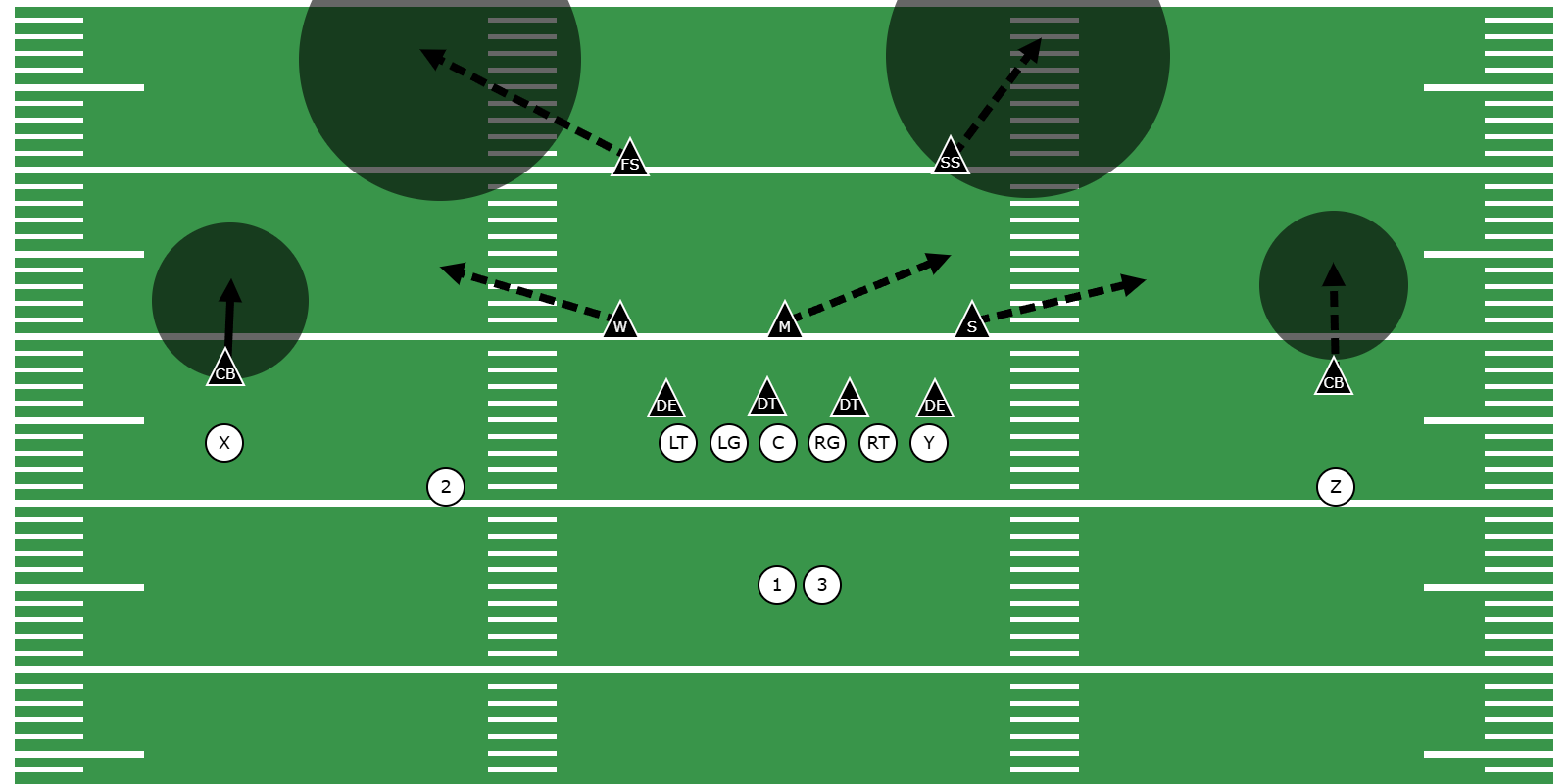
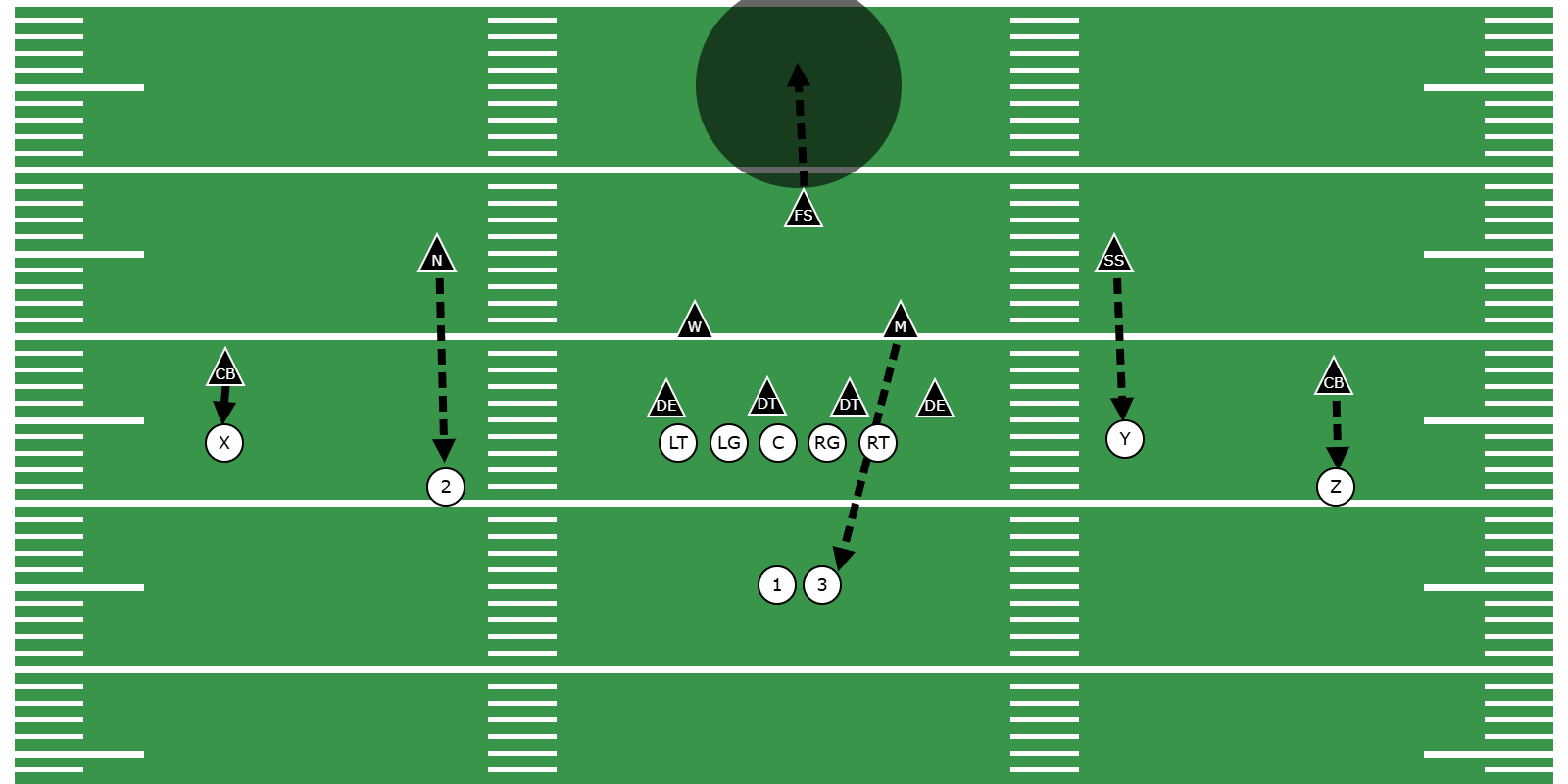
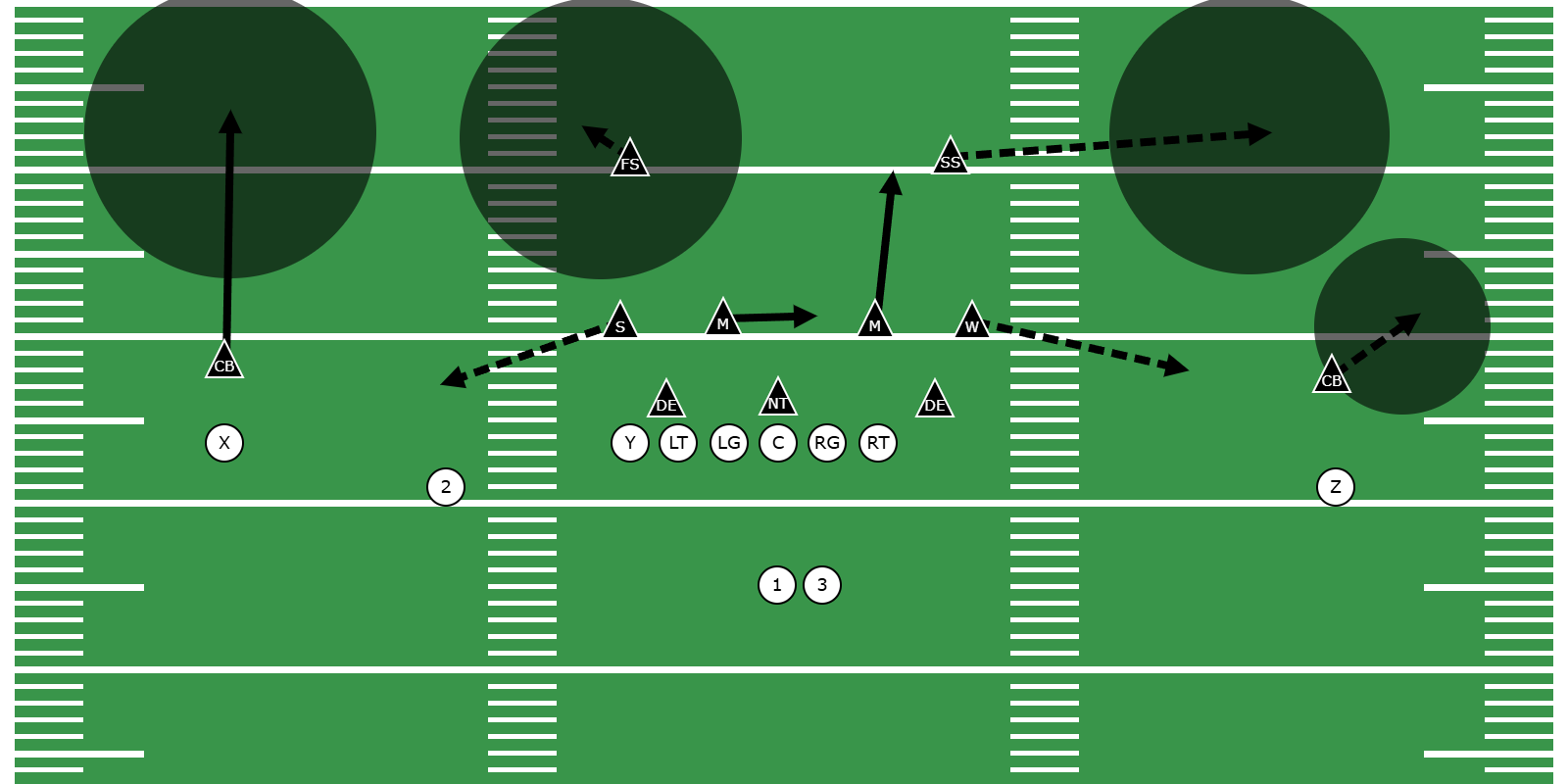
Cover 2 Man
What Is Cover 2 Man?
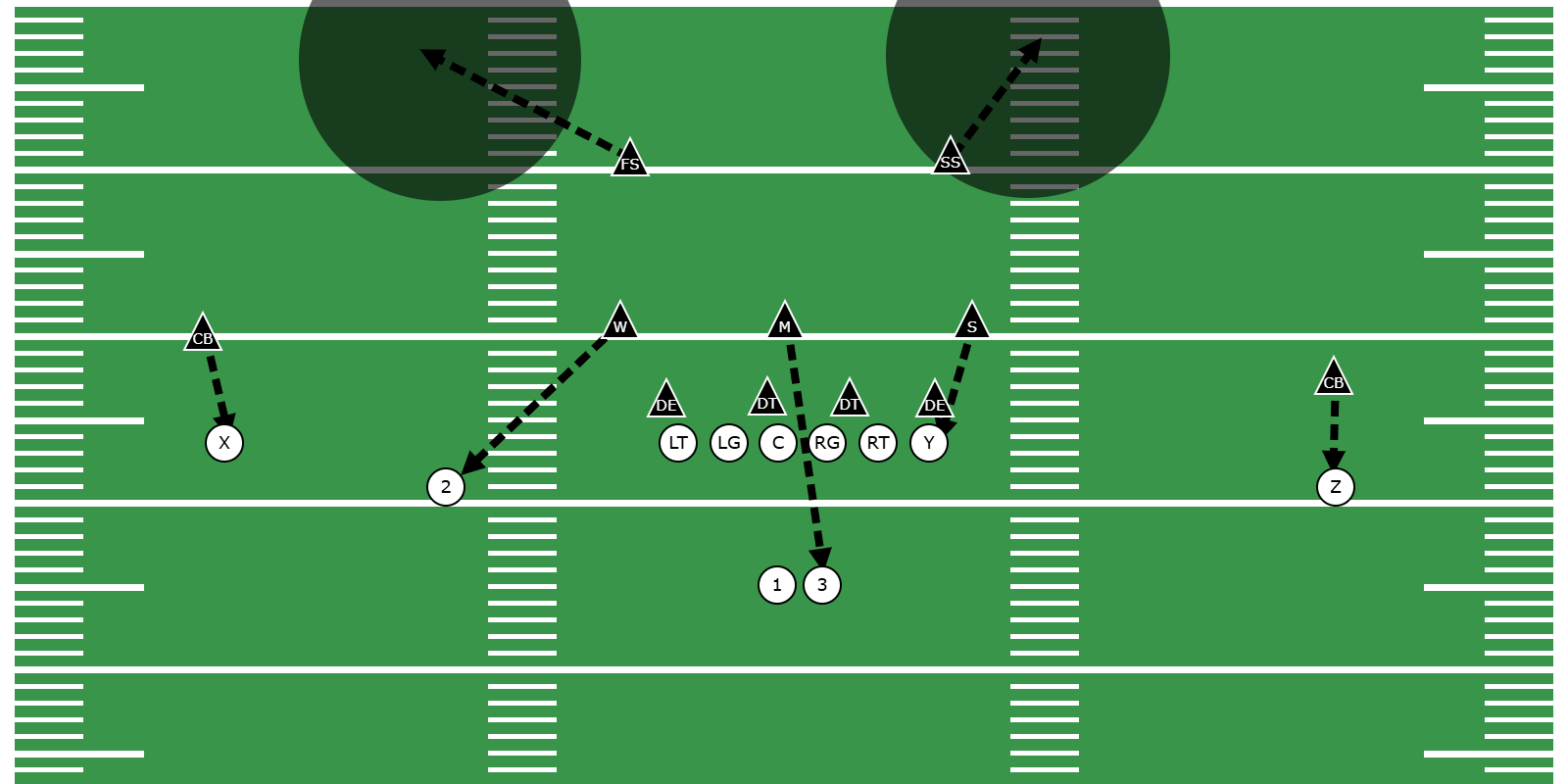
Cover 2 Man combines two familiar defensive ideas.
The first is man coverage. Underneath defenders are assigned to specific eligible receivers and remain responsible for those players through the route.
The second is two-deep safety help. Two safeties divide the deep field, generally with each safety responsible for one half.
A common structure against five eligible receivers therefore includes:
- Five man defenders.
- Two deep safeties.
- Four pass rushers.
That creates seven defenders in coverage.
The underneath defenders handle the individual matchups while the safeties protect against deep throws and provide help over the top.
Basic Cover 2 Man Structure
The exact matchups depend on formation and personnel, but a typical structure includes:
- Two safeties aligned deep.
- Cornerbacks matched against outside receivers.
- Linebackers, safeties, or nickel defenders matched against slots, tight ends, and running backs.
- Four defenders rushing the passer.
- Defined leverage rules that take advantage of the two deep safeties.
Unlike traditional Cover 2, the underneath defenders are not dropping into zones.
If a receiver crosses the field, his man defender normally travels with him unless the defense has installed a specific switch or exchange rule.
That distinction is critical.
Deep Safety Responsibilities
The two safeties protect the defense over the top.
Each safety generally owns a deep half and should remain deeper than vertical threats entering that portion of the field.
Their responsibilities include:
- Staying on top of deep routes.
- Reading the quarterback and route distribution.
- Helping man defenders against vertical throws.
- Maintaining proper width.
- Avoiding unnecessary reactions to short routes.
- Taking good angles to completed passes.
- Supporting the run according to the defensive fit.
The safeties should not become spectators simply because the underneath defenders are playing man coverage.
They must identify which receivers are threatening vertically and position themselves to provide meaningful help.
Cornerback Responsibilities
Cornerbacks commonly match the offense’s outside receivers.
Because they have safety help over the top, they may be able to play more aggressively underneath than they would in Cover 0.
Depending on the defensive system, corners may be taught to:
- Maintain inside leverage.
- Deny quick inside routes.
- Trail the receiver from underneath.
- Stay in phase on vertical routes.
- Funnel deep routes toward the safety.
- Play through the receiver’s hands at the catch point.
The exact technique should be defined by the defense.
The important point is that the corner must understand where the safety help actually exists.
A safety aligned inside and deep cannot automatically save a corner who loses badly to an outside-breaking route near the sideline.
Linebacker Responsibilities
Linebackers frequently match:
- Running backs.
- Tight ends.
- Inside receivers in certain personnel packages.
These assignments can be challenging because Cover 2 Man requires defenders to stay with receivers rather than dropping into underneath zones.
A linebacker assigned to a running back must account for:
- Immediate releases.
- Swing routes.
- Option routes.
- Wheel routes.
- Delayed releases after pass protection.
If the back blocks initially, the linebacker needs a clearly defined rule for when he can help elsewhere and when he must remain alert for a late release.
Nickel and Safety Matchups
Against spread formations, nickel defenders and additional defensive backs often handle slot receivers.
These players need enough movement skill to defend:
- Option routes.
- Slants.
- Crossers.
- Out routes.
- Vertical seams.
- Motion.
Personnel matters greatly in Cover 2 Man.
A coverage that looks excellent on a diagram can become vulnerable if the offense consistently creates a matchup between a fast receiver and a defender who cannot stay with him.
Leverage in Cover 2 Man
Leverage is one of the most important parts of the coverage.
Because the defense has two safeties deep, underneath defenders can often play with an understanding that vertical help exists behind them.
Many defenses use inside leverage in 2-Man because they want to make quick inside-breaking routes difficult and force receivers toward areas where the deep safeties can help.
However, leverage rules vary by system, offensive formation, and matchup.
Every man defender should know:
- Who is my assignment?
- What leverage am I playing?
- Where is my safety help?
- Which routes can my help realistically affect?
- What happens if my receiver motions?
Youth coaches should make these rules consistent rather than changing them every week.
Trail Technique
Cover 2 Man is often associated with an underneath or trail position by man defenders.
The basic idea is that the defender can stay underneath the receiver because deep safety help exists behind him.
A good trail defender can make it difficult for the quarterback to throw:
- Slants.
- Digs.
- Curls.
- Comebacks.
- Other routes breaking back toward the football.
However, trail technique should not be interpreted as intentionally getting beaten.
The defender still needs to remain close enough to challenge the route.
If he trails by several yards, the quarterback can simply throw into the open space before the safety arrives.
Why Defenses Use Cover 2 Man
Cover 2 Man gives the defense tight underneath coverage while retaining two deep defenders.
Aggressive Underneath Coverage
Man defenders can challenge short and intermediate routes without being solely responsible for every vertical throw.
Two Deep Safeties
The defense has protection over both sides of the field.
Help Against Vertical Routes
Outside and slot receivers pushing deep can encounter safety help.
Useful in Passing Situations
The coverage can be effective on obvious passing downs when run support is less important.
Disguise
Cover 2 Man can begin from the same two-high shell as Cover 2, Tampa 2, Cover 4, and Cover 6.
Strengths of Cover 2 Man
The coverage can be particularly effective when the defense has capable man defenders.
Its strengths include:
- Tight underneath coverage.
- Two-deep protection against vertical throws.
- Ability to challenge timing routes.
- Reduced exposure compared with Cover 0.
- Useful leverage against inside-breaking routes.
- Potential to disguise with zone coverages.
- Strong application on long-yardage passing downs.
The combination can force the quarterback to hold the ball while receivers attempt to separate from man coverage.
Weaknesses of Cover 2 Man
Cover 2 Man also creates several important problems.
Limited Pass-Rush Numbers
With seven defenders committed to coverage, the defense often relies on four rushers.
If the rush does not affect the quarterback, receivers have more time to separate.
Quarterback Scrambles
This is one of the coverage’s most important vulnerabilities.
Man defenders may turn their backs to the quarterback while following receivers, and both safeties are deep. If the four-man rush loses contain, the quarterback can find open running space.
Running Game
Keeping two safeties deep and multiple defenders occupied with man assignments can reduce immediate run support.
Crossing Traffic
Mesh, shallow cross, bunch, and stack concepts can create collisions and separation.
Matchup Problems
The offense can use motion and formation to isolate a favorable matchup.
Outside-Breaking Routes
Deep safety help is generally more useful toward the middle than near the sideline. Out routes, corner routes, and other routes breaking away from help can stress individual defenders.
Try The Interactive Playbook Tool: Cover 2 Man
Draw your own Cover 2 Man concept based play diagram right here using our embedded interactive play designer demo:
GET STARTED: To get started simply click on any of the player icons in the diagram.
Start drawing your own plays like this and build your playbook with CoachYouths Playbook Designer.
Cover 2 Man Against Common Offensive Concepts
Slants
Inside leverage and underneath man positioning can make slants difficult.
The defender should not rely entirely on safety help because the throw occurs too quickly for a deep safety to become the primary defender.
Digs
Trail positioning can place the man defender underneath a dig while the safety protects over the top, squeezing the route vertically.
Mesh
Mesh creates natural traffic against man coverage.
Defenders need practiced rules for avoiding collisions and handling receivers who cross closely together.
Shallow Cross
A shallow crosser can force a defender to run across the entire field. The deep safeties provide little direct help on such a short route.
Four Verticals
The two safeties can provide help against deep routes, but four vertical threats can still stretch the coverage.
Man defenders must remain attached to their receivers. The safeties cannot cover all four routes themselves.
Corner Routes
A corner route can break away from the deep safety’s leverage and toward the sideline.
The underneath defender must stay connected because the safety may not be able to arrive in time.
Running Back Option Routes
A running back isolated against a linebacker can create a difficult matchup, especially if the back has space to work underneath the safeties.
The Quarterback Scramble Problem
Cover 2 Man can create excellent pass coverage and still allow a first down because the quarterback runs.
The reason is structural.
Underneath defenders are focused on their assigned receivers.
Safeties are deep.
If the rushers move beyond the quarterback or create an escape lane, there may be nobody immediately available to tackle him.
Defenses can address this through:
- Disciplined rush lanes.
- A controlled pass rush.
- A designated quarterback player in certain calls.
- Situational coverage checks.
- Awareness of quarterback tendencies.
Youth coaches should consider the opposing quarterback before calling Cover 2 Man repeatedly.
Against a dangerous runner, the coverage may create exactly the space he wants.
Cover 2 Man Against Motion
Motion can reveal man coverage and create new matchups.
The defense needs simple rules for whether it will:
- Travel with motion.
- Bump assignments.
- Exchange receivers.
- Check to another coverage.
If a defender travels across the formation, the offense may immediately identify man coverage.
That does not make traveling wrong. Execution is more important than disguise, especially at younger levels.
The defense should also make sure motion does not accidentally pull a defender into poor leverage before the snap.
Cover 2 Man Against Bunch and Stack Formations
Bunch and stack formations are designed to create problems for man defenders.
Receivers can release in multiple directions while using teammates as natural obstacles.
Possible defensive answers include:
- Locking onto specific receivers.
- Banjo calls between two defenders.
- Switch rules.
- Playing different alignment levels.
- Checking to zone coverage.
The two deep safeties help against vertical routes but do not solve underneath traffic.
These situations need to be practiced.
Cover 2 Man Against the Run
Cover 2 Man is usually thought of as a pass coverage, but the defense still needs complete run-fit rules.
Man defenders can often use the behavior of their assigned receiver as a key.
If the receiver blocks, the defender may become involved in the run fit.
However, coaches should prepare for:
- Run-pass options.
- Crack blocks.
- Receivers showing block before releasing.
- Running backs initially showing pass protection.
- Quarterback runs.
The safeties also need clear run-support responsibilities so they do not attack downhill prematurely and expose play-action.
Cover 2 Man Against Play Action
Play-action can challenge defenders whose man assignments begin near the backfield.
A linebacker responsible for a tight end or running back may react to the run fake and lose his receiver.
The safeties can also become vulnerable if they attack the run too aggressively.
Useful rules include:
- Know your man before the snap.
- Read your assigned key.
- Do not abandon an eligible receiver because of backfield action.
- Keep safeties deeper than vertical threats.
- Confirm run before triggering downhill.
Man coverage does not eliminate the need for disciplined eyes.
Cover 2 Man and the Pass Rush
The coverage often depends heavily on the front four.
If four rushers can pressure the quarterback, Cover 2 Man becomes difficult to attack because receivers must separate against man coverage before the rush arrives.
If the quarterback has unlimited time, the advantage shifts toward the offense.
The rush should emphasize:
- Pocket compression.
- Edge contain.
- Interior push.
- Coordinated rush lanes.
- Preventing easy quarterback escape.
Against mobile quarterbacks, contain may be more valuable than a rusher taking a reckless path in search of a sack.
Tackling in Cover 2 Man
Man defenders frequently have to tackle their assigned receiver without immediate underneath help.
That makes open-field tackling important.
Defenders should:
- Close under control.
- Maintain leverage.
- Keep the receiver from cutting back across the field.
- Secure the tackle.
- Expect pursuit from teammates.
The safeties should take good downhill angles after a completion rather than arriving out of control.
A short completion is manageable. A missed tackle that turns it into an explosive gain is not.
Disguising Cover 2 Man
A two-high shell provides useful disguise possibilities.
The defense can show a similar pre-snap picture before playing:
- Cover 2.
- Tampa 2.
- Cover 2 Man.
- Cover 4.
- Cover 6.
The offense may not know immediately whether underneath defenders will play zone or man.
At the youth level, disguise should only be added after players understand their assignments.
A perfectly disguised coverage with a blown matchup is still a bad call.
Coaching Cover 2 Man in Youth Football
Cover 2 Man should usually be installed after players understand basic man coverage.
A practical progression is:
- Teach individual man assignments.
- Establish leverage rules.
- Teach the two safeties their deep-half responsibilities.
- Practice vertical routes with safety help.
- Practice slants and digs.
- Add running back releases.
- Add crossing routes.
- Add motion.
- Add bunch and stack formations.
- Practice quarterback scramble situations.
- Connect the coverage to the run fits.
- Run full-team situations.
Players should understand exactly what the safety help changes—and what it does not change.
A Simple Cover 2 Man Drill
Use a half-field setup with:
- One safety.
- One man defender.
- One receiver.
- One quarterback.
Run:
- Slant.
- Dig.
- Out.
- Fade.
- Corner.
- Comeback.
The man defender practices leverage and underneath positioning while the safety maintains deep responsibility.
Then add a second receiver and defender to create route combinations.
Grade:
- Pre-snap leverage.
- Ability to stay connected.
- Understanding of safety help.
- Route recognition.
- Ball disruption.
- Tackling.
The drill should reinforce that the man defender and safety are working together.
Common Youth Football Mistakes
Man Defenders Assume the Safety Will Cover Their Receiver
Safety help does not remove the man assignment.
Safeties Get Too Shallow
The safety reacts to an underneath throw and allows a receiver to run behind him.
Defenders Lose Outside-Breaking Routes
A defender expects inside safety help on a route that breaks toward the sideline.
Linebackers Lose Running Backs
The back initially blocks, then releases after the linebacker looks elsewhere.
No Quarterback Scramble Plan
Everyone covers successfully while the quarterback runs through an empty middle.
Defenders Collide on Crossers
Mesh and bunch formations create traffic that the defense has never practiced.
Pass Rush Loses Contain
Rushers run past the quarterback and create large scramble lanes.
Personnel Considerations
Cover 2 Man requires defenders who can survive individual matchups.
Before using it extensively, coaches should evaluate:
- Can the corners stay with the outside receivers?
- Can linebackers handle backs or tight ends?
- Can nickel defenders match slot receivers?
- Can the safeties cover enough ground from deep halves?
- Can four rushers create pressure?
- Can the front contain a mobile quarterback?
If the answers are consistently no, the coverage may not fit the team’s personnel.
Scheme should support the players available rather than forcing players into assignments they cannot execute.
When to Call Cover 2 Man
Cover 2 Man can be useful when:
- The offense faces a clear passing situation.
- The defense matches up well with the receivers.
- The front four can generate pressure.
- The defense wants to deny short timing routes.
- The offense has limited quarterback running ability.
- The defense wants man coverage with deep help.
- The offense has struggled against physical underneath coverage.
It may be a poor choice when the quarterback is a dangerous runner, the offense has major matchup advantages, or the defense cannot generate pressure without blitzing.
Cover 2 Man vs. Cover 2
Both use two deep safeties.
Cover 2: Underneath defenders generally protect zones.
Cover 2 Man: Underneath defenders match receivers man-to-man.
Cover 2 keeps more defenders facing the quarterback and can rally to throws from zone positions.
Cover 2 Man provides tighter matchup coverage but can create scramble and crossing-route problems.
Cover 2 Man vs. Cover 1
Both commonly use man coverage underneath.
Cover 1: One safety protects the deep middle.
Cover 2 Man: Two safeties divide the deep field.
Cover 1 generally leaves another defender available for pressure, the box, or an underneath helper.
Cover 2 Man gives the man defenders more deep protection but uses an additional defender in the deep coverage.
Cover 2 Man vs. Cover 0
The difference in protection is significant.
Cover 0: No dedicated deep safety help.
Cover 2 Man: Two safeties protect over the top.
Cover 0 can create greater pressure numbers.
Cover 2 Man sacrifices those pressure numbers to give the secondary a much larger margin against vertical routes.
Key Coaching Points
- Make every man assignment clear before the snap.
- Establish consistent leverage rules.
- Teach defenders exactly where their safety help exists.
- Keep both safeties deeper than vertical threats.
- Do not allow man defenders to depend completely on the safeties.
- Practice crossing routes, bunches, and stacks.
- Prepare for running back option and wheel routes.
- Maintain disciplined pass-rush lanes.
- Have a plan for quarterback scrambles.
- Connect man responsibilities to the run fits.
- Practice open-field tackling.
- Match the coverage to the defense’s personnel.
- Use disguise only after execution is dependable.
Final Thoughts
Cover 2 Man combines tight man-to-man coverage underneath with two safeties protecting the defense over the top. That structure can make short and intermediate throws difficult while giving man defenders protection against vertical routes that they do not have in Cover 0.
The coverage comes with clear tradeoffs. Committing seven defenders to coverage can reduce pressure, man defenders still have to win individual matchups, crossing routes can create traffic, and mobile quarterbacks can exploit open space when defenders turn their backs.
For youth coaches, Cover 2 Man is best treated as a coordinated man coverage rather than simply adding two safeties behind five individual matchups. Teach leverage, explain exactly where the help exists, practice the routes designed to beat man coverage, and make quarterback containment part of the call.
When the underneath defenders, safeties, and pass rush understand how their responsibilities fit together, Cover 2 Man can be an effective passing-down coverage that challenges receivers without leaving the defense completely exposed over the top.
Published by CoachYouths Staff on 08/25/2026
You are NOT currently logged in, you may login or signup for FREE at any time: