Cover 3 Buzz
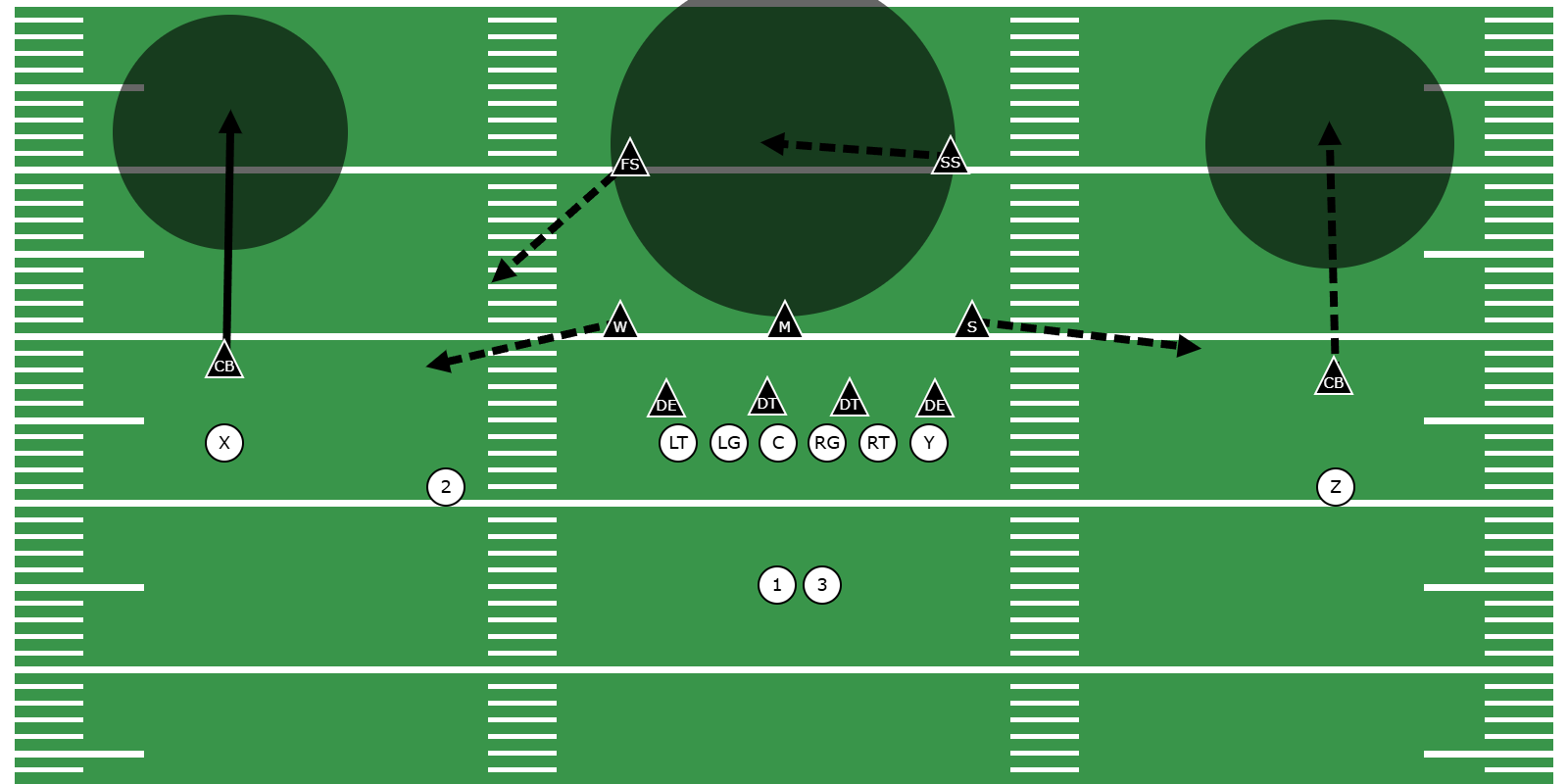
What Is Cover 3 Buzz?
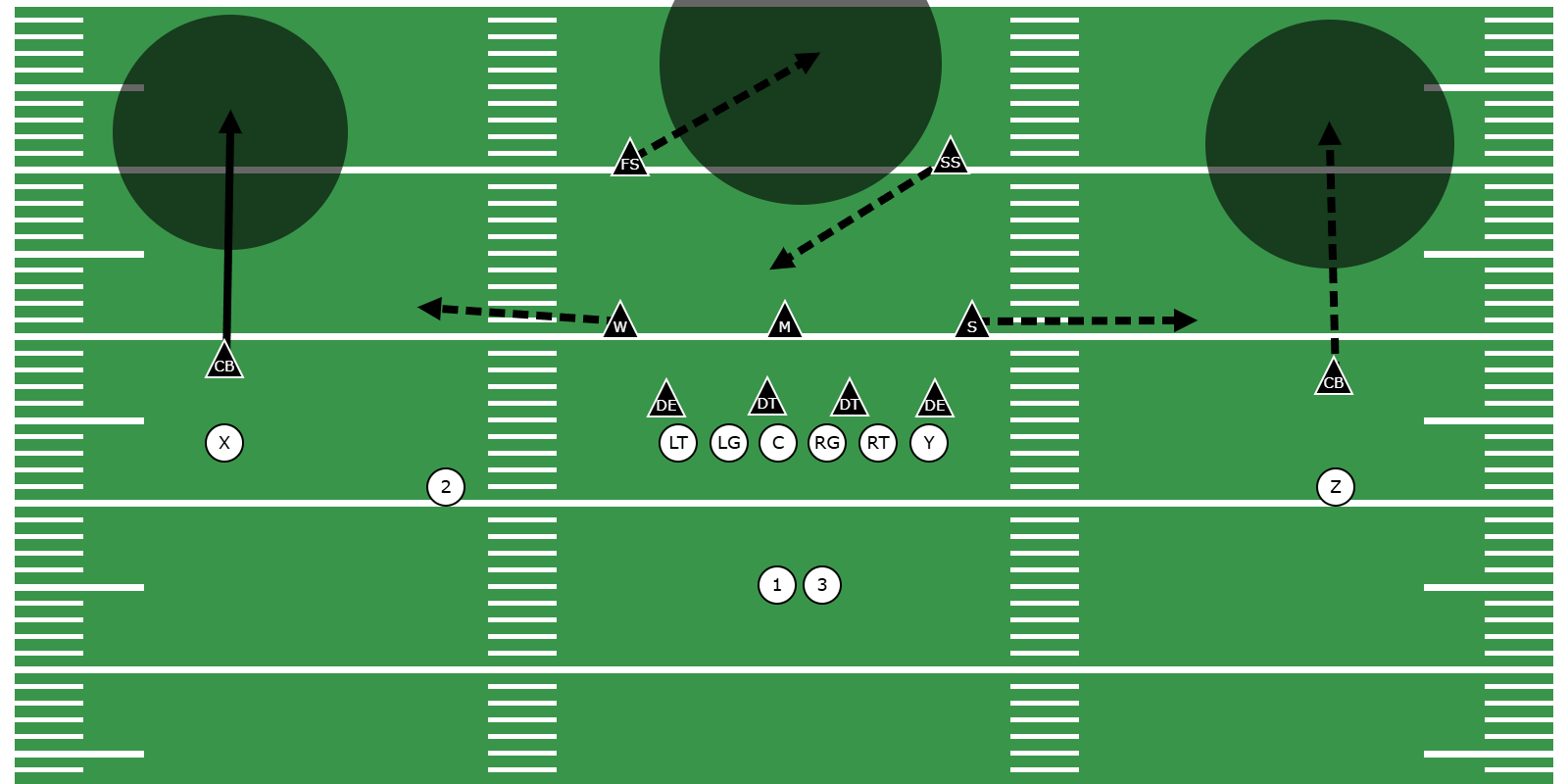
Basic Cover 3 divides the defense into:
- Three deep defenders.
- Four underneath defenders.
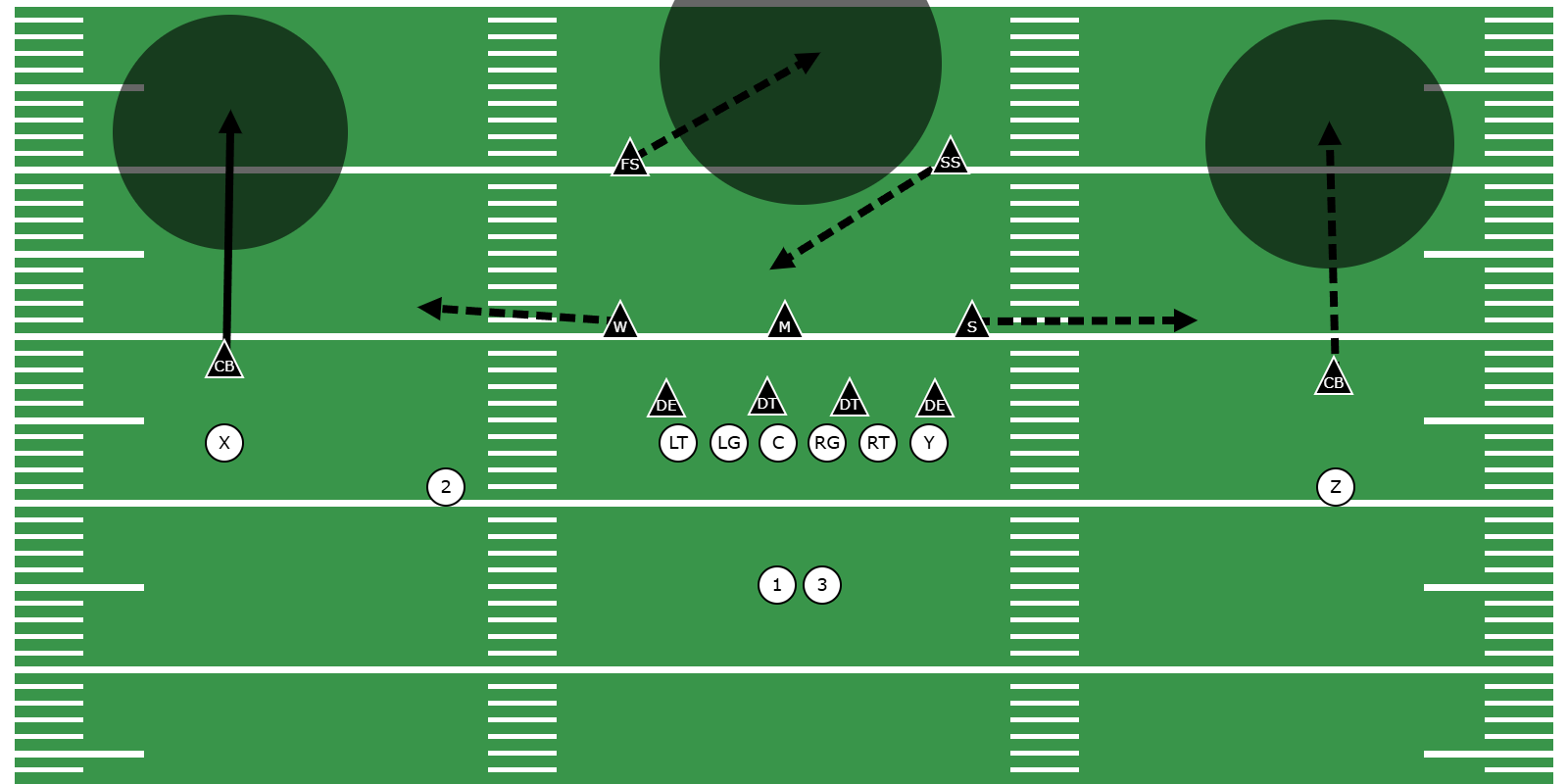
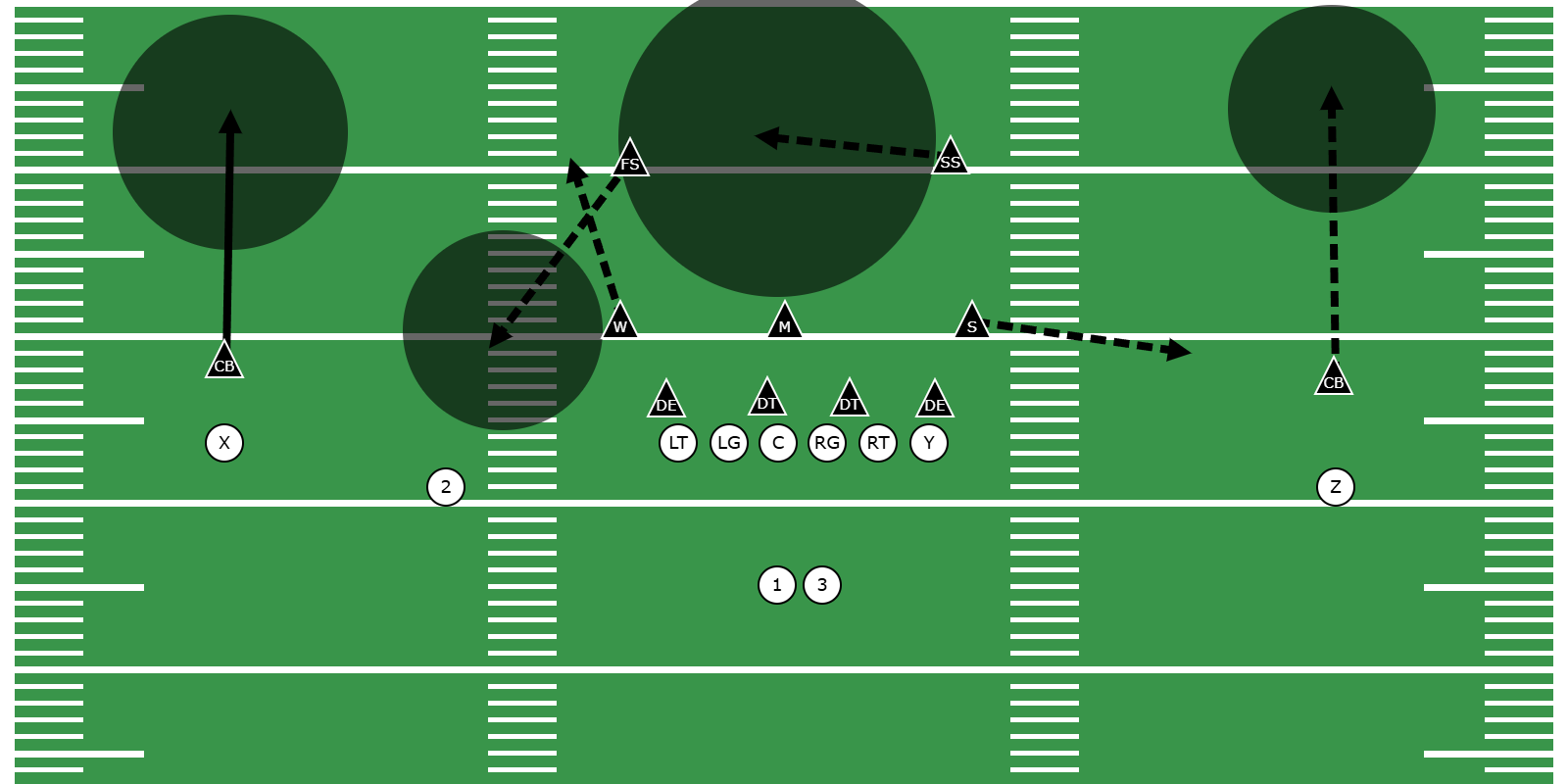
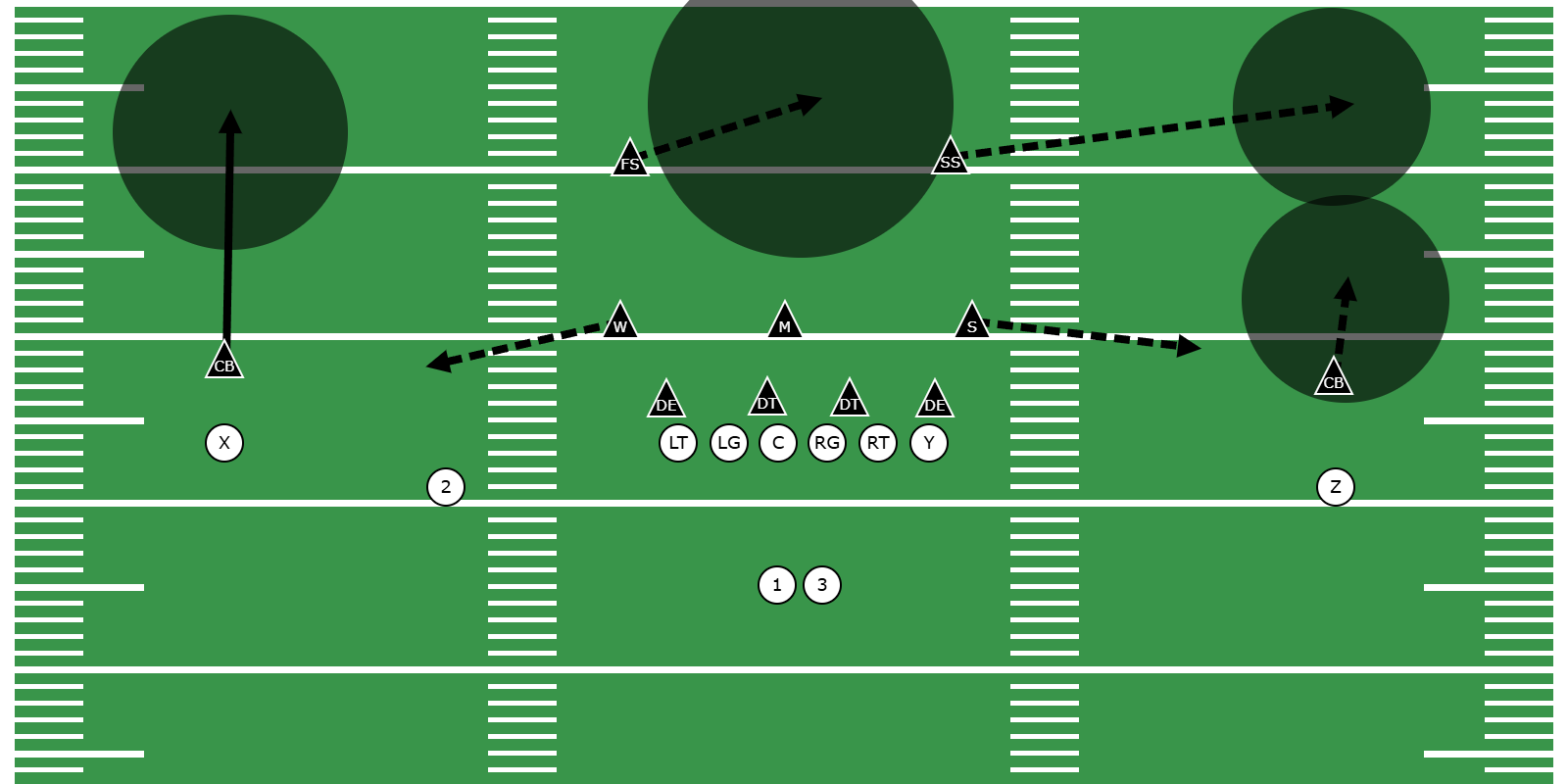
Cover 3 Buzz creates that same basic structure through safety rotation.
A defense may begin with two safeties aligned deep. After the snap:
- One safety rotates toward the deep middle.
- The other safety rotates down into an underneath interior zone.
- The cornerbacks protect the outside deep thirds.
- The remaining underneath defenders complete the four-under structure.
The offense may initially see a two-high shell but receive a single-high Cover 3 structure after the snap.
That change can force the quarterback to confirm the coverage rather than relying entirely on the pre-snap picture.
Why Is It Called “Buzz”?
The term buzz usually refers to the safety rotating down into an inside underneath area.
Instead of rotating all the way toward the flat or perimeter, the safety “buzzes” down into a hook or curl relationship.
That distinguishes the concept from other Cover 3 rotations in which a safety may become the primary flat defender.
Terminology varies between coaching systems, so coaches should define the word clearly within their own playbook.
A useful youth-level definition is:
Buzz means a safety rotates down inside as the defense moves into Cover 3.
That definition gives players a clear picture without requiring them to memorize terminology from other defensive systems.
Basic Cover 3 Buzz Structure
A typical Cover 3 Buzz structure can include:
- Two cornerbacks protecting the outside deep thirds.
- One safety rotating to the deep middle third.
- One safety rotating down into an underneath hook or curl area.
- Three additional underneath defenders.
- Four pass rushers.
Once the rotation is complete, the coverage still resembles Cover 3:
- Deep third.
- Deep middle third.
- Deep third.
- Four underneath zones.
The major difference is which defender occupies one of those underneath zones and how he gets there.
The Buzz Safety’s Responsibility
The buzz safety is the defining player in the coverage.
He begins from a deeper alignment and rotates down into an underneath interior area.
His responsibilities can include:
- Protecting an inside hook or curl window.
- Reading inside receivers.
- Closing passing lanes on slants and digs.
- Helping against crossing routes.
- Reacting to checkdowns.
- Supporting the run once the play declares.
- Maintaining vision toward the quarterback.
- Communicating route exchanges with linebackers.
The safety should not simply sprint downhill because the call contains a rotation.
He must arrive under control and understand which routes threaten his final zone.
How Fast Should the Safety Rotate?
The timing of the rotation matters.
If the safety rotates too early before the snap, the offense may immediately identify the coverage.
If he rotates too slowly after the snap, the offense can throw into the area he is supposed to protect before he arrives.
The correct timing depends on:
- Offensive tempo.
- Formation.
- Motion.
- Quarterback ability.
- Defensive disguise.
- The safety’s athletic ability.
For youth football, execution should come before disguise.
If the safety cannot consistently reach his responsibility on time, align him closer to where he needs to play.
The defense should never sacrifice sound coverage merely to hide the call for another second.
Deep-Middle Safety Responsibility
While one safety buzzes down, another defender must establish the deep middle third.
Often that defender is the opposite safety.
His responsibility is similar to the middle safety in standard Cover 3:
- Stay deeper than the deepest middle threat.
- Protect against posts.
- Recognize seam routes.
- Maintain enough range to help both sides.
- Avoid reacting too aggressively to underneath routes.
- Stay disciplined against play-action.
The rotating safety structure makes communication particularly important.
The deep safety must know that he is responsible for the middle before the ball is snapped, even if his pre-snap alignment does not make that responsibility obvious to the offense.
Cornerback Responsibilities
The cornerbacks normally protect the outside deep thirds.
Their primary rule remains:
Do not allow a vertical receiver to get behind the coverage.
Corners should:
- Maintain appropriate depth.
- Read the release of the outside receiver.
- Recognize routes entering their third.
- Communicate with underneath defenders.
- Break downhill only after the vertical threat is controlled.
- Support the run according to the defensive fit.
The safety rotation does not change the corner’s fundamental deep responsibility.
A corner who jumps an underneath route too quickly can still expose the defense to an explosive pass.
Underneath Defender Responsibilities
The buzz safety becomes one of four underneath defenders.
The other underneath players must adjust their spacing around him.
Depending on the defensive structure, they may protect:
- Curl/flat areas.
- Hook areas.
- The opposite curl/flat area.
- Interior windows not occupied by the buzz safety.
The key is spacing.
Two defenders should not occupy the same zone while another area is left completely uncovered.
The linebackers and buzz safety need to understand how the rotation changes their normal Cover 3 landmarks.
The Buzz Safety and Crossing Routes
Crossing routes are one of the areas where the buzz safety can be particularly useful.
Offenses often attack linebackers with:
- Shallow crosses.
- Digs.
- Over routes.
- Inside-breaking routes from slots or tight ends.
A safety rotating into the interior can provide a more athletic defender in those passing lanes.
He may be able to:
- Collision a crosser.
- Close an intermediate window.
- Rally quickly to a short completion.
- Help a linebacker who has been stretched by another route.
The safety should still defend his area rather than chasing every receiver across the field.
The Buzz Safety and the Run Game
Rotating a safety down can also improve run support.
Once run is confirmed, the buzz safety is already moving toward the box and may become involved in:
- An interior fit.
- An alley fit.
- Cutback support.
- Quarterback support.
- Pursuit from inside-out.
His exact responsibility depends on the defensive front.
The run fit should be established before the coverage is installed.
A safety who does not know his run responsibility may simply chase the football and create another open gap.
Why Defenses Use Cover 3 Buzz
Cover 3 Buzz gives the defense several tactical benefits.
Disguise the Coverage
The defense can show two safeties deep before rotating into Cover 3.
Put a Safety Underneath
A defensive back may provide better coverage ability than a linebacker against certain inside routes.
Strengthen Interior Passing Lanes
The buzz safety can help close slants, digs, crossers, and other routes entering the middle.
Maintain Three-Deep Protection
The defense still protects both outside thirds and the deep middle.
Support the Run
The rotating safety can become an additional run defender near the box.
Change the Quarterback’s Read
The quarterback may expect a two-high coverage before the rotation changes the structure after the snap.
Strengths of Cover 3 Buzz
Cover 3 Buzz can provide:
- Three-deep protection.
- A safety defending an underneath interior zone.
- Improved help against crossing and inside-breaking routes.
- Useful post-snap disguise.
- Strong run-support possibilities.
- Zone vision on the quarterback.
- A familiar Cover 3 structure after the rotation.
- Flexibility against different offensive formations.
The coverage can be particularly effective when the defense wants a more athletic player occupying an area normally handled by a linebacker.
Weaknesses of Cover 3 Buzz
The rotation also creates challenges.
Rotation Timing
The buzz safety must reach his zone before the offense can attack it.
Communication
Every defender needs to understand how the safety rotation changes the underneath spacing.
Seam Routes
Like other Cover 3 structures, vertical seams can stress the defense.
Flats
The buzz safety rotates inside, so another defender must handle the perimeter underneath area.
Four Verticals
Four deep threats can still stress three deep defenders.
Flood Concepts
Three-level route combinations can overload one side of the coverage.
Play Action
The rotating safety may become too aggressive downhill and leave an intermediate passing window.
Motion
Motion can change the strength of the formation after the rotation has been called.
Try The Interactive Playbook Tool: Cover 3 Buzz
Draw your own Cover 3 Buzz concept based play diagram right here using our embedded interactive play designer demo:
GET STARTED: To get started simply click on any of the player icons in the diagram.
Start drawing your own plays like this and build your playbook with CoachYouths Playbook Designer.
Cover 3 Buzz Against Four Verticals
Four Verticals remains one of the most important concepts for any Cover 3 defense.
The outside corners handle outside vertical threats.
The middle safety protects the deep middle.
The inside vertical routes attack the seams between them.
The buzz safety and other underneath defenders may need to reroute or carry seam receivers according to the defensive rules.
The safety rotating down cannot simply settle at shallow depth while a receiver runs vertically past him without resistance.
If the defense uses match principles, the buzz safety may have a specific vertical carry rule.
If the defense uses spot-drop principles, he still needs to affect the seam before settling into his underneath area.
Cover 3 Buzz Against Slant/Flat
Slant/Flat can stress the relationship between the buzz safety and the curl/flat defender.
The outside underneath defender expands toward the flat.
The buzz safety can help close the inside slant window.
This can make the concept difficult to throw if both defenders maintain proper spacing.
The offense may attempt to manipulate the buzz safety with another inside route, so he must read the complete distribution rather than locking onto the first receiver he sees.
Cover 3 Buzz Against Dig Routes
Dig routes enter an area where the buzz safety can provide meaningful help.
If the safety gains proper depth, he can:
- Sit underneath the dig.
- Force the quarterback to throw over him.
- Reduce the receiver’s open window.
- Break on the throw from inside leverage.
The middle safety remains responsible for deep routes behind the dig.
The two defenders should create vertical compression without both attacking the same route.
Cover 3 Buzz Against Shallow Cross
A shallow crosser may move through the buzz safety’s area.
He can:
- Collision the route when legal.
- Force the receiver to alter his path.
- Rally to the catch.
- Pass the route according to the defensive rules.
He should avoid following a shallow route all the way toward the sideline unless the coverage specifically tells him to do so.
Chasing the route can open the interior behind him.
Cover 3 Buzz Against Flood
Flood attacks one side with routes at three levels.
The deep-third corner handles the deep threat.
The curl/flat defender handles the outside underneath relationship.
The buzz safety or another inside defender may need to close the intermediate route from inside.
Spacing and route recognition are critical.
If the buzz safety becomes too attracted to an underneath crosser, the intermediate Flood route can settle behind him.
Cover 3 Buzz Against Smash
Smash can place a short outside route underneath a corner route.
The outside deep-third corner needs to recognize the deeper route entering his area.
The curl/flat defender controls the short outside threat.
The buzz safety protects the inside window and reacts to any route breaking toward him.
The buzz rotation does not automatically solve Smash, but the additional inside coverage presence can discourage complementary routes designed to occupy linebackers.
Cover 3 Buzz Against Trips
Trips formations can influence which safety should rotate and how the underneath defenders align.
The defense needs rules for:
- The number-three receiver.
- The two seam threats.
- The flat.
- The backside receiver.
- The running back.
The buzz safety may be especially useful against the number-three receiver when that player runs an inside route.
However, if number three releases vertically, the defense must know who carries or reroutes him.
Youth defenses should practice the exact Trips adjustment rather than assuming the normal rotation will automatically fit the formation.
Cover 3 Buzz Against Bunch
Bunch formations create compressed releases that can quickly enter the buzz safety’s zone.
The defense should prepare for:
- Crossers.
- Over routes.
- Fast flat routes.
- Corner routes.
- Vertical switch releases.
The buzz safety needs to remain patient enough to identify which route actually threatens his area.
If he chases the first receiver leaving the bunch, another route may replace it immediately behind him.
Cover 3 Buzz Against Motion
Motion can change:
- Formation strength.
- Receiver distribution.
- Run strength.
- Which safety has the best angle to rotate.
- The underneath zones.
The defense needs a simple rule.
Possible approaches include:
- Keep the original buzz call.
- Reset the rotation based on the new strength.
- Check to basic Cover 3.
- Check to another coverage.
For youth teams, a simple automatic check may be better than requiring both safeties to completely change responsibilities immediately before the snap.
Cover 3 Buzz Against Play Action
Play-action directly tests the buzz safety’s discipline.
Because he is rotating toward the line of scrimmage, he may already be moving in the direction the run fake wants him to go.
That makes it especially important that he:
- Understand his coverage landmark.
- Read the assigned run/pass key.
- Avoid attacking the line of scrimmage before confirming run.
- Locate inside routes.
- Maintain enough depth to affect intermediate throws.
The middle safety must also remain deep.
If both safeties react downhill to the run fake, the defense can give up an explosive pass.
Cover 3 Buzz and Pressure
Cover 3 Buzz can be paired with a traditional four-man rush or incorporated into pressure packages.
With four rushers, the defense maintains the full three-deep, four-under structure.
With additional pressure, the defense may become a three-deep, three-under variation.
The safety rotation can help disguise pressure because the offense may not know before the snap:
- Which safety is rotating down.
- Whether the rotating safety is covering or blitzing.
- Which linebacker may rush.
- Which defender will occupy the vacated zone.
Youth coaches should install the base rotation before adding pressure exchanges.
Disguising Cover 3 Buzz
Disguise is one of the coverage’s major advantages.
The defense can align with two safeties deep and initially resemble:
- Cover 2.
- Cover 4.
- Cover 6.
- Another two-high zone.
After the snap, one safety rotates down and the other establishes the deep middle.
The quarterback must recognize that the coverage has changed.
However, the disguise should not cause poor alignment.
If the buzz safety cannot reach his zone from the chosen starting position, move him closer.
Sound coverage is more important than a perfect disguise.
Spot-Drop and Match Versions
Cover 3 Buzz can be played with different underlying techniques.
Spot-Drop Cover 3 Buzz
The rotating safety and other underneath defenders protect defined zones and react to receivers entering them.
This is simpler and may be appropriate for youth defenses.
Match Cover 3 Buzz
Defenders use route-distribution rules that determine when they carry or match receivers.
This can provide tighter coverage against seams and modern route combinations but increases the mental workload.
A defense should not add match rules simply because they are more advanced.
The coverage needs to fit the players and available practice time.
Coaching Cover 3 Buzz in Youth Football
Cover 3 Buzz should generally be installed after basic Cover 3.
A practical progression is:
- Review the standard three-deep, four-under structure.
- Align with two safeties deep.
- Identify which safety is buzzing down.
- Identify which safety becomes the middle-third defender.
- Walk through the rotation without an offense.
- Add basic receiver releases.
- Practice Slant/Flat.
- Add Dig and Shallow Cross.
- Add Four Verticals.
- Add Flood.
- Add Trips and bunch formations.
- Add play-action.
- Connect the rotation to the run fit.
- Add disguise only after the rotation is dependable.
The first goal is not fooling the quarterback.
The first goal is getting all eleven defenders to the correct responsibilities.
A Simple Buzz Rotation Drill
Begin with:
- Two safeties.
- Two cornerbacks.
- Underneath defenders.
- A coach or quarterback.
Before the snap, align in the chosen two-high shell.
At the snap:
- One safety rotates to the deep middle.
- The buzz safety rotates to his underneath landmark.
- Corners gain outside-third depth.
- Underneath defenders adjust to their zones.
Initially, run the drill without receivers.
Then add:
- Slant.
- Dig.
- Seam.
- Shallow cross.
- Flat.
Grade:
- Rotation timing.
- Final alignment.
- Depth.
- Communication.
- Eyes.
- Route recognition.
Only after the structure is consistent should the offense begin using multiple route combinations.
Common Youth Football Mistakes
Buzz Safety Rotates Too Slowly
The offense throws into his zone before he arrives.
Buzz Safety Runs Straight to the Line of Scrimmage
He treats the rotation like a run blitz and leaves the hook area open.
Deep Safety Does Not Get to the Middle
Both safeties begin moving downhill or toward the same side.
Underneath Defenders Do Not Adjust
A linebacker drops to his normal Cover 3 landmark and occupies the same space as the buzz safety.
Cornerbacks Watch the Rotation
Corners become distracted by the safeties and lose their outside vertical threats.
Rotation Reveals the Coverage Too Early
The safety moves well before the snap even though the defense intended to disguise the call.
Players Prioritize Disguise Over Assignment
Defenders remain out of position simply to avoid showing the coverage.
Poor Communication After Motion
The formation changes, but the safeties and linebackers continue executing different versions of the call.
Personnel Considerations
The buzz safety should ideally have:
- Good route recognition.
- Short-area quickness.
- Reliable tackling ability.
- Comfort playing in traffic.
- Enough coverage skill to handle inside receivers.
- Discipline against play-action.
The deep safety needs:
- Range.
- Depth discipline.
- Ability to recognize posts and seams.
- Reliable open-field tackling.
The linebackers need to understand how their landmarks change when a safety enters the underneath structure.
A defense should assign the rotation based on personnel rather than assuming both safeties are interchangeable.
When to Call Cover 3 Buzz
Cover 3 Buzz can be useful when:
- The defense wants to disguise Cover 3 from a two-high shell.
- The offense attacks linebackers with inside-breaking routes.
- Crossing routes are creating problems underneath.
- A safety is a better coverage matchup than a linebacker.
- The defense wants a safety involved in the run fit.
- The offense relies heavily on pre-snap coverage identification.
- The defense wants to maintain three-deep protection.
It may be less attractive when the safeties struggle with rotation communication, the offense uses rapid tempo that prevents proper alignment, or the defense cannot consistently handle the seam responsibilities created by Cover 3.
Cover 3 Buzz vs. Cover 3
Both finish with a three-deep, four-under structure.
Cover 3: Can align directly in its final structure or rotate into it in several ways.
Cover 3 Buzz: Specifically uses a safety rotating down into an inside underneath responsibility.
The final zone structure may look similar, but the personnel distribution and pre-snap presentation differ.
Cover 3 Buzz vs. Cover 3 Sky
Terminology varies, but a common distinction is based on the safety’s final underneath responsibility.
Cover 3 Buzz: A safety rotates down into an inside hook or curl area.
Cover 3 Sky: A safety commonly rotates down toward an outside curl/flat or force responsibility.
Both create Cover 3, but the rotating safety enters different portions of the underneath coverage.
Coaches should define these terms within their own system because terminology is not universal.
Cover 3 Buzz vs. Cover 3 Cloud
Again, terminology can vary.
A common distinction is:
Cover 3 Buzz: The safety rotates down inside while the corner generally protects the outside deep third.
Cover 3 Cloud: A corner may remain as the short outside or flat defender while a safety rotates over the top to handle the deep outside third.
The resulting Cover 3 structure uses different defenders in the underneath and deep responsibilities.
Cover 3 Buzz vs. Cover 3 Match
These terms describe different aspects of the coverage.
Buzz describes the safety rotation used to create the Cover 3 structure.
Match describes how defenders distribute routes after the snap.
A defense can therefore use a buzz rotation and also play match principles.
They are not necessarily mutually exclusive concepts.
Key Coaching Points
- Install basic Cover 3 before adding the buzz rotation.
- Define exactly which safety is rotating down.
- Give the buzz safety a clear final landmark and responsibility.
- Make the opposite safety’s deep-middle responsibility explicit.
- Adjust linebacker spacing around the rotating safety.
- Keep cornerbacks focused on outside vertical threats.
- Practice seams and Four Verticals.
- Use the buzz safety to affect inside-breaking and crossing routes.
- Maintain disciplined eyes against play-action.
- Connect the safety rotation to the run fit.
- Establish simple motion rules.
- Add disguise only after the rotation is dependable.
- Define Buzz, Sky, and Cloud terminology within the defensive system rather than assuming universal definitions.
Final Thoughts
Cover 3 Buzz creates the familiar three-deep structure of Cover 3 by rotating a safety into an underneath interior responsibility.
That rotation can give the defense a more athletic player against slants, digs, crossers, and other inside routes while maintaining three defenders over the top. It can also disguise the final coverage by presenting a two-high shell before the snap and changing to a single-high structure after the ball is snapped.
The effectiveness of the coverage depends on coordination. The buzz safety must arrive in the correct area on time, the opposite safety must establish the deep middle, the cornerbacks must protect their outside thirds, and the linebackers must adjust their spacing around the rotation.
For youth coaches, Cover 3 Buzz should be an extension of a dependable Cover 3 defense. Teach the final responsibilities first, walk through the rotation until it becomes automatic, and only then emphasize disguise.
When players understand both where they start and where they must finish, Cover 3 Buzz can give a defense the stability of Cover 3 with a useful change in personnel distribution, run support, and post-snap presentation.
Related Articles
Published by CoachYouths Staff on 08/25/2026
You are NOT currently logged in, you may login or signup for FREE at any time: