Cover 4 Quarters
What Is Cover 4 Quarters?
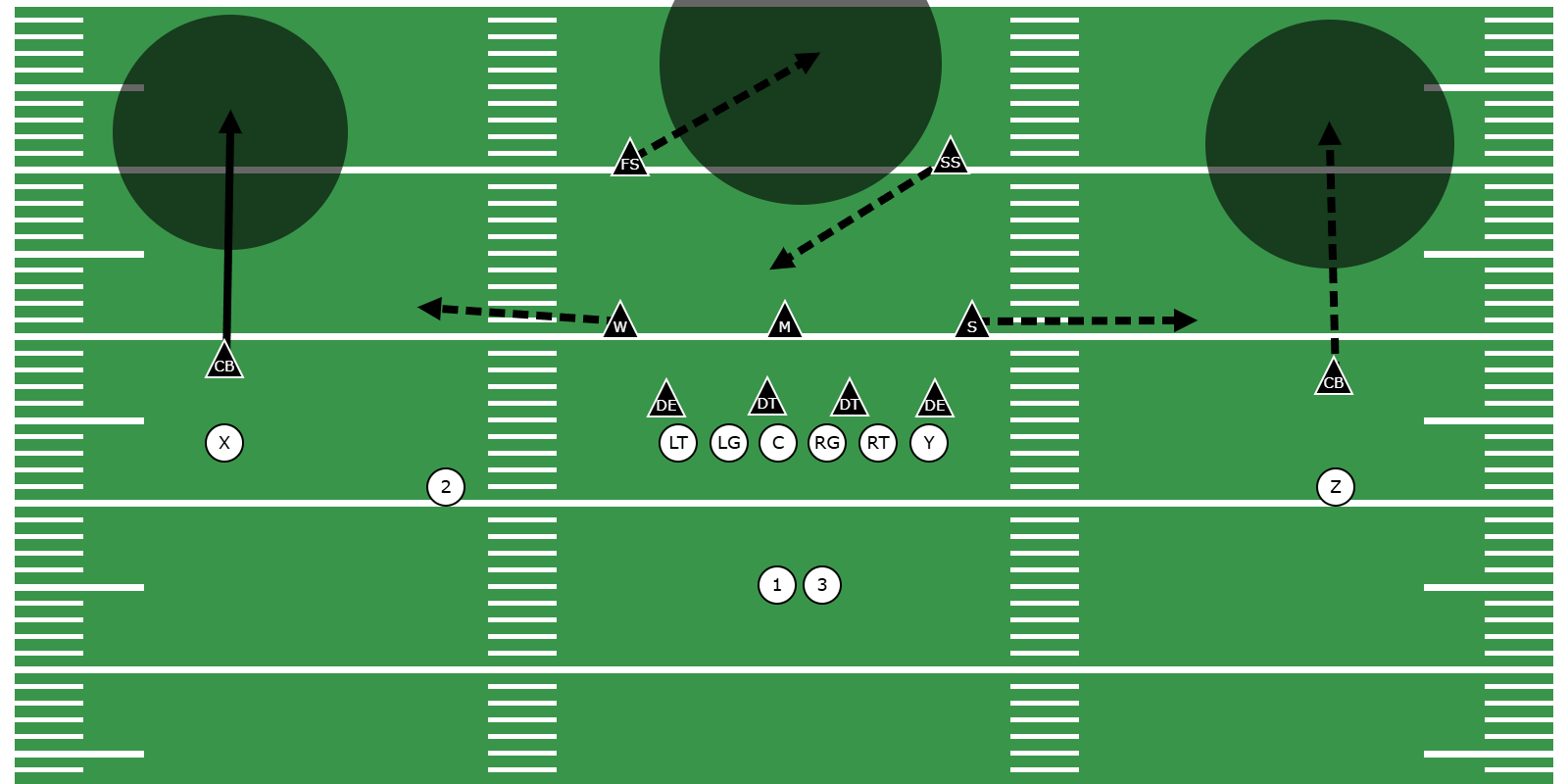
The “4” in Cover 4 refers to the four deep portions of the field.
A basic structure includes:
- Cornerback: outside quarter.
- Safety: inside quarter.
- Safety: inside quarter.
- Cornerback: outside quarter.
Underneath those four defenders, three defenders commonly protect the shorter zones when the defense rushes four.
That creates a basic:
Four-deep, three-under structure.
Quarters coverage can become more aggressive than that description suggests because the safeties do not always remain deep throughout the play.
If their assigned receiver does not threaten vertically, they may be able to attack another route or become involved in run support.
Basic Cover 4 Structure
A common Quarters alignment includes:
- Two cornerbacks aligned over the outside receivers.
- Two safeties aligned deep over the inside receivers.
- Three underneath defenders.
- Four pass rushers.
The corners generally key the number-one receivers.
The safeties commonly key the number-two receivers.
On each side of the formation:
- #1 is the widest eligible receiver.
- #2 is the next eligible receiver inside.
- #3 is the next receiver inside when present.
Receiver numbering gives defenders a consistent way to identify route threats regardless of offensive personnel.
The Four Deep Quarters
The field can be visualized as four vertical sections.
From one sideline to the other:
- Outside quarter.
- Inside quarter.
- Inside quarter.
- Outside quarter.
The cornerbacks protect the outside portions.
The safeties protect the inside portions.
In a pure zone version, defenders can simply maintain depth and defend receivers entering those areas.
In a match version, the routes determine how those responsibilities develop after the snap.
Cornerback Responsibilities
The cornerback commonly reads the number-one receiver.
If #1 releases vertically, the corner generally carries or matches him.
The corner should:
- Maintain proper leverage.
- Stay on top of vertical routes.
- Recognize short releases.
- Understand when #1 is no longer a deep threat.
- Communicate route exchanges.
- Support the run according to the defensive structure.
A corner cannot assume that a safety will automatically help against every deep route.
The safety is often occupied by #2.
Against two vertical receivers on the same side, the corner may effectively be responsible for #1 by himself.
Safety Responsibilities
The safeties are central to Quarters coverage.
A safety commonly reads the number-two receiver to his side.
The release of #2 can determine whether the safety:
- Carries him vertically.
- Drives on an inside-breaking route.
- Helps the corner.
- Looks for a crossing route.
- Becomes involved in the run fit.
A simplified rule might be:
If #2 goes vertical, the safety matches him.
If #2 does not threaten vertically, the safety may become available to help elsewhere.
The exact rules vary among defensive systems.
The important principle is that the safety’s responsibility changes based on the route distribution.
Underneath Defender Responsibilities
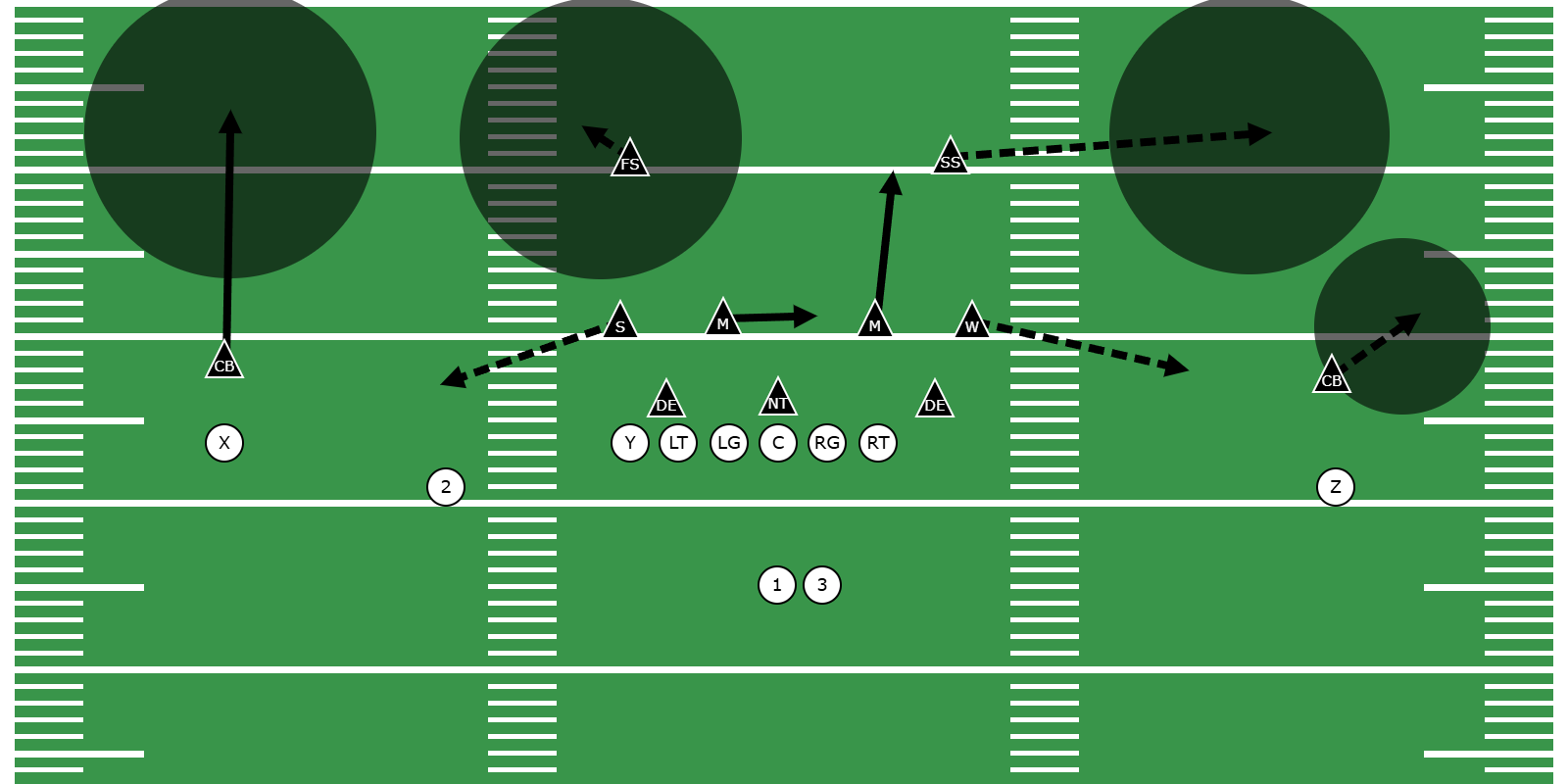
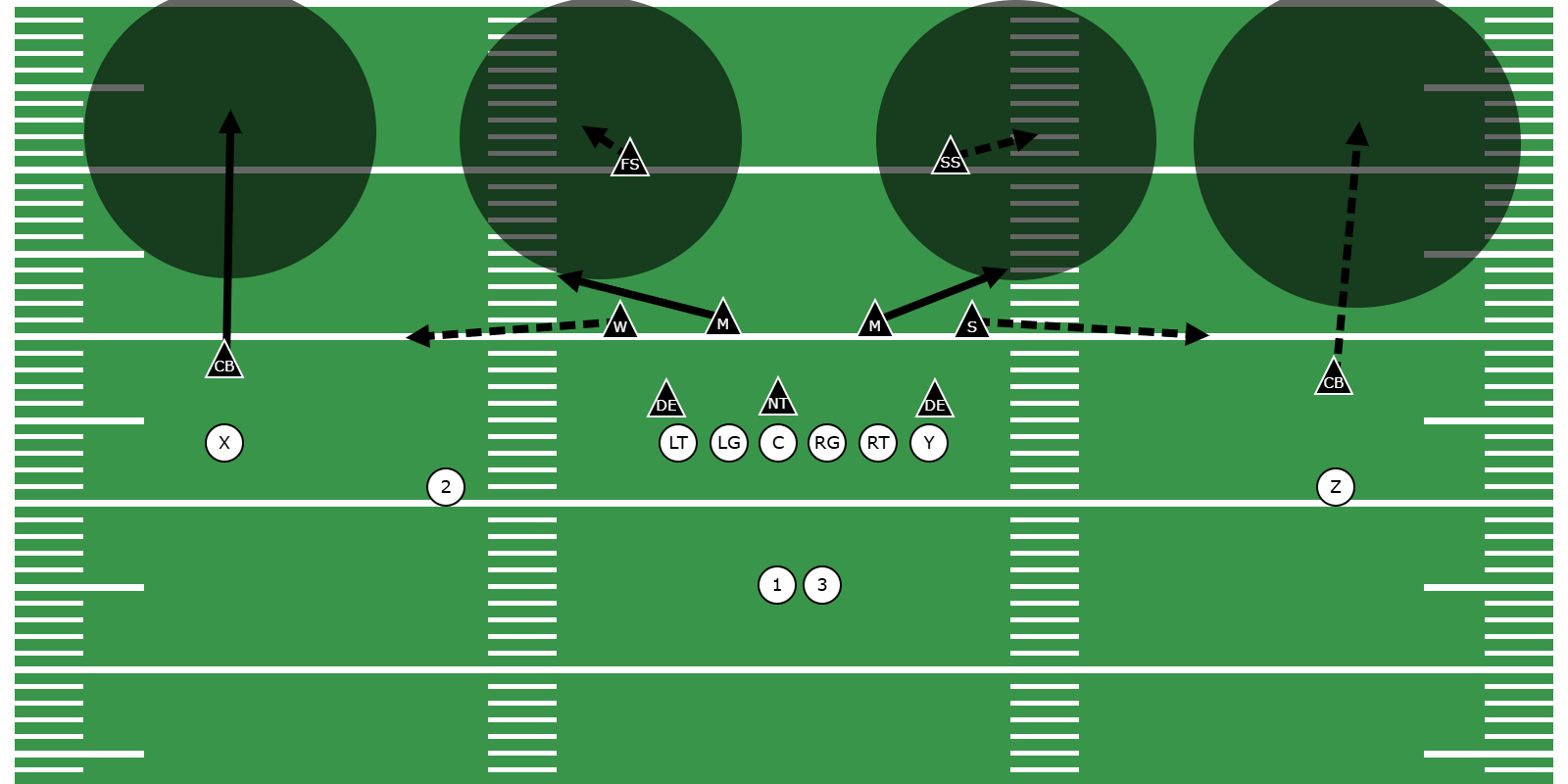
With four defenders initially committed to the deep structure, three defenders commonly protect underneath areas.
These players may be:
- Linebackers.
- Nickel defenders.
- Hybrid safeties.
Their responsibilities can include:
- Rerouting inside receivers.
- Protecting hook areas.
- Expanding toward the flat.
- Carrying short crossers.
- Matching running back releases.
- Reading the quarterback.
- Supporting the run.
The underneath defenders are particularly important against short horizontal stretches.
Four deep defenders do not automatically protect quick passes underneath.
Why Quarters Is More Than Prevent Coverage
Cover 4 is sometimes misunderstood as a conservative coverage designed only to prevent deep passes.
Quarters can be much more aggressive.
Because the safeties read receivers, they may not need to remain deep if their pass threat disappears.
For example, if #2 blocks on a running play, the safety may be able to attack downhill quickly.
That can allow a Quarters defense to play with two safeties who appear deep before the snap while still gaining strong run support after the ball is snapped.
This is one of the major differences between Quarters and a simple four-deep prevent coverage.
The Number-Two Receiver
The number-two receiver is often the most important read for the safety.
If #2:
Releases Vertically
The safety generally carries or matches him.
Releases Outside
The safety may communicate the route and look inside or toward #1 depending on the coverage rules.
Releases Inside
The safety may match, pass, or drive the route depending on its depth and the defensive system.
Blocks
The safety may become an immediate run-support defender.
This ability to react to #2 gives Quarters much of its flexibility.
It also means the safety needs good recognition and disciplined eyes.
What Counts as Vertical?
Quarters systems need a clear definition of a vertical release.
A receiver does not need to run a straight go route to threaten vertically.
Routes such as:
- Seam.
- Post.
- Corner.
- Deep over.
can all begin with vertical stems.
The defense should establish a simple depth or route-intent rule that tells the safety when he must carry #2.
If defenders use different definitions, coverage busts can occur.
For youth football, the definition should be easy to recognize at full speed.
Why Defenses Use Cover 4 Quarters
Quarters offers several structural advantages.
Four Deep Defenders
The defense begins with excellent protection against vertical routes.
Two-High Shell
The pre-snap structure can discourage deep throws and provide disguise possibilities.
Safety Run Support
Safeties can become aggressive against the run when their receiver keys block or release short.
Pattern-Match Flexibility
Defenders can adapt to route distribution instead of defending static zones.
Strong Against Vertical Concepts
Four deep defenders provide natural answers to many vertical route combinations.
Formation Flexibility
Quarters can be adjusted to balanced formations, Trips, tight ends, and different personnel packages.
Strengths of Cover 4 Quarters
Quarters can provide:
- Four defenders protecting the deep field.
- Strong answers against vertical routes.
- Two-high pre-snap structure.
- Safeties who can participate in run support.
- Pattern-match flexibility.
- Ability to bracket certain receivers through route distribution.
- Useful disguise with other two-high coverages.
- Good adaptability to modern spread formations.
When taught correctly, the coverage can defend both explosive passes and the run without forcing the defense to declare its intentions before the snap.
Weaknesses of Cover 4 Quarters
The coverage also has vulnerabilities.
Short Underneath Throws
Only three defenders may initially protect underneath space.
Flats
Quick routes to the flat can stress the underneath defenders.
Play Action
Aggressive safeties can be manipulated by run action.
Crossing Routes
Routes that move across the field can challenge match rules.
Post Routes
Certain route combinations can occupy a safety and isolate a corner against a post.
Bunch and Stack Formations
Compressed releases can make receiver identification difficult.
Motion
Motion can change receiver numbering and coverage responsibilities.
Complexity
Match rules require more teaching than a basic spot-drop zone.
Try The Interactive Playbook Tool: Cover 4 Quarters
Draw your own Cover 4 Quarters concept based play diagram right here using our embedded interactive play designer demo:
GET STARTED: To get started simply click on any of the player icons in the diagram.
Start drawing your own plays like this and build your playbook with CoachYouths Playbook Designer.
Cover 4 Quarters Against Four Verticals
Four Verticals is one of the concepts Quarters is naturally designed to handle.
Against a balanced 2x2 formation:
- Each corner can handle #1 vertical.
- Each safety can handle #2 vertical.
That creates four defenders against four vertical threats.
The coverage does not need one safety to split two seams as Cover 3 often does.
This is one of Quarters’ major strengths.
The defenders still need proper leverage and communication, especially if the vertical routes convert into posts, corners, or crossing routes.
Cover 4 Quarters Against Two-by-Two Formations
A balanced 2x2 formation provides one of the cleanest Quarters structures.
On each side:
- Corner reads #1.
- Safety reads #2.
- Underneath defender works beneath them.
The defense can effectively treat each side as a two-receiver distribution.
That makes the coverage easier to teach before introducing Trips and other formations.
Youth coaches installing Quarters should usually begin with 2x2 route combinations.
Cover 4 Quarters Against Trips
Trips requires additional rules because three receivers align to one side.
The defense must account for:
- #1.
- #2.
- #3.
- The backside receiver.
- The running back.
The #3 receiver is especially important.
He can:
- Release vertically.
- Cross the formation.
- Run underneath.
- Attack the opposite safety.
- Create a three-receiver vertical distribution.
Many Quarters systems use specific Trips checks rather than attempting to play the exact same 2x2 rules.
Youth coaches should install a clear Trips adjustment rather than expecting players to improvise.
Cover 4 Quarters Against Post Routes
Post routes can challenge Quarters depending on the route distribution.
If #2 releases vertically, the safety may become occupied with him.
That can leave the corner responsible for #1’s post route without immediate inside help.
Offenses can intentionally create this situation with combinations that hold the safety inside.
The corner needs good leverage and awareness.
The defense may also use specific rules to help against dangerous post routes based on formation and receiver alignment.
Cover 4 Quarters Against Corner Routes
A corner route by #2 can threaten the space between the safety and corner.
If #2 is considered vertical, the safety may carry him.
The corner must remain aware of #1 and avoid abandoning his own vertical threat.
The defenders should understand how their leverage changes when the routes begin to cross or exchange areas.
Communication becomes particularly important against switch releases.
Cover 4 Quarters Against Slant/Flat
Slant/Flat attacks underneath rather than immediately threatening the deep quarters.
The underneath defender may be placed in conflict between:
- The slant.
- The flat.
Because the safety and corner begin with deeper responsibilities, the offense may be willing to take a short completion.
The defense should rally quickly and tackle.
If the safety’s #2 key immediately releases to the flat, the coverage rules may allow the safety to become involved more aggressively.
The exact response depends on the defensive system.
Cover 4 Quarters Against Curl/Flat
Curl/Flat can stretch the underneath defender vertically and horizontally.
The flat route pulls him outside.
The curl settles behind or inside him.
The corner may be able to drive on the curl once #1 is no longer threatening vertically, but he must not abandon a deep responsibility too early.
Quarters defenders need to recognize when a route has truly declared.
Guessing creates explosive plays.
Cover 4 Quarters Against Smash
Smash commonly combines:
- A short hitch.
- A corner route.
If #2 runs the corner route, the safety may carry him as a vertical threat.
The corner can potentially become involved with the short #1 route once he confirms that #1 is no longer vertical.
This can give Quarters a useful answer to Smash.
However, the exact distribution depends on the coverage rules and receiver splits.
The defense should practice the concept rather than assuming the zone structure automatically handles it.
Cover 4 Quarters Against Mesh
Mesh creates crossing routes underneath the deep coverage.
The three underneath defenders can be stressed horizontally.
The safeties may also become involved if crossers develop at greater depth.
The defense needs rules for:
- Shallow crossers.
- Intermediate crossers.
- Routes that pass from one side to the other.
- Running backs releasing underneath.
A defense using match principles must know when to carry a crosser and when to pass it.
Otherwise two defenders may follow one receiver while another runs free.
Cover 4 Quarters Against Flood
Flood places three receiving threats at different depths on one side.
The defense must distribute:
- The deep route.
- The intermediate route.
- The flat route.
The corner and safety protect the deeper threats.
An underneath defender handles the short relationship.
Depending on the route distribution, the offense may create a window between the deep defenders and the underneath player.
Good spacing and quarterback vision are essential.
Cover 4 Quarters Against Switch Releases
Switch releases can challenge the initial #1 and #2 relationships.
The receivers may exchange paths shortly after the snap.
The defense needs rules determining whether:
- The corner and safety exchange receivers.
- Each defender stays with his original receiver.
- The routes are matched based on where they finish.
The answer varies by system.
The important point is that the defense must practice the exchange.
Quarters becomes vulnerable when both defenders follow the same route.
Cover 4 Quarters Against Bunch
Bunch formations compress the receivers and make traditional #1/#2 relationships less obvious.
The defense may need:
- A special bunch check.
- Modified receiver numbering.
- Box principles.
- Banjo calls.
- Another coverage.
Youth teams should avoid forcing complicated Quarters rules into a bunch formation if the players cannot identify the distribution quickly.
A simple automatic check can be more effective than a sophisticated rule nobody executes consistently.
Cover 4 Quarters Against Motion
Motion can change:
- Receiver numbering.
- Formation strength.
- Trips distribution.
- Run strength.
- Safety reads.
The defense should establish whether it:
- Renumbers receivers after motion.
- Travels with a specific receiver.
- Checks the coverage.
- Keeps the original call and adjusts alignment.
Communication must happen before the snap.
Quarters depends heavily on defenders knowing which receiver they are reading.
Cover 4 Quarters and the Run Game
Run support is one of the most important features of Quarters.
The safeties may align deep but can become active run defenders based on their receiver keys.
If #2 blocks, the safety may be able to trigger downhill quickly.
Depending on the front, the safety can become:
- An alley defender.
- A force defender.
- A cutback defender.
- An extra fitter inside the box.
This can allow the defense to present a light box before the snap while still adding a safety after the run declares.
The exact fit must be coordinated with the front.
The safety should know which gap or leverage he owns rather than simply running toward the ball.
Safety Run Reads
The safety’s run/pass read should be tied to a reliable offensive key.
Possible keys include:
- #2 receiver.
- Tight end.
- Offensive line.
- A combination of receiver and backfield action.
The defense should avoid teaching the safety to stare only at the running back.
Play-action is designed to manipulate defenders who read the backfield too aggressively.
A receiver key can help the safety determine whether he is still needed in coverage.
Cover 4 Quarters Against Play Action
Play-action is one of the major challenges for aggressive Quarters safeties.
The offense wants the safety to trigger downhill and then throw behind him.
Common threats include:
- Post routes.
- Deep overs.
- Seams.
- Corner routes.
The safety should:
- Read his assigned key.
- Confirm that his receiver is blocking or no longer a pass threat.
- Maintain enough depth to react to play-action.
- Avoid attacking downhill based solely on backfield action.
Corners must also remain disciplined against vertical routes.
A safety who is aggressive against the run makes Quarters powerful, but that aggression must be controlled.
Cover 4 Quarters Against RPOs
Run-pass options can place Quarters defenders in conflict.
The offense may read a safety who is responsible for both:
- Fitting the run.
- Defending a receiver.
If the safety attacks the run, the quarterback throws behind him.
If the safety remains deep, the offense hands the ball off.
Defenses can respond through:
- Front structure.
- Leverage.
- Exchange responsibilities.
- Pressure.
- Modified coverage rules.
Youth coaches should understand which defender the offense is attempting to read.
Simply telling the safety to “play both” is rarely a complete answer.
Cover 4 Quarters and the Pass Rush
A standard Quarters call commonly uses a four-man rush.
That leaves seven defenders in coverage.
The rush should:
- Maintain contain.
- Collapse the pocket.
- Prevent extended routes.
- Force the quarterback to make decisions on time.
Match coverage becomes harder as the play extends because receivers can change direction and move across the original zone structure.
A disciplined pass rush reduces the amount of time defenders must maintain those matches.
Cover 4 Quarters and Quarterback Scrambles
Quarters can keep several defenders facing the quarterback early in the play.
That can help against scrambles.
Underneath defenders may react once their immediate coverage responsibilities allow.
Safeties can also become involved downhill if their vertical threats disappear.
However, the pass rush must maintain lane integrity.
If the rush creates a large escape lane, the quarterback can still gain yards before the secondary arrives.
Spot-Drop Cover 4 vs. Quarters Match Principles
Cover 4 can be taught at different levels.
Spot-Drop Cover 4
Defenders primarily protect their assigned quarter or underneath zone.
Advantages:
- Simpler installation.
- Fewer route rules.
- Easier for inexperienced players.
Weaknesses:
- More open zone windows.
- Less aggressive run support.
- Less adaptable to route distribution.
Quarters Match
Defenders read receivers and adjust responsibilities based on releases.
Advantages:
- Tighter coverage.
- Better route distribution.
- More aggressive safety involvement.
- Strong answers to vertical concepts.
Weaknesses:
- More complexity.
- Greater communication demands.
- More potential for assignment errors.
Youth coaches can begin with the first approach and gradually add matching rules.
Disguising Cover 4 Quarters
Quarters naturally begins from a two-high shell.
That allows the defense to show a similar pre-snap picture before playing:
- Cover 2.
- Tampa 2.
- Cover 4.
- Cover 6.
- Other split-safety coverages.
The safeties can also adjust their depth and alignment based on formation while attempting to maintain a consistent appearance.
Disguise should remain secondary to execution.
A safety who is intentionally misaligned to hide the coverage may be unable to carry #2 vertically.
Coaching Cover 4 Quarters in Youth Football
Quarters should be installed in manageable stages.
A practical progression is:
- Teach the four deep quarters.
- Teach receiver numbering.
- Assign corners to #1.
- Assign safeties to #2.
- Define a vertical release.
- Practice #1 and #2 both vertical.
- Practice #2 releasing outside.
- Practice #2 releasing inside.
- Add Slant/Flat.
- Add Smash.
- Add Four Verticals.
- Add switch releases.
- Add Trips.
- Add bunch checks.
- Add motion.
- Connect the safeties to the run fits.
- Add play-action and RPO periods.
The defense does not need every possible Quarters adjustment on the first day.
Players should master a small set of rules before additional situations are added.
A Simple Quarters Read Drill
Use one side of the formation with:
- One cornerback.
- One safety.
- One underneath defender.
- Two receivers.
- One quarterback.
Number the receivers #1 and #2.
Run:
- #1 vertical / #2 vertical.
- #1 hitch / #2 vertical.
- #1 vertical / #2 out.
- #1 slant / #2 flat.
- #1 hitch / #2 corner.
- Switch verticals.
The corner and safety identify their keys before the snap.
Grade:
- Alignment.
- Receiver identification.
- Route recognition.
- Correct match.
- Leverage.
- Communication.
- Transition to run support when appropriate.
Once the defenders handle the two-receiver distribution consistently, add a third receiver.
A Simple Quarters Run-Pass Drill
Align:
- One safety.
- One #2 receiver.
- An offensive backfield.
- The appropriate front defenders.
Give the safety two basic pictures:
Pass
#2 releases vertically or into a route.
The safety remains in coverage.
Run
#2 blocks while the offense executes a run.
The safety triggers into his assigned run fit.
Then add play-action where #2 initially gives a blocking appearance before releasing.
This teaches the safety to react to actual keys rather than guessing based on the backfield.
Common Youth Football Mistakes
Safeties Watch the Quarterback Instead of Their Key
They lose #2 on vertical routes.
Safeties Trigger on Every Run Fake
Play-action creates easy throws behind them.
Corners Expect Automatic Safety Help
The safety is occupied by #2, leaving the corner alone against #1.
Players Do Not Define Vertical Consistently
One defender carries a route while another expects it to be passed.
Underneath Defenders Stay Too Shallow
Intermediate routes settle behind them.
Nobody Handles the Flat
The deep defenders remain deep while underneath players fail to expand.
Poor Trips Communication
The defense attempts to use 2x2 rules against a three-receiver distribution without an adjustment.
Confusion on Switch Releases
Both the corner and safety follow the same receiver.
Safeties Run to the Ball Without a Fit
They recognize run correctly but create a new gap by attacking without assignment discipline.
Personnel Considerations
Quarters requires several important traits.
Cornerbacks
Useful traits include:
- Ability to cover vertical routes.
- Route recognition.
- Good leverage.
- Discipline.
- Open-field tackling.
Safeties
Useful traits include:
- Ability to cover #2 vertically.
- Run-support ability.
- Route recognition.
- Communication.
- Tackling.
- Disciplined eyes.
Underneath Defenders
Useful traits include:
- Zone awareness.
- Ability to reroute receivers.
- Open-field tackling.
- Communication.
- Understanding of route distribution.
A safety who cannot cover a slot receiver vertically may limit how aggressively the defense can use true Quarters principles.
When to Call Cover 4 Quarters
Quarters can be useful when:
- The offense has multiple vertical threats.
- The defense wants a two-high shell.
- The safeties are capable run defenders.
- The defense wants to disguise multiple split-safety coverages.
- The offense frequently uses 2x2 spread formations.
- The defense wants pattern-match answers to vertical concepts.
- The defense wants safeties involved in the run fit without aligning them permanently near the box.
A simpler coverage may be preferable if defenders cannot consistently identify receiver releases, communicate motion, or execute the run/pass reads.
Cover 4 Quarters vs. Cover 3
Cover 3: Three deep defenders, commonly with a single-high safety structure.
Cover 4 Quarters: Four deep defenders, commonly from a two-high safety structure.
Cover 3 can naturally place an additional defender near the box before the snap.
Quarters can still produce strong run support by allowing safeties to trigger based on receiver keys.
Four Verticals also creates different stresses: Cover 3 has three deep defenders against four vertical threats, while Quarters can naturally match four vertical receivers with four deep defenders.
Cover 4 Quarters vs. Cover 2
Both commonly begin with two safeties deep.
Cover 2: Safeties divide the deep field into halves while corners generally play underneath.
Cover 4 Quarters: Corners and safeties divide the deep field into four quarters.
The corners therefore play very different roles.
Cover 2 places more defenders underneath.
Quarters provides more immediate deep defenders and can use safeties aggressively through route reads.
Cover 4 Quarters vs. Cover 6
Cover 6 is commonly a split-field coverage combining a Quarters structure to one side with a Cover 2-style structure to the other.
Quarters uses a four-deep relationship across the full formation.
Cover 6 intentionally plays different coverage principles to opposite sides.
The two concepts are closely related because Quarters principles often make up one half of Cover 6.
Cover 4 Quarters vs. Prevent Cover 4
The two should not automatically be treated as the same coverage.
Prevent Cover 4
The primary objective is keeping receivers in front of four deep defenders and preventing an explosive pass.
Quarters
The safeties and corners can use route reads, matching rules, and aggressive run support.
Quarters can therefore be a base defensive coverage rather than merely a late-game prevent call.
Key Coaching Points
- Teach receiver numbering before advanced match rules.
- Make #1 the corner’s primary route key.
- Make #2 the safety’s primary route key when using traditional Quarters principles.
- Define vertical releases clearly.
- Practice Four Verticals early.
- Teach corners not to assume automatic safety help.
- Teach safeties when they can become run defenders.
- Use disciplined receiver keys against play-action.
- Practice Slant/Flat, Smash, and Flood.
- Install a specific Trips adjustment.
- Practice switch releases and crossing routes.
- Establish simple motion rules.
- Connect every safety trigger to a defined run fit.
- Add complexity only when players execute the base rules at full speed.
Final Thoughts
Cover 4 Quarters combines four-deep protection with route-reading principles that can make the coverage far more aggressive than a simple prevent defense.
The corners and safeties divide the deep field, but their responsibilities are influenced by receiver releases. Corners commonly handle the number-one receivers while safeties read number two. When those receivers threaten vertically, the secondary can match four deep routes with four defenders. When a safety’s receiver blocks or releases short, that safety may become available to help against another route or attack the run.
That flexibility is the coverage’s greatest strength and its primary teaching challenge.
For youth coaches, Quarters does not need to begin as a complicated pattern-match system. Start with the four-deep structure, teach receiver numbering, give the corners and safeties simple route keys, and build the coverage one rule at a time.
When players understand both their pass responsibilities and their run fits, Cover 4 Quarters can provide a defense with strong vertical protection, active safety support, and a flexible two-high foundation for defending modern offensive formations.
Published by CoachYouths Staff on 08/25/2026
You are NOT currently logged in, you may login or signup for FREE at any time: