Box Coverage
What Is Box Coverage?
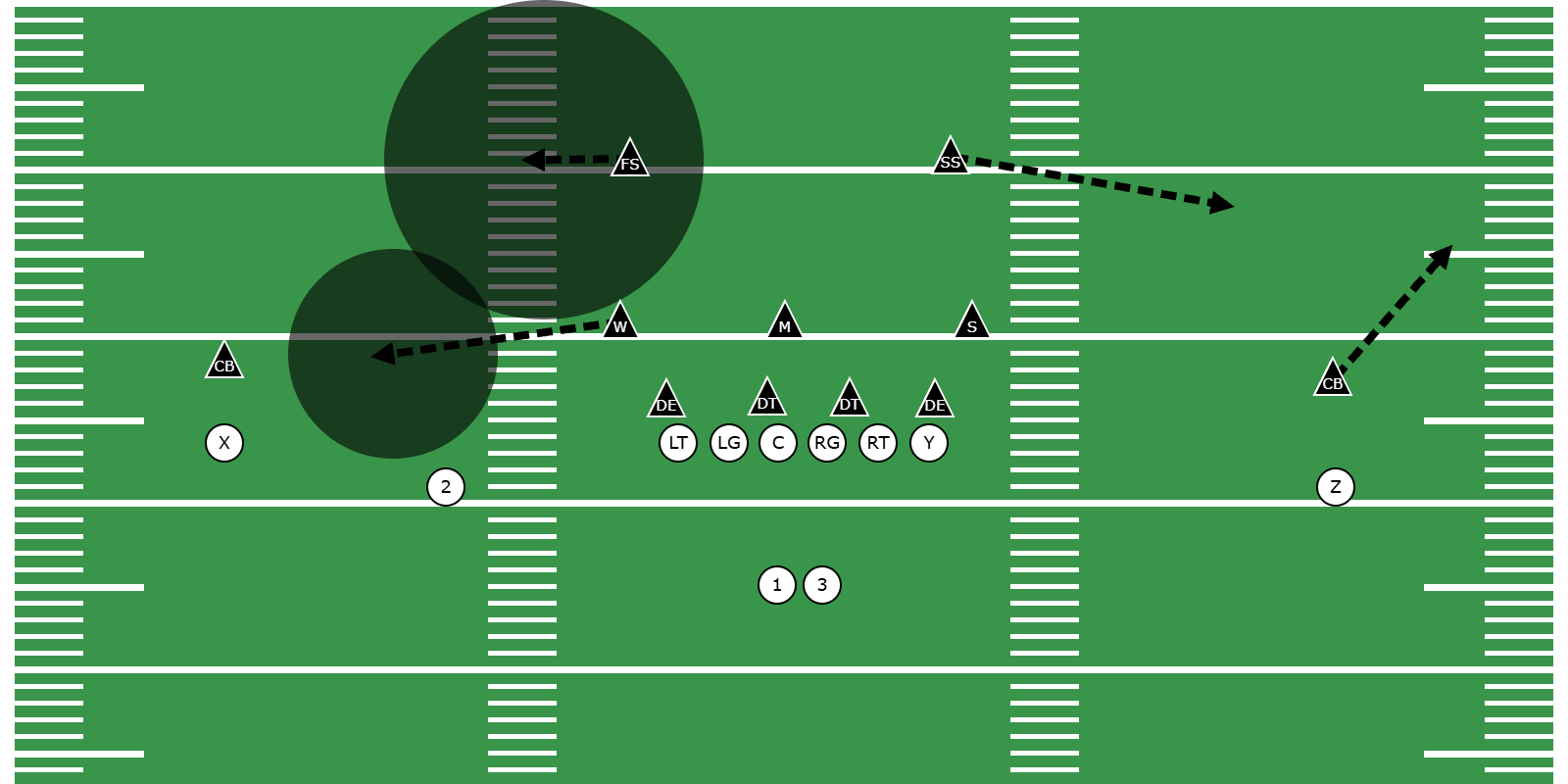
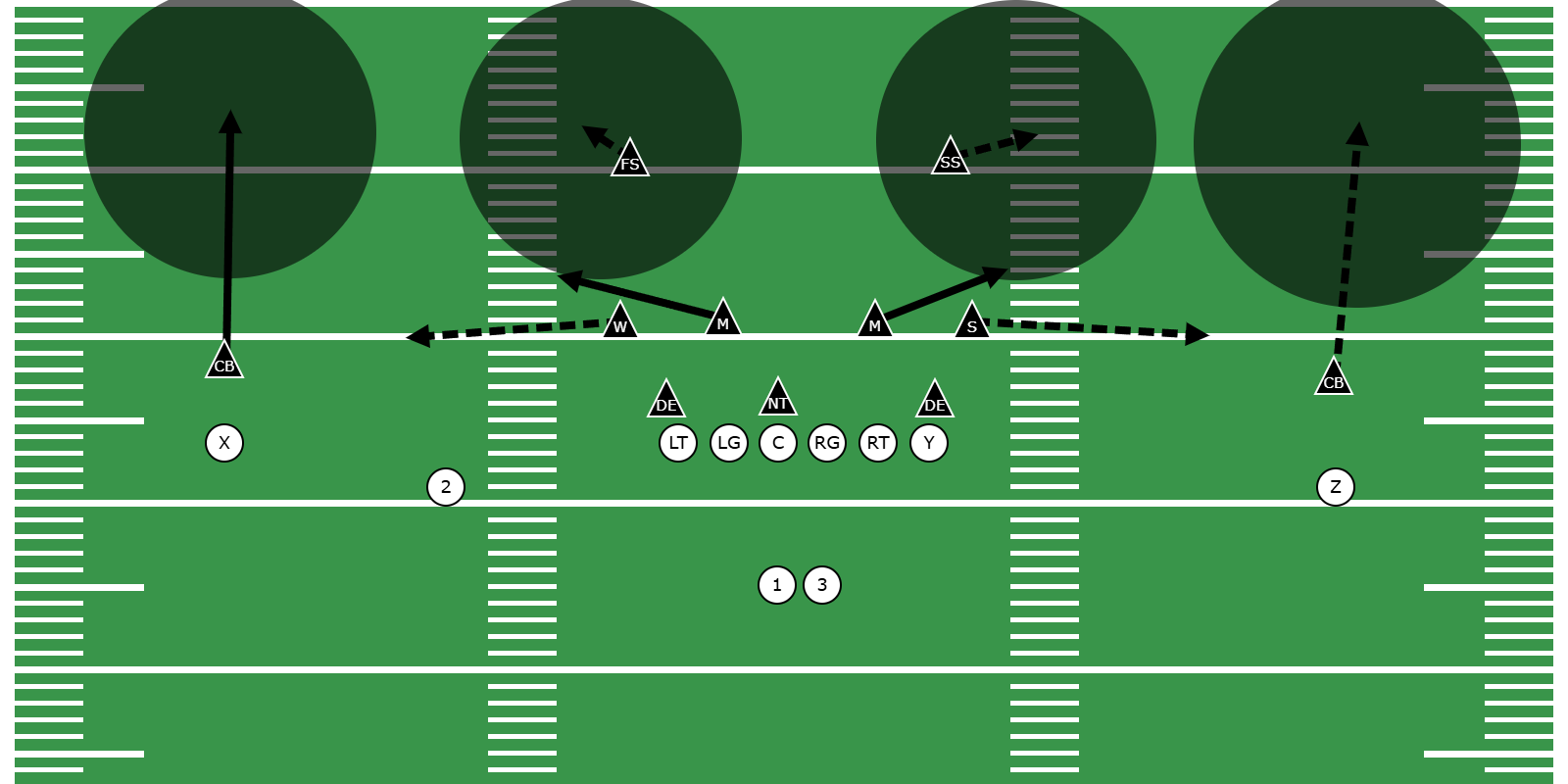
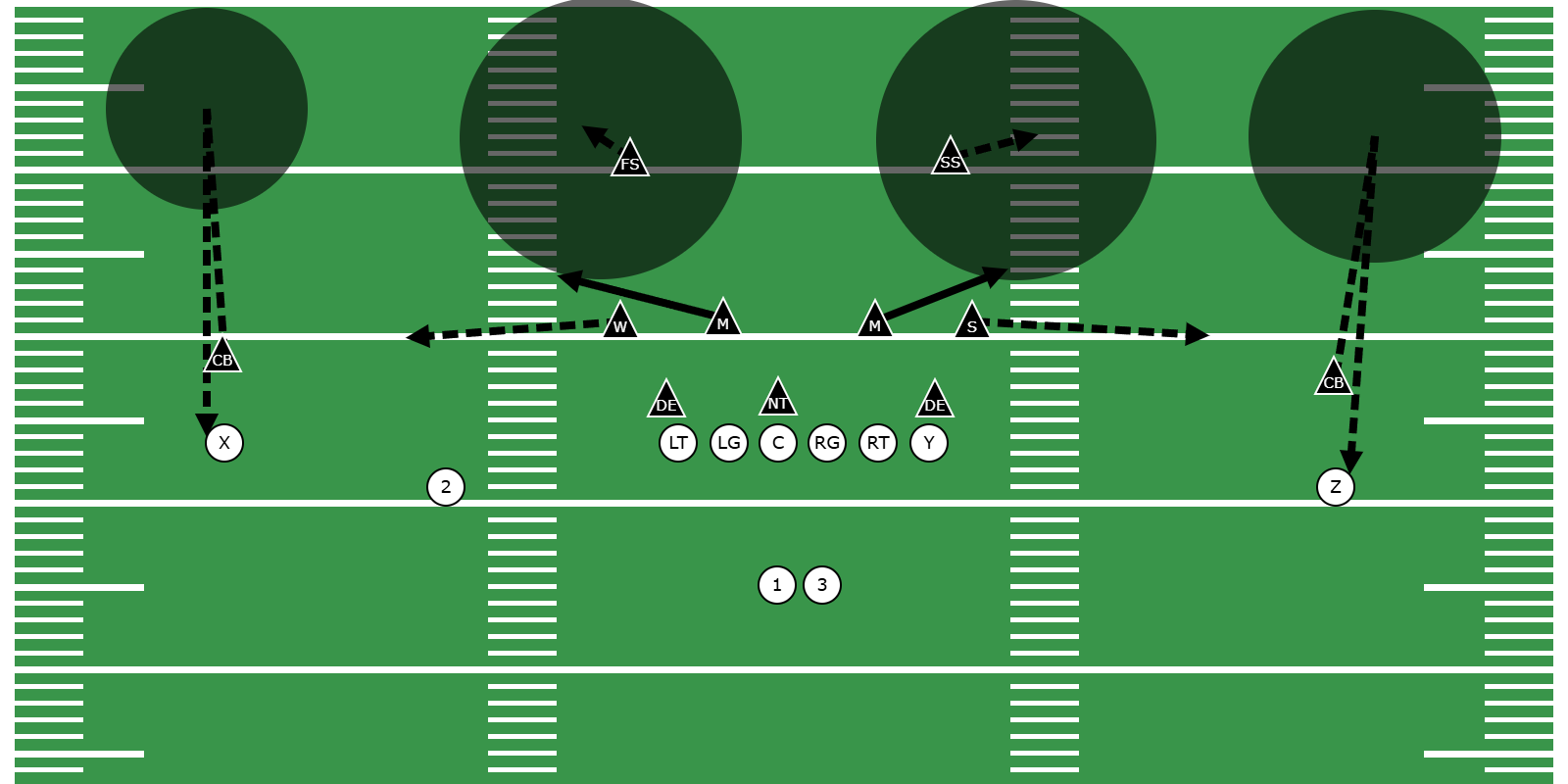
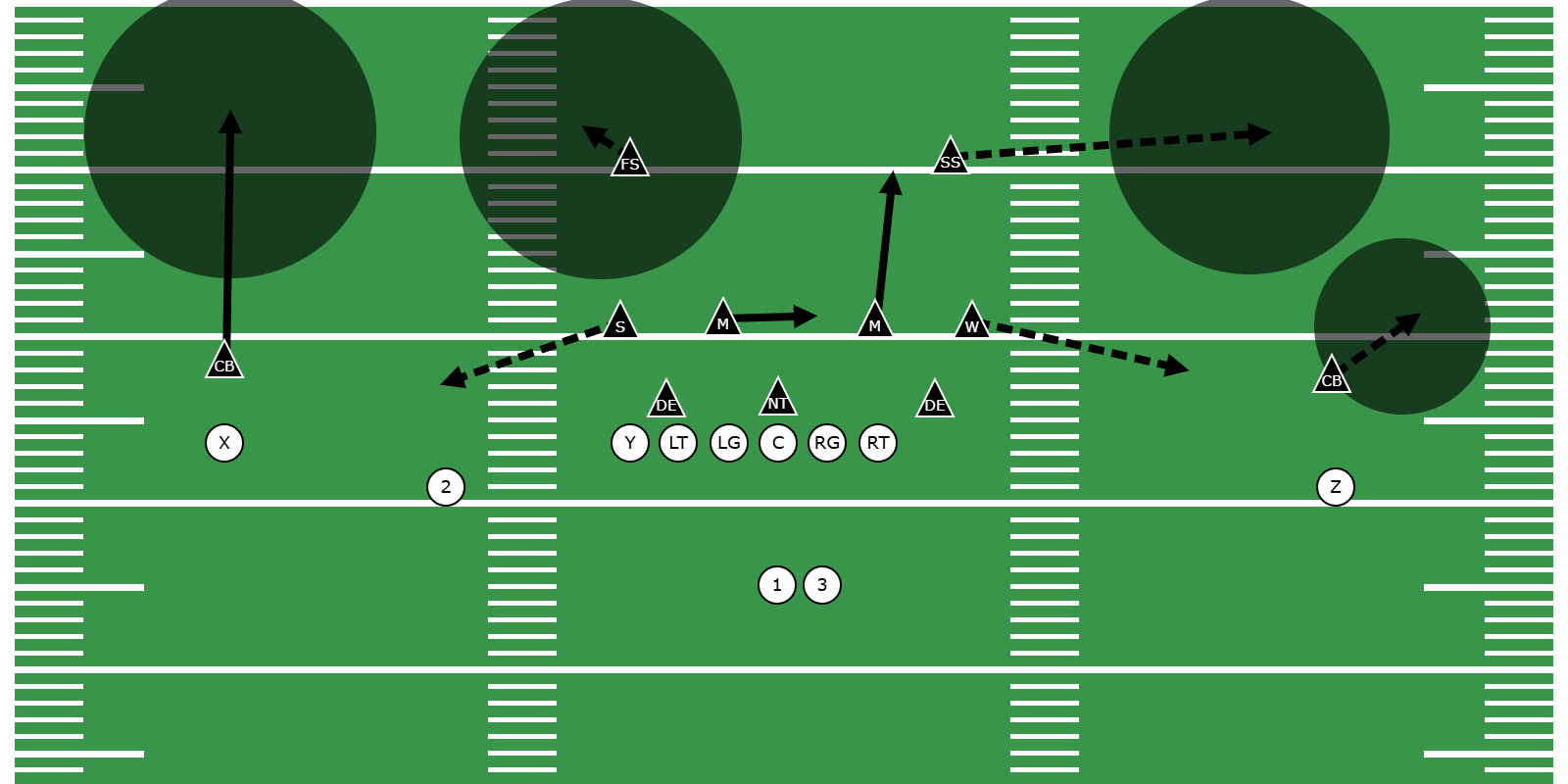
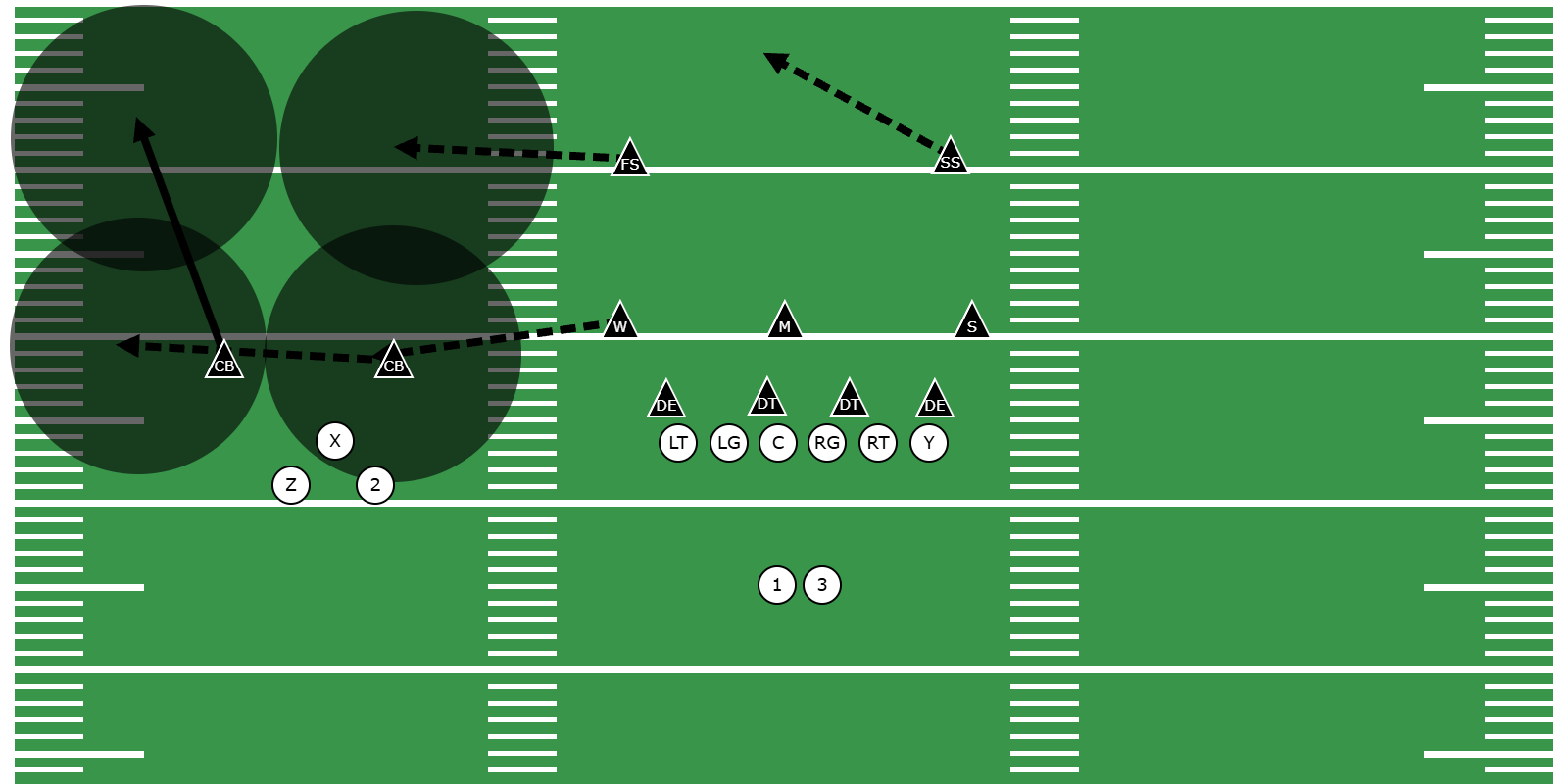
Box Coverage surrounds a three-receiver formation with four defenders.
A typical structure includes:
- An inside underneath defender.
- An outside underneath defender.
- An inside deep defender.
- An outside deep defender.
Those four defenders create the box.
The exact defensive positions can vary.
Depending on personnel and formation, the box may include:
- Cornerback.
- Safety.
- Nickel defender.
- Linebacker.
- Hybrid defensive back.
The important part is the relationship between the defenders rather than their position names.
Each defender protects a portion of the route distribution.
Why Use Box Coverage Against Bunch?
Bunch formations create problems for traditional man coverage.
Three receivers align close together, allowing the offense to create natural traffic.
If defenders attempt to follow individual receivers immediately, they may:
- Collide with each other.
- Get picked by another receiver.
- Lose leverage.
- Chase crossing routes.
- Allow a receiver a free release.
Box Coverage reduces those problems by allowing defenders to react to the receivers after they release from the bunch.
Instead of asking:
Which receiver is mine before the snap?
the defense can ask:
Which route is entering my responsibility after the snap?
That difference can make bunch formations much easier to defend.
The Four-Over-Three Advantage
The mathematical advantage is simple.
The offense presents:
- Three receivers.
The defense places:
- Four coverage defenders.
That gives the defense one additional player around the route distribution.
The extra defender can provide:
- Inside help.
- Outside help.
- Deep help.
- Support against crossing routes.
- Run support when released from coverage.
However, the extra defender is not free.
Using four defenders against three receivers means fewer defenders are available elsewhere.
The defense must still account for:
- The backside receiver.
- The running back.
- The quarterback.
- The run game.
Box Coverage solves one problem by intentionally allocating resources toward the bunch.
Basic Box Structure
Imagine three receivers aligned tightly together.
The defense places four defenders around them.
Underneath Inside Defender
Protects short inside releases.
Underneath Outside Defender
Protects short outside releases.
Deep Inside Defender
Protects vertical and deeper inside releases.
Deep Outside Defender
Protects vertical and deeper outside releases.
The exact assignments can change based on the defensive system.
The central principle remains:
Defenders own leverage and route distribution rather than chasing receivers through the bunch.
Inside Underneath Defender
The inside underneath defender commonly protects against routes breaking toward the middle of the field.
Potential threats include:
- Slants.
- Shallow crosses.
- Quick ins.
- Inside releases.
- Short option routes.
He should maintain inside leverage and prevent receivers from crossing his face uncontested.
He may also:
- Reroute vertical releases.
- Carry a route temporarily.
- Pass a deeper route to the inside high defender.
- Support the run when his pass threat disappears.
The defender must understand when to pass a route and when to stay attached.
Outside Underneath Defender
The outside underneath defender commonly protects the perimeter.
Potential threats include:
- Quick outs.
- Flats.
- Bubbles.
- Speed outs.
- Short corner-side releases.
He should maintain outside leverage and prevent an easy completion immediately toward the sideline.
Depending on the run fit, he may also become:
- Force.
- Perimeter contain.
- Screen defender.
The outside underneath player must avoid getting pulled too far inside by traffic from the bunch.
Inside Deep Defender
The inside deep defender protects deeper routes toward the middle.
Potential threats include:
- Seams.
- Posts.
- Deep crosses.
- Vertical releases bending inside.
He should remain deeper than the deepest inside threat.
The underneath inside defender can help reroute receivers, but the high defender cannot assume those routes will be stopped underneath.
His depth protects the box against explosive passes.
Outside Deep Defender
The outside deep defender protects vertical and deep outside routes.
Potential threats include:
- Go routes.
- Corner routes.
- Deep outs.
- Vertical switch releases.
He should remain deeper than the deepest outside threat.
If the bunch releases multiple receivers vertically, he must communicate with the inside high defender so the two do not match the same route.
Leverage Is the Foundation
Box Coverage works because the defenders maintain complementary leverage.
The four defenders surround the bunch:
- Inside.
- Outside.
- Underneath.
- Over the top.
The offense should not receive an uncontested release into open space.
If a receiver breaks inside, an inside defender is waiting.
If he breaks outside, an outside defender is waiting.
If he releases vertically, a high defender is positioned over him.
The defenders do not need to win every route immediately.
They need to funnel routes toward help.
Route Distribution
Route distribution is the central skill in Box Coverage.
The defenders must identify how the three receivers release.
Possible releases include:
- One inside, one outside, one vertical.
- Two vertical, one underneath.
- Three vertical.
- Two crossing, one vertical.
- Switch releases.
- Delayed releases.
The defense should develop rules for the most common distributions it expects to face.
Youth teams do not need rules for every theoretical combination.
They need clear answers to the route patterns their opponents actually use.
Communication
Box Coverage requires communication before and after the snap.
Before the snap, defenders should identify:
- The bunch.
- Their position in the box.
- Inside and outside leverage.
- High and low responsibilities.
After the snap, useful communication can identify:
- In.
- Out.
- Vertical.
- Cross.
- Switch.
The terminology should be short enough to use during a live play.
Long verbal calls are rarely useful once receivers begin moving.
Box Coverage Against Three Verticals
Three vertical releases test the two deep defenders.
The defense must prevent three receivers from simply running between the high players.
Underneath defenders can help by:
- Rerouting releases.
- Disrupting stems.
- Carrying routes temporarily.
- Forcing receivers toward the high defenders.
The deep defenders then distribute the vertical threats according to leverage.
The defense should practice this route distribution early because vertical bunch releases can create explosive plays when defenders hesitate.
Box Coverage Against a Fast Flat
A fast flat route is common from bunch.
One receiver immediately releases outside.
The outside underneath defender should be positioned to attack it.
He should:
- Recognize the release.
- Maintain outside leverage.
- Close under control.
- Tackle immediately.
The outside deep defender remains available for any vertical route behind him.
That high-low relationship discourages the offense from using the flat defender’s aggression to create an easy vertical throw.
Box Coverage Against Shallow Cross
A shallow crossing route can be handled by the inside underneath portion of the box.
The defender should:
- Recognize the inside release.
- Maintain leverage.
- Avoid getting caught in bunch traffic.
- Carry or pass the route according to the call.
The defense needs a clear rule if the crosser continues all the way across the formation.
A shallow route that begins inside the box can eventually leave the coverage structure.
Box Coverage Against Mesh
Mesh can be particularly challenging because multiple receivers cross in opposite directions.
The offense wants defenders to:
- Chase.
- Collide.
- Lose leverage.
- Get picked.
Box Coverage can reduce that problem because defenders can distribute the crossers instead of following them through traffic.
The inside underneath defender may handle one crossing threat while another defender takes the route entering his area.
The exact exchange should be practiced.
The most important rule is that two defenders should not chase the same crosser while another receiver escapes uncovered.
Box Coverage Against Switch Releases
Bunch formations frequently use switch releases.
Receivers exchange their initial paths immediately after the snap.
Traditional man coverage can struggle because defenders must navigate the exchange.
Box Coverage allows the defense to respond based on where the routes emerge.
The deep defenders distribute vertical threats.
The underneath defenders distribute short inside and outside threats.
Players should avoid locking their eyes onto the receiver who initially aligned closest to them.
The release matters more than the starting position.
Box Coverage Against Smash
A bunch can create Smash-like route relationships with:
- A short outside route.
- A corner route behind it.
The outside underneath defender handles the short threat.
The outside deep defender protects the corner route.
That creates a natural high-low relationship.
The underneath defender should trust the high defender and attack the short route once it declares.
The high defender should not drive downhill and surrender the corner route.
Box Coverage Against Flood
Flood creates three levels toward one side:
- Deep.
- Intermediate.
- Flat.
This can stretch one edge of the box.
The outside deep defender protects the deepest route.
The outside underneath defender handles the flat.
Another defender must account for the intermediate route.
If the defense does not distribute the middle level correctly, Flood can create a large completion window between the high and low defenders.
This concept should be included in installation periods.
Box Coverage Against Corner Routes
Corner routes commonly emerge from the interior of a bunch.
The receiver may initially release vertically before breaking outside.
The deep outside defender should recognize the route entering his leverage.
The deep inside defender should avoid chasing the route so aggressively that he opens an inside vertical threat.
The underneath outside defender can help by rerouting or squeezing the stem when the coverage rules allow.
Box Coverage Against Post Routes
A post route attacks the inside high portion of the box.
The deep inside defender must remain disciplined.
He should:
- Stay deeper than the route.
- Maintain inside leverage.
- Recognize vertical stems.
- Avoid being pulled outside unnecessarily.
The deep outside defender remains responsible for threats attacking his side.
The offense may pair a post with an outside vertical route specifically to separate the two high defenders.
Box Coverage Against Rub Routes
Rub routes are one of the primary reasons to use Box Coverage.
The offense attempts to create contact between defenders by crossing receiver paths.
Because Box defenders are not necessarily chasing individual receivers across the formation, they can avoid some of that traffic.
The defenders should:
- Maintain their leverage.
- Keep vision on the route distribution.
- Avoid following receivers into another defender’s space.
- Communicate exchanges.
The coverage turns the offense’s compressed spacing from an advantage into a more manageable route-distribution problem.
Box Coverage Against Picks
A legal route combination can function like a pick even when the offense does not intentionally initiate illegal contact.
Box Coverage helps by reducing the need for defenders to run through those intersections.
The defense should still practice:
- Stacked releases.
- Crossing releases.
- Vertical rubs.
- Wheel combinations.
The more familiar defenders become with the traffic, the less likely they are to panic and abandon their leverage.
Box Coverage Against Delayed Releases
A receiver may initially block, hesitate, or hide behind the bunch before releasing.
Defenders should not assume a receiver has disappeared from the route simply because he does not release immediately.
The underneath defenders should maintain awareness.
Delayed routes can include:
- Leak.
- Drag.
- Wheel.
- Late flat.
The offense may use the initial route traffic to pull the box away before releasing the delayed receiver.
Box Coverage Against Screens
Compressed formations are frequently used for screens.
The outside underneath defender can become important against:
- Bubble screens.
- Tunnel screens.
- Quick receiver screens.
He should recognize blockers rather than routes.
The other defenders should:
- Defeat blocks.
- Maintain leverage.
- Rally to the ball.
- Avoid running past the screen.
The extra defender in the four-over-three structure can provide useful support if the coverage recognizes the screen quickly.
Box Coverage Against Bunch Motion
The offense may motion into bunch late in the cadence.
The defense needs an automatic call.
Once the bunch forms, the defenders should know:
- Who becomes inside low.
- Who becomes outside low.
- Who becomes inside high.
- Who becomes outside high.
The call must happen quickly.
If the defense requires a sideline signal every time the offense motions into bunch, it may not have enough time to align.
Box Coverage Against Bunch Breaking Apart
The offense can also begin in bunch and motion a receiver away.
The defense must decide whether:
- Box Coverage remains active.
- The box converts to another coverage.
- A defender travels with the motion.
- The entire secondary checks the call.
Youth teams should choose one consistent answer.
Trying to make several post-motion decisions can create unnecessary confusion.
Box Coverage Against Stack Formations
A two-receiver stack does not create the same three-receiver distribution as a bunch, but similar principles can be useful.
The defense may use a smaller version of the concept or another banjo-style call.
The key objective remains:
- Avoid chasing through traffic.
- Maintain inside/outside leverage.
- Distribute releases.
The defense should not automatically use a four-over-three box against every compressed alignment if the offensive threat does not require four defenders.
Box Coverage and the Backside Receiver
Committing four defenders to the bunch affects the backside.
If the offense aligns:
- Three receivers in bunch.
- One isolated receiver opposite.
the defense must decide how to cover that isolated receiver.
Possible structures include:
- Man coverage.
- Corner with safety help.
- Another zone relationship.
The quarterback may recognize that the defense has allocated extra resources to the bunch and immediately attack the backside matchup.
The Box call must include an answer for that receiver.
Box Coverage and the Running Back
The running back remains an eligible receiver.
The defense needs to account for:
- Swing.
- Checkdown.
- Angle route.
- Wheel.
- Screen.
- Backside release.
A linebacker or another defender outside the four-man box may be responsible.
The box defenders should not all become so focused on the bunch that they lose awareness of a back releasing into their space.
Box Coverage and the Run Game
Using four defenders around three receivers affects the run fit.
Some box defenders may still be involved in:
- Force.
- Alley support.
- Perimeter contain.
- Crack replacement.
The defense should identify which players are available when the bunch blocks.
A bunch formation can create a strong perimeter blocking surface.
The offense may use:
- Toss.
- Sweep.
- Outside zone.
- Quarterback run.
- Receiver screen.
The Box Coverage rules must connect directly to the run defense.
Crack-Replace Responsibilities
Bunch formations can create crack blocks on linebackers or safeties.
If an outside receiver cracks inside, another defender may need to replace him as the force player.
Box Coverage can help because several defenders are positioned around the bunch.
However, the replacement rule must be explicit.
Defenders should know:
- Who recognizes the crack.
- Who replaces outside.
- Who fits inside.
- Who remains responsible for play-action.
Without a clear rule, multiple defenders can follow the crack inside and lose the edge.
Box Coverage Against Play Action
The offense may use bunch to create run action before releasing receivers.
Box defenders should read their assigned keys.
A defender involved in run support cannot abandon a vertical threat based only on backfield action.
Common play-action threats include:
- Deep corner.
- Post.
- Over route.
- Delayed leak.
- Wheel.
The high defenders should remain particularly disciplined.
Their depth protects the defense when underneath players react aggressively to the run fake.
Box Coverage Against RPOs
Bunch formations can be paired with RPOs.
The quarterback may read:
- An underneath box defender.
- A linebacker.
- A force player.
If that defender attacks the run, the offense throws into the space he vacated.
The defense should identify the conflict player and determine whether the coverage or run fit needs adjustment.
The answer should come from the structure rather than asking one defender to cover both choices simultaneously.
Box Coverage and Quarterback Runs
Spread offenses may use bunch to remove defenders from the box before running the quarterback.
The defense must know how many players remain available for:
- Designed quarterback runs.
- Read option.
- Scrambles.
If four defenders are dedicated to three receivers and another defender is isolated on the backside receiver, the box count can become important.
Coverage strength should not create an unacceptable run-defense weakness.
Box Coverage and the Pass Rush
A standard Box Coverage call may still use a four-man pass rush, depending on the overall defensive structure.
The rush should:
- Maintain contain.
- Compress the pocket.
- Prevent extended plays.
- Force the quarterback to process the route distribution quickly.
Bunch routes can become difficult to match when the quarterback extends the play.
A disciplined rush reduces the amount of time receivers have to work free after the initial pattern.
Box Coverage and Pressure
Pressure can be combined with Box concepts, but every extra rusher removes a defender from somewhere else.
The defense must determine:
- Whether all four box defenders remain.
- Who covers the running back.
- How the backside receiver is handled.
- Which run fit changes.
Youth defenses should generally master the base Box Coverage before combining it with pressure.
Box Coverage in the Red Zone
Box Coverage can be especially useful in the red zone because offenses frequently use bunch formations to create quick separation.
Common red-zone bunch concepts include:
- Picks.
- Slants.
- Flats.
- Pivot routes.
- Corners.
- Quick outs.
The compressed field also helps the defense.
There is less vertical space behind the high defenders.
The four-over-three structure can make throwing windows extremely tight if defenders maintain leverage.
Box Coverage Near the Goal Line
Near the goal line, the defense should expect routes to develop quickly.
The offense may use:
- Sprint-out.
- Flat.
- Rub slant.
- Pivot.
- Fade from the bunch.
- Tight end leak.
The box defenders need simple rules.
There may not be enough time for complicated route exchanges.
Inside/outside and high/low leverage should be obvious before the snap.
Box Coverage on Third Down
Third down is another useful situation for Box Coverage.
Offenses frequently use bunch to create:
- Natural picks.
- Option routes.
- Quick separation.
- Conversion routes.
The defense can use the four-over-three structure to remove easy throws.
The pass rush can then force the quarterback to move away from the designed bunch concept.
The defense should know the offense’s preferred third-down route from the formation and practice that route repeatedly.
Disguising Box Coverage
The defense can disguise Box Coverage by initially showing:
- Man coverage.
- Quarters.
- Cover 2.
- Another zone structure.
As the offense settles into bunch, the defenders establish their box leverage.
Disguise can prevent the quarterback from immediately identifying the four-over-three structure.
However, alignment is more important than disguise.
A defender who begins too far away from his responsibility may not reach the route in time.
Box Coverage vs. Man Coverage
Traditional man coverage assigns defenders to individual receivers.
Against bunch, those defenders may need to fight through traffic.
Box Coverage instead distributes routes based on leverage and release.
Man Coverage
Advantages:
- Clear individual assignment.
- Tight coverage when defenders win.
Challenges:
- Picks.
- Rubs.
- Traffic.
- Switch releases.
Box Coverage
Advantages:
- Four-over-three leverage.
- Less chasing through traffic.
- Better ability to distribute crossing releases.
Challenges:
- More communication.
- Route-distribution rules.
- Fewer defenders elsewhere.
Box Coverage vs. Bracket Coverage
Bracket Coverage commonly uses two defenders to control one priority receiver.
Box Coverage commonly uses four defenders to control a three-receiver distribution.
Both concepts rely on complementary leverage.
The difference is the target.
Bracket: Surrounds an individual receiver.
Box: Surrounds a group of receivers.
A defense can use similar inside/outside and high/low teaching language for both.
Box Coverage vs. Quarters
Quarters commonly distributes defenders based on #1 and #2 receiver releases across a two-high structure.
Box Coverage is specifically useful against compressed multi-receiver formations where normal receiver relationships become difficult to maintain.
A defense may check from Quarters into Box when the offense aligns in bunch.
That allows the secondary to keep a familiar two-high foundation while using a specialized bunch adjustment.
Box Coverage vs. Palms
Palms is a two-read coverage that commonly uses the release of #2 to determine the relationship between a corner and safety.
Box Coverage uses four defenders around three receivers.
Palms is therefore built primarily around a two-receiver distribution.
Box is built around a three-receiver compressed distribution.
A defense may use Palms against normal 2x2 formations and Box as its automatic bunch check.
Box Coverage vs. Banjo Coverage
Banjo terminology commonly refers to defenders exchanging receivers based on releases rather than following predetermined man assignments through traffic.
Box Coverage can use similar principles.
The difference is that Box describes the larger four-over-three structure.
Banjo may describe a smaller exchange between two defenders.
Terminology varies by defensive system, so coaches should define the exact assignments rather than relying on the label alone.
Personnel Considerations
Box Coverage benefits from defenders who can communicate and play in space.
Underneath Defenders
Useful traits include:
- Quick route recognition.
- Open-field tackling.
- Ability to reroute.
- Short-area movement.
- Communication.
Deep Defenders
Useful traits include:
- Vertical coverage ability.
- Range.
- Route recognition.
- Disciplined eyes.
- Communication.
The four defenders do not need identical skills.
The defense can position its best tackler or force player in the underneath outside role while keeping its best range player high.
Coaching Box Coverage in Youth Football
Box Coverage should be installed as a specific answer to bunch rather than as an abstract coverage concept.
A practical progression is:
- Show the players a three-receiver bunch.
- Place four defenders around it.
- Identify inside low.
- Identify outside low.
- Identify inside high.
- Identify outside high.
- Teach inside, outside, and vertical releases.
- Practice one receiver releasing each direction.
- Add three verticals.
- Add shallow cross.
- Add fast flat.
- Add Smash.
- Add Flood.
- Add switch releases.
- Add Mesh.
- Add screens.
- Add bunch motion.
- Connect the coverage to the run fit.
- Practice third-down situations.
- Practice red-zone situations.
The defense should not begin by teaching dozens of route combinations.
Start with leverage and release recognition.
A Simple Box Release Drill
Align three receivers in bunch.
Place four defenders around them:
- Inside low.
- Outside low.
- Inside high.
- Outside high.
On the snap, send:
- One receiver inside.
- One receiver outside.
- One receiver vertical.
The defenders distribute the routes.
Repeat while changing which receiver takes each path.
This teaches defenders to react to the release rather than memorize the receiver’s starting position.
A Three-Vertical Drill
Align the same structure.
Send all three receivers vertically.
Teach:
- Underneath defenders to reroute and carry.
- Deep defenders to maintain leverage.
- Communication between the high defenders.
- Proper passing of vertical threats.
This is an important stress test because the offense is attempting to create three deep routes against two primary high defenders.
The underneath players must contribute.
A Traffic Drill
Have the three receivers execute:
- Mesh.
- Switch releases.
- Rub routes.
- Crossing patterns.
The defenders should maintain their box leverage and avoid chasing through traffic.
Grade:
- Communication.
- Route distribution.
- Leverage.
- Collisions.
- Uncovered receivers.
This drill directly addresses the reason the defense uses Box Coverage.
Common Youth Football Mistakes
Defenders Lock Onto Receivers Before the Snap
They turn Box Coverage into man coverage and chase through traffic.
Both Underneath Defenders Follow the Same Route
Another receiver escapes underneath.
Both Deep Defenders Take the Same Vertical
The offense creates an explosive play.
Underneath Defenders Get Too Deep
Quick flats and crosses become easy completions.
Deep Defenders Get Too Shallow
Vertical routes get behind the coverage.
Nobody Communicates Switch Releases
Two defenders match one receiver.
Defenders Ignore the Running Back
All eyes remain on the bunch while the back releases uncovered.
No Backside Plan
The isolated receiver receives an easy one-on-one matchup.
No Run-Fit Plan
Four defenders concentrate on the bunch while the offense runs the football.
Too Many Rules
Players hesitate because they are trying to identify a complicated route combination.
When to Call Box Coverage
Box Coverage can be useful when:
- The offense uses a three-receiver bunch.
- The offense relies on rub and pick concepts.
- Man coverage struggles with compressed formations.
- The defense wants a four-over-three advantage.
- The offense uses frequent switch releases.
- The defense wants a dedicated red-zone bunch answer.
- The offense repeatedly uses bunch on third down.
- The defense has four players who can communicate route distribution.
It may be less attractive when:
- The offense uses bunch primarily to create a strong running surface.
- The backside matchup becomes unacceptable.
- The defense cannot account for the running back.
- Players struggle with route exchanges.
- The coverage removes too many defenders from the run fit.
Building a Youth Game Plan Against Bunch
A youth defense does not need an answer for every possible bunch route.
Study what the opponent actually runs.
Identify:
- Does the point receiver go vertical?
- Who runs the flat?
- Who runs the crosser?
- Do they use picks?
- Do they throw screens?
- Do they run from bunch?
- Do they motion into bunch?
- What do they run on third down?
- What do they run near the goal line?
Then practice those distributions from the Box structure.
The goal is not to create the most sophisticated coverage.
The goal is to remove the offense’s most common answers.
Key Coaching Points
- Treat Box Coverage as a four-over-three structure.
- Teach leverage before complicated route rules.
- Identify inside low, outside low, inside high, and outside high.
- Do not lock defenders onto receivers before the snap.
- Distribute routes based on release.
- Keep underneath defenders underneath.
- Keep deep defenders deeper than vertical threats.
- Practice fast flat, shallow cross, and three verticals early.
- Practice switch releases and Mesh.
- Establish rules for delayed releases.
- Account for the running back.
- Account for the backside receiver.
- Connect the coverage to the run fit.
- Install an automatic response to motion into and out of bunch.
- Keep youth communication short and consistent.
Final Thoughts
Box Coverage gives a defense a structured way to handle one of the offense’s most difficult compressed formations.
By placing four defenders around three receivers, the defense creates inside, outside, underneath, and deep leverage around the bunch. That allows defenders to distribute routes after the snap instead of chasing receivers through the traffic that bunch formations are designed to create.
The four-over-three advantage can be especially useful against picks, rubs, switch releases, crossing routes, and quick outside throws.
The coverage still requires discipline.
The defense must account for the running back, the backside receiver, and the run game. The four box defenders must communicate route distribution without becoming so complicated that they hesitate.
For youth football, Box Coverage works best as a simple automatic answer to a specific problem: three receivers aligned tightly together.
Teach the four leverage positions, practice inside, outside, and vertical releases, and then build toward the route combinations the offense actually uses.
When defenders maintain their leverage and trust the distribution rules, Box Coverage can turn the traffic and confusion created by bunch formations into a manageable four-over-three coverage advantage.
Related Articles
Published by CoachYouths Staff on 11/24/2026
You are NOT currently logged in, you may login or signup for FREE at any time: