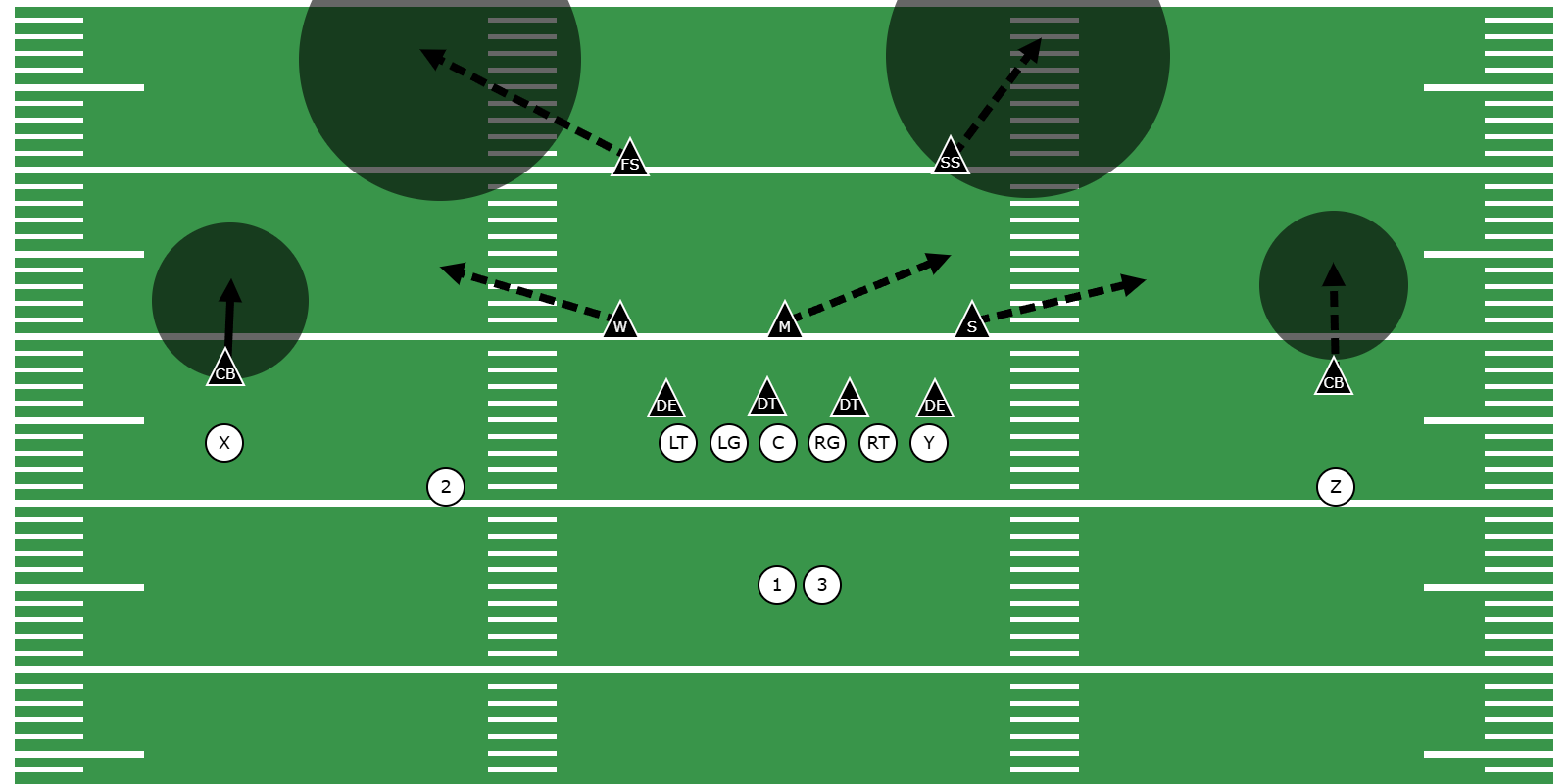
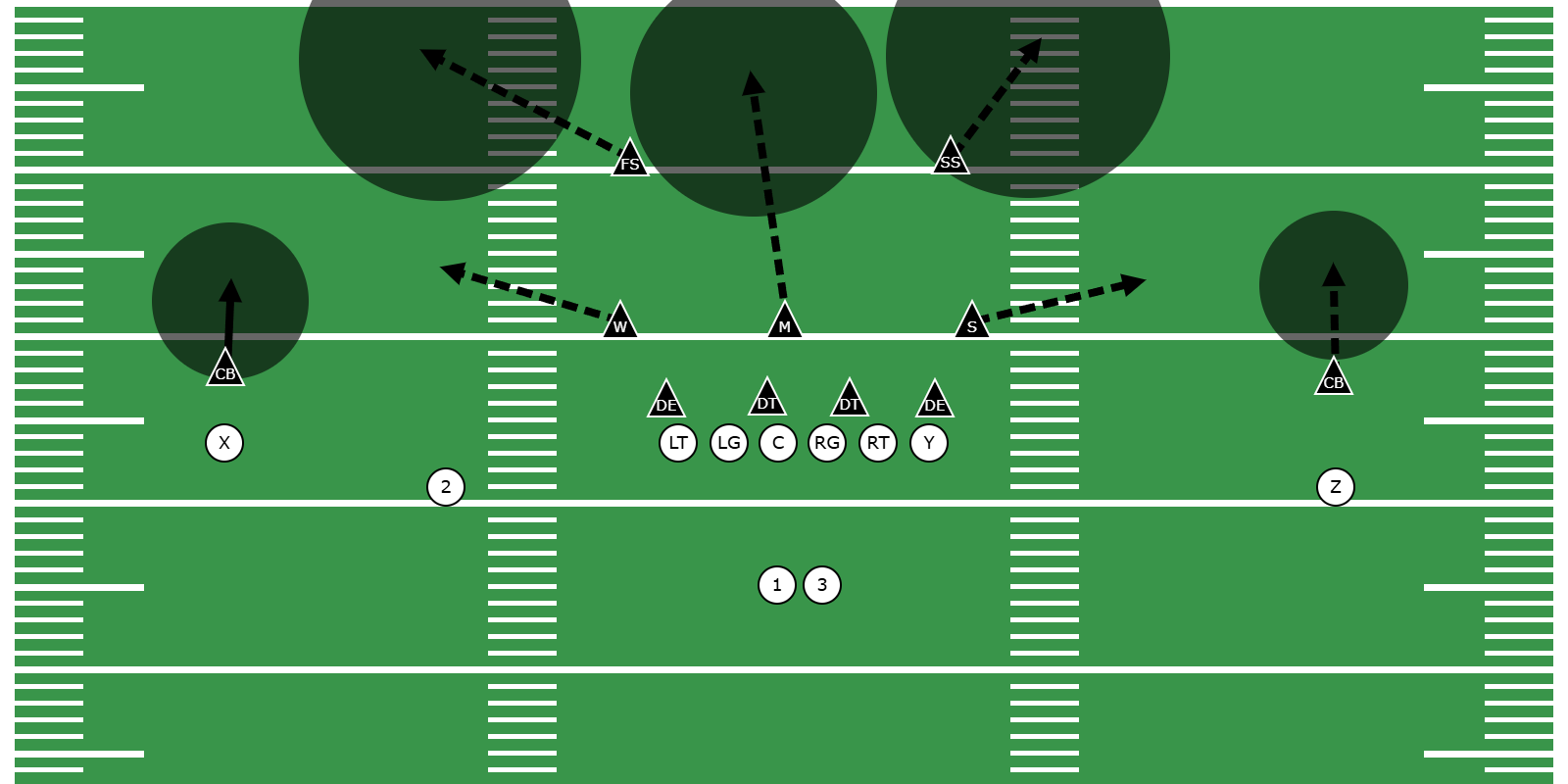
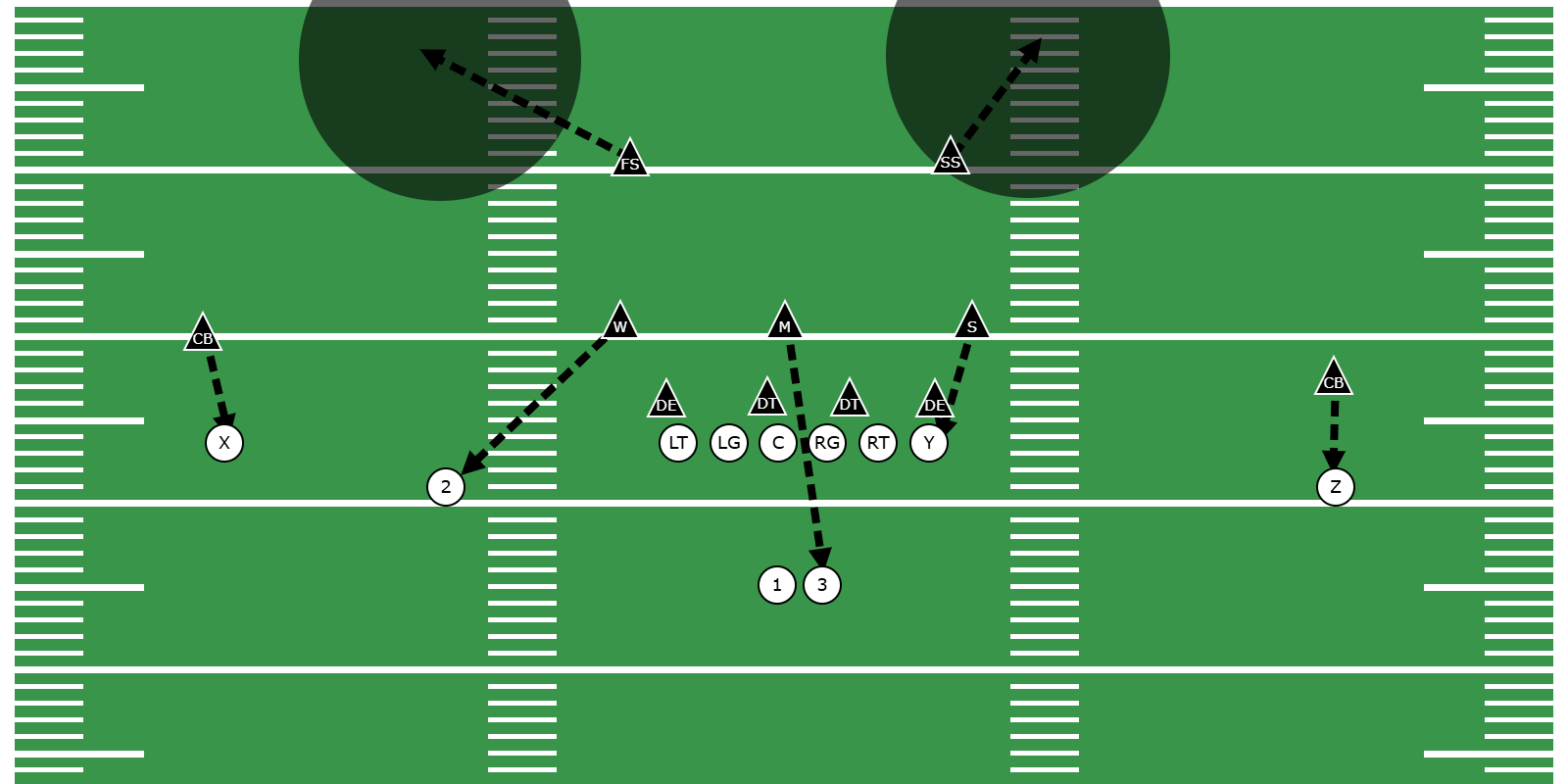
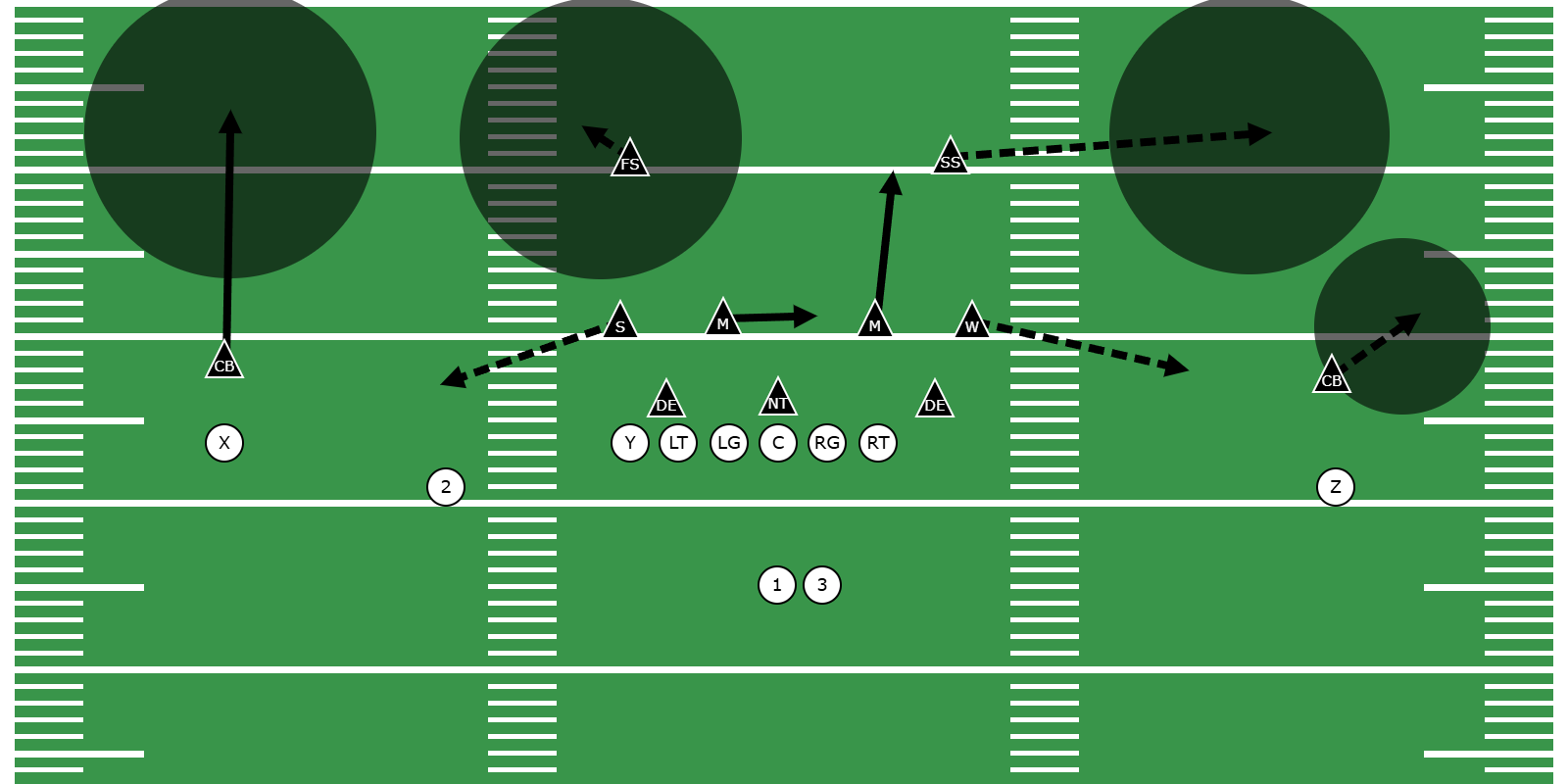
Cover 2 Trap
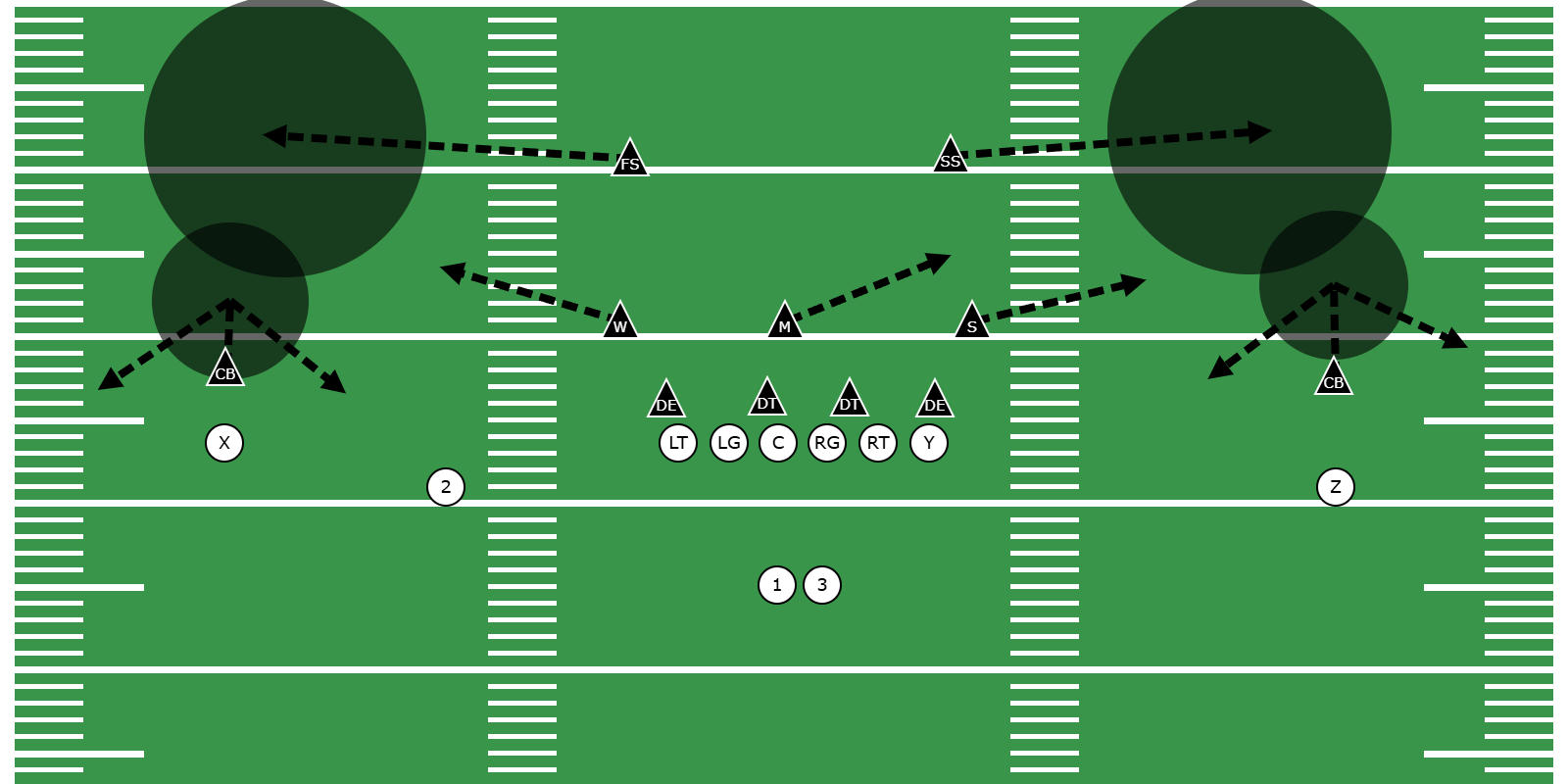
What Is Cover 2 Trap?
Cover 2 Trap begins with the basic structure of Cover 2:
- Two safeties protect the deep field.
- Cornerbacks work underneath near the flats.
- Linebackers and other underneath defenders protect hook, curl, and middle zones.
- The defense commonly rushes four.
The trap element changes how one or both cornerbacks play their underneath responsibility.
Rather than immediately showing a normal flat drop, the corner can present an alignment or technique that encourages the quarterback to believe a short outside throw will be open.
When the route and quarterback confirm that throw, the corner drives aggressively to the football.
The goal is not simply to tackle the receiver after the catch.
The goal is to arrive in the passing lane as the ball arrives.
Why Is It Called Trap Coverage?
The defense is attempting to create a trap for the quarterback.
The offense sees a defender apparently removed from a short route or sees a coverage picture that suggests the route should be available.
The quarterback makes the expected throw.
The corner then closes the window from outside or underneath.
A successful trap depends on three things:
- The quarterback believes the route is open.
- The corner recognizes the throw early enough to attack it.
- The rest of the coverage protects the routes created when the corner drives aggressively.
Without the third piece, Cover 2 Trap becomes little more than a cornerback gambling for an interception.
Basic Cover 2 Trap Structure
A common structure includes:
- Two deep safeties.
- A trap corner responsible for aggressively attacking a defined short outside threat.
- Underneath defenders protecting hook, curl, and middle zones.
- A four-man rush.
- Coverage rules that protect the vertical receiver when the corner triggers.
The exact trap can be called to:
- One side of the formation.
- The wide side.
- The boundary.
- A specific receiver.
- A specific offensive tendency.
Not every Cover 2 Trap call needs both corners playing identically.
A defense can trap one side while playing a different technique to the other.
The Trap Corner’s Responsibility
The cornerback is the defining player in the coverage.
He must balance patience with aggression.
Depending on the defensive system, the trap corner may be coached to:
- Show an off alignment before the snap.
- Read the quarterback through the receiver.
- Key the release of the outside receiver.
- Recognize a short outside route.
- Drive underneath the throw.
- Maintain awareness of the flat threat.
- Avoid chasing a route that does not belong to him.
- Tackle immediately if he cannot make a play on the ball.
The corner must understand exactly which route he is allowed to trap.
“Jump anything short” is too vague.
A well-coached trap call defines the trigger.
The Importance of the Corner’s Trigger
The corner should not attack merely because a receiver makes a short movement.
He needs confirmation.
Possible triggers can include:
- A specific receiver release.
- A route breaking immediately toward the sideline.
- The quarterback setting and throwing quickly.
- A known formation tendency.
- A route combination identified in the game plan.
The exact trigger depends on the defense.
The principle is universal: the corner needs a rule that separates recognition from guessing.
A corner who guesses correctly may make an interception.
A corner who guesses incorrectly may leave a receiver running uncovered behind him.
Safety Responsibilities
The safeties remain responsible for protecting the deep field.
Their role becomes especially important because the trap corner may aggressively leave a receiver who continues vertically.
The safety to the trap side must be prepared to handle deep threats entering his half.
He should:
- Stay deeper than the deepest route.
- Recognize the outside receiver’s release.
- Maintain enough width to protect the sideline.
- Understand when the corner is triggering underneath.
- Avoid driving on short routes the corner is already attacking.
- Break downhill only when the deep threat is controlled.
The safety and corner must work together.
If the corner traps underneath while the safety also attacks short, the defense can give up an uncontested touchdown.
Underneath Defender Responsibilities
The hook/curl and middle defenders must maintain proper spacing inside the trap corner.
Their responsibilities can include:
- Protecting inside-breaking routes.
- Closing intermediate windows.
- Carrying vertical threats according to the coverage rules.
- Reading the quarterback.
- Rallying to completed passes.
- Preventing the quarterback from simply replacing the trap with an inside throw.
The trap corner’s aggression can change the spacing around him.
Defenders inside the corner must understand where the new stress appears when he drives outside.
The Pass Rush
Cover 2 Trap is much more effective when the quarterback is forced to make a quick decision.
A strong pass rush can:
- Speed up the quarterback’s read.
- Encourage the anticipated quick throw.
- Prevent double moves from developing.
- Reduce the time receivers have to find open zone windows.
- Make disguise more effective.
If the quarterback has unlimited time, he can recognize the trap rotation and move to another route.
The rush and coverage should work together to create the mistake.
Why Defenses Use Cover 2 Trap
Cover 2 Trap is primarily a tendency-breaking and quarterback-confusion coverage.
Attack Quick Outside Throws
The defense can aggressively challenge hitches, outs, and other perimeter throws.
Create Turnovers
A properly timed trap corner can arrive underneath the receiver with an opportunity to intercept the football.
Punish Predictable Quarterbacks
Quarterbacks who throw based only on the pre-snap picture can be vulnerable to trap coverage.
Change the Meaning of a Familiar Shell
The defense can show a coverage picture the offense has seen previously and play it differently after the snap.
Discourage Repeated Concepts
Even one successful trap can make an offense hesitant to repeatedly throw a favorite quick route.
Strengths of Cover 2 Trap
The coverage can provide several advantages:
- Aggressive defense of short outside routes.
- Potential for interceptions and defensive touchdowns.
- Two deep defenders remain available for vertical protection.
- Useful against predictable route tendencies.
- Can disguise from familiar Cover 2 structures.
- Forces the quarterback to confirm coverage after the snap.
- Can make an offense hesitant to throw rhythm passes.
The concept is especially valuable when the defensive staff has identified a route the offense throws repeatedly from a predictable formation.
Weaknesses of Cover 2 Trap
The aggression that makes trap coverage dangerous also creates risk.
Double Moves
A receiver can show the route the corner expects and then continue vertically.
If the corner triggers too early, the safety may be forced to defend a large amount of space alone.
Vertical Routes
The corner’s aggressive underneath technique places additional stress on the deep safety.
Incorrect Reads
A corner who guesses rather than reads can abandon his responsibility.
Inside Replacement Routes
When the corner drives outside, the quarterback may throw into the space created inside him.
Play Action
Backfield action can delay underneath defenders and create openings behind them.
Poor Disguise
If the offense recognizes the trap before the snap, the quarterback can simply avoid the bait.
Try The Interactive Playbook Tool: Cover 2 Trap
Draw your own Cover 2 Trap concept based play diagram right here using our embedded interactive play designer demo:
GET STARTED: To get started simply click on any of the player icons in the diagram.
Start drawing your own plays like this and build your playbook with CoachYouths Playbook Designer.
Cover 2 Trap Against Quick Out Routes
Quick outs and speed outs are natural trap targets.
The quarterback often expects the receiver to gain immediate outside leverage and believes the ball can be delivered before a deep defender becomes involved.
The trap corner attempts to close from underneath or outside as the quarterback begins the throw.
For the coverage to work:
- The corner must recognize the route.
- The inside defenders must control replacement routes.
- The safety must stay on top of vertical threats.
- The pass rush must prevent the quarterback from holding the ball indefinitely.
The corner should attack the throwing lane, not simply run toward the receiver after the catch.
Cover 2 Trap Against Hitch Routes
A hitch can also become a trap target.
The quarterback sees the receiver stop in apparent open space and delivers the football on rhythm.
The corner can drive aggressively once the route and throw declare.
However, the defense must prepare for hitch-and-go double moves.
If the corner attacks every hitch immediately based only on the receiver’s initial body language, the offense can exploit his aggression.
Cover 2 Trap Against Slant/Flat
Slant/Flat stresses the relationship between the trap corner and inside underneath defender.
If the corner attacks the flat, the inside defender must be positioned to close the slant window.
If both defenders widen toward the flat, the quarterback receives an easy inside throw.
The defense should practice the combination repeatedly so the two defenders understand how their zones connect.
Cover 2 Trap Against Smash
Smash is already designed to stress Cover 2.
The short hitch threatens the corner underneath while the corner route attacks the safety over the top.
An overly aggressive trap corner can make the high-low stress even more severe.
The safety must recognize the corner route and maintain proper leverage.
The defense should know whether the trap call is appropriate against a formation that frequently produces Smash.
Cover 2 Trap Against Four Verticals
Four Verticals can quickly remove the trap corner’s preferred short target.
When the outside receiver releases vertically, the corner must follow the coverage rules rather than inventing a trap opportunity.
The safeties and underneath defenders become responsible for distributing the vertical routes.
A corner who waits for a short route that never comes can become useless to the coverage.
Cover 2 Trap Against Double Moves
Double moves are one of the greatest dangers.
Common examples include:
- Hitch-and-go.
- Out-and-up.
- Sluggo.
- Stop-and-go.
These routes intentionally show the corner the short break he wants to attack.
The corner must read the quarterback and route together.
If the quarterback does not commit to the short throw, the corner should remain disciplined.
The safest trap defender is aggressive after confirmation, not before it.
Cover 2 Trap Against Trips
Trips can create difficult spacing because three receiving threats are aligned to one side.
Before trapping a Trips side, the defense should know:
- Which receiver is the trap target?
- Who protects the vertical outside receiver?
- Who handles the number-two receiver?
- Who handles the number-three receiver?
- Where does the running back fit?
- What happens if all three receivers release vertically?
A trap call without answers to those questions can create an easy overload for the offense.
For youth defenses, trapping the simpler backside of Trips may sometimes be easier than trapping the three-receiver side.
Cover 2 Trap Against Bunch Formations
Bunch formations can make route identification more difficult because receivers release from condensed alignments and exchange positions quickly.
The corner may not immediately know which receiver will enter the flat.
The defense should practice:
- Fast flat routes.
- Corner routes behind them.
- Crossing routes from the bunch.
- Vertical releases.
- Switch releases.
If the corner cannot identify his trigger consistently, another coverage may be a better choice against bunch.
Cover 2 Trap Against Motion
Motion can change the receiver the defense intends to trap.
The coverage needs a clear rule for whether the trap:
- Stays attached to a side.
- Travels with a specific receiver.
- Cancels against certain motions.
- Checks to another coverage.
Youth defenses should avoid complex motion adjustments.
A simple “trap remains to the called side” or “check out of trap when the receiver motions” rule may be easier to execute than trying to redesign the coverage while the offense is moving.
Cover 2 Trap and the Run Game
The corner’s alignment can make him an important perimeter run defender.
Against run, he may be responsible for:
- Force.
- Contain.
- Defeating receiver blocks.
- Turning the ball back inside.
- Supporting outside runs.
The trap technique should not prevent him from executing his run responsibility.
A receiver can also attempt to influence the corner with a stalk-block look before releasing into a route.
The corner must read his keys rather than reacting solely to the receiver’s first movement.
Cover 2 Trap Against Play Action
Play-action can affect both the corner and underneath defenders.
If linebackers attack downhill, the quarterback may have an inside replacement throw when the corner triggers outside.
Safeties must also avoid becoming too aggressive against the run.
The defense should practice trap calls against:
- Run-action quick outs.
- Boot concepts.
- Flat routes from backs or tight ends.
- Deep routes developing behind run action.
A trap call should remain structurally sound even when the offense changes the backfield picture.
Disguising Cover 2 Trap
Disguise is a major part of the concept.
The defense may want the quarterback to believe he is seeing:
- Cover 3.
- Off-man coverage.
- A standard Cover 2 corner.
- Another familiar zone structure.
The corner’s pre-snap alignment and initial movement can help sell that picture.
However, disguise should never override assignment.
Youth defenders should first learn:
- Where to align.
- What to read.
- When to trigger.
- Where the safety help exists.
Only then should coaches emphasize making the coverage look like something else.
Film Study and Tendency Recognition
Cover 2 Trap becomes much more useful when it is tied to offensive tendencies.
Coaches can look for situations such as:
- The offense throws a quick out whenever the corner aligns off.
- A receiver runs a hitch from a specific split.
- The quarterback immediately throws the flat against a certain shell.
- A formation repeatedly produces the same perimeter concept.
- A down-and-distance tendency predicts a quick rhythm throw.
The trap can then be called intentionally against that tendency.
This is better than calling trap coverage randomly and hoping the offense cooperates.
Coaching Cover 2 Trap in Youth Football
Cover 2 Trap should generally be installed after basic Cover 2.
A practical progression is:
- Review normal Cover 2 responsibilities.
- Identify the trap side.
- Teach the corner’s exact trigger.
- Review the safety’s responsibility behind the trap.
- Practice quick outs.
- Practice hitches.
- Add Slant/Flat.
- Add Smash.
- Add double moves.
- Add motion.
- Add play-action.
- Connect the call to offensive tendencies.
- Run full-team situations.
The corner should never be told simply to “go make a play.”
He needs a repeatable rule.
A Simple Trap Corner Drill
Set up:
- One quarterback.
- One receiver.
- One trap corner.
- One deep safety.
Run a mixture of:
- Quick out.
- Hitch.
- Fade.
- Out-and-up.
- Hitch-and-go.
The corner must identify whether the receiver is actually running the trap route before driving.
The quarterback should sometimes pump the short route and throw deep so the corner learns not to guess.
Grade:
- Alignment.
- Patience.
- Eyes.
- Trigger recognition.
- Break angle.
- Ball disruption.
- Ability to remain disciplined against double moves.
As the defender improves, add an inside receiver and underneath defender to create real route combinations.
Common Youth Football Mistakes
The Corner Guesses
The corner decides before the snap that the short route is coming and attacks without confirmation.
The Corner Watches Only the Receiver
He reacts to a route fake without seeing whether the quarterback is actually throwing the football.
The Safety Gets Too Aggressive
The safety sees the corner drive underneath and also attacks the short route, leaving the deep field exposed.
Nobody Replaces Inside
The corner traps outside while an inside receiver settles into an open window.
Poor Communication
One defender believes trap has been called while another plays ordinary Cover 2.
Trap Is Called Without a Tendency
The defense repeatedly takes unnecessary risks against an offense that is not throwing the route the trap is designed to attack.
Players Forget the Run Fit
The corner becomes so focused on intercepting a pass that he loses his perimeter run responsibility.
Personnel Considerations
A good trap corner should have:
- Quick recognition.
- Good short-area acceleration.
- Confidence playing the football.
- Discipline against route fakes.
- Reliable tackling ability.
- Understanding of safety help.
- Enough experience to distinguish route concepts.
The best athlete is not automatically the best trap defender.
A slightly slower corner who reads correctly can be more effective than a faster player who guesses constantly.
The safety behind the trap also needs enough range to protect the deep route when the corner drives underneath.
When to Call Cover 2 Trap
Cover 2 Trap can be useful when:
- The offense repeatedly throws quick outs.
- The quarterback relies heavily on pre-snap reads.
- A receiver has a predictable route tendency.
- The offense repeatedly attacks the flat.
- The defense wants to create a turnover opportunity.
- The pass rush can force quick decisions.
- The defense has already shown another coverage from a similar alignment.
It should be used more cautiously when:
- The offense frequently uses double moves.
- The quarterback is patient and reads rotations well.
- The defense cannot protect the vertical route behind the corner.
- The trap corner is undisciplined.
- The offensive formation creates unclear route distribution.
Cover 2 Trap vs. Cover 2
Both coverages use a two-deep structure.
Cover 2: The corner generally protects the flat within the normal zone distribution.
Cover 2 Trap: The corner plays with an aggressive read designed to jump a specific short outside throw.
Cover 2 is generally more conservative.
Cover 2 Trap deliberately accepts additional risk in exchange for the opportunity to create a negative play or turnover.
Cover 2 Trap vs. Tampa 2
Both can use a two-high safety shell.
Tampa 2 modifies the middle of Cover 2 by sending the middle linebacker vertically between the safeties.
Cover 2 Trap modifies the underneath perimeter technique by allowing a corner to aggressively attack a defined short route.
One addresses deep-middle stress.
The other attempts to bait and attack a perimeter throw.
Cover 2 Trap vs. Cover 2 Man
The two coverages may begin from similar two-high looks, but their underneath structures are different.
Cover 2 Trap: Primarily a zone concept with an aggressive trapping corner.
Cover 2 Man: Man-to-man coverage underneath with two deep safeties.
The quarterback’s post-snap read should therefore look very different once the underneath defenders declare.
Key Coaching Points
- Install basic Cover 2 before installing the trap variation.
- Define the trap corner’s trigger precisely.
- Teach the corner to read rather than guess.
- Keep the safety deeper than the vertical threat.
- Practice double moves from the beginning.
- Make underneath defenders understand the space created by the trap.
- Coordinate the pass rush with the coverage.
- Tie trap calls to offensive tendencies whenever possible.
- Establish clear motion rules.
- Maintain perimeter run responsibilities.
- Practice the route combinations most likely to attack the trap.
- Use disguise only after the assignment is dependable.
- Treat turnovers as the result of disciplined technique, not gambling.
Final Thoughts
Cover 2 Trap turns a familiar two-deep zone structure into an aggressive tool for attacking predictable perimeter throws.
The defense attempts to show the quarterback a route he believes is available, then closes that window with a cornerback who has been coached to recognize and attack the throw. When the corner, safety, underneath defenders, and pass rush work together, the coverage can turn a routine quick pass into an interception or negative play.
The same aggression creates the danger. A corner who guesses, a safety who loses depth, or an underneath defender who fails to replace space can turn the trap against the defense.
For youth coaches, Cover 2 Trap should therefore be a deliberate changeup rather than a foundational coverage. Build sound Cover 2 technique first, identify a specific offensive tendency, give the trap corner a clear trigger, and practice the double moves and route combinations the offense can use in response.
The best Cover 2 Trap call is not a gamble. It is a calculated attempt to make the offense throw exactly where the defense wants the football to go.
Related Articles
Published by CoachYouths Staff on 08/25/2026
You are NOT currently logged in, you may login or signup for FREE at any time: