Cover 1 Robber
What Is Cover 1 Robber?
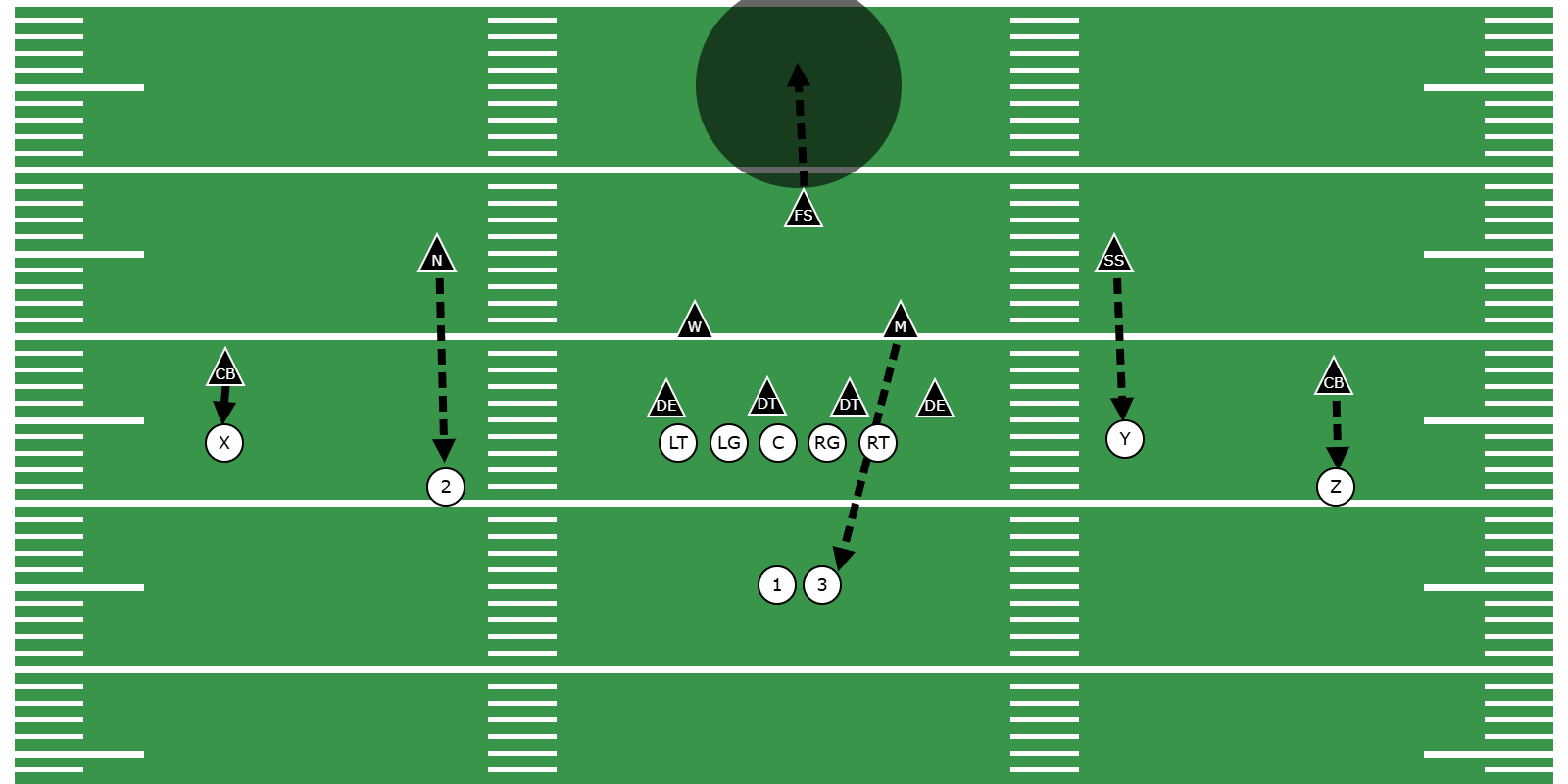
Start with standard Cover 1:
- One safety protects the deep middle.
- Eligible receivers are matched man-to-man.
- Remaining defenders can rush or perform another defensive responsibility.
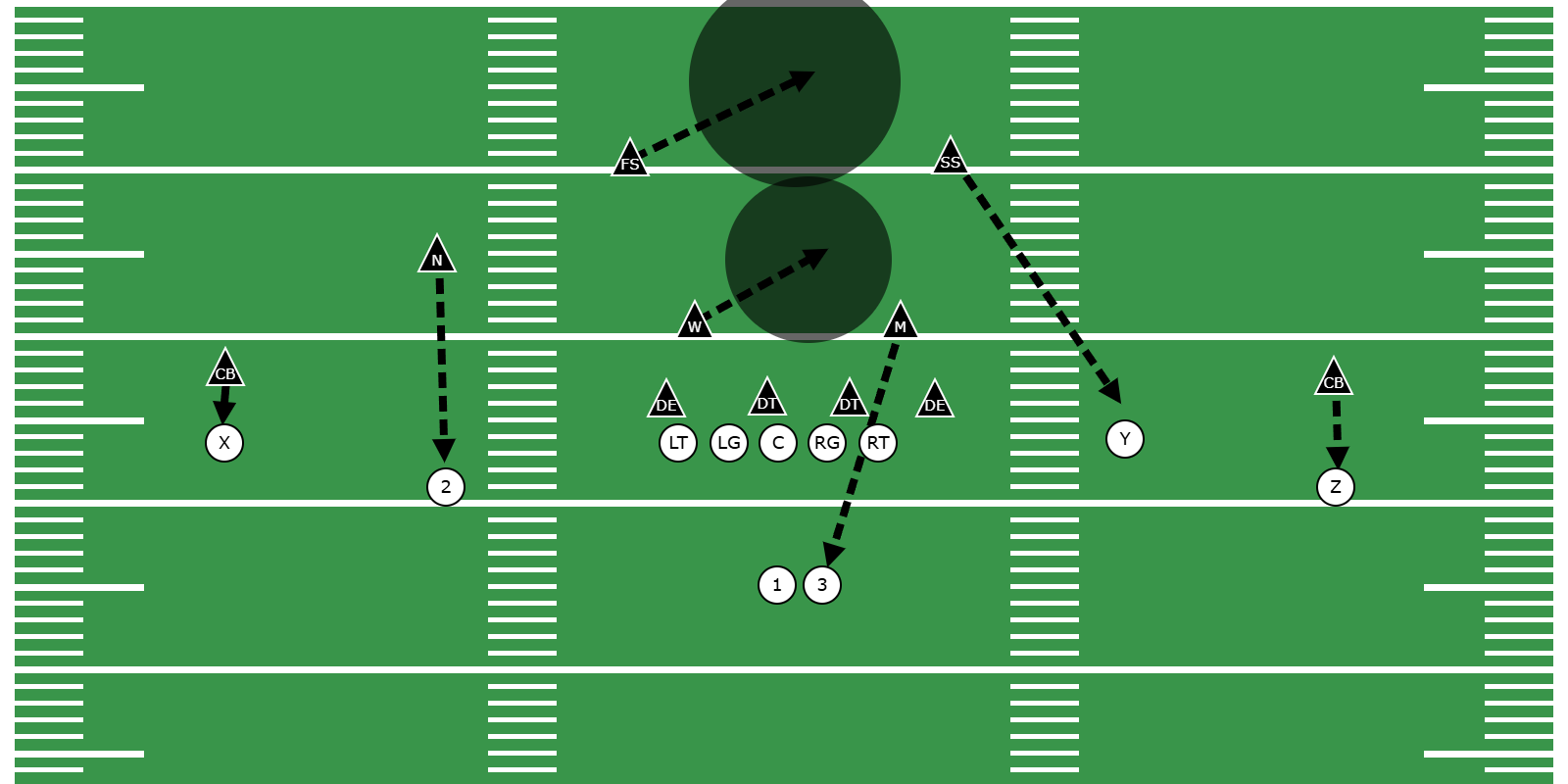
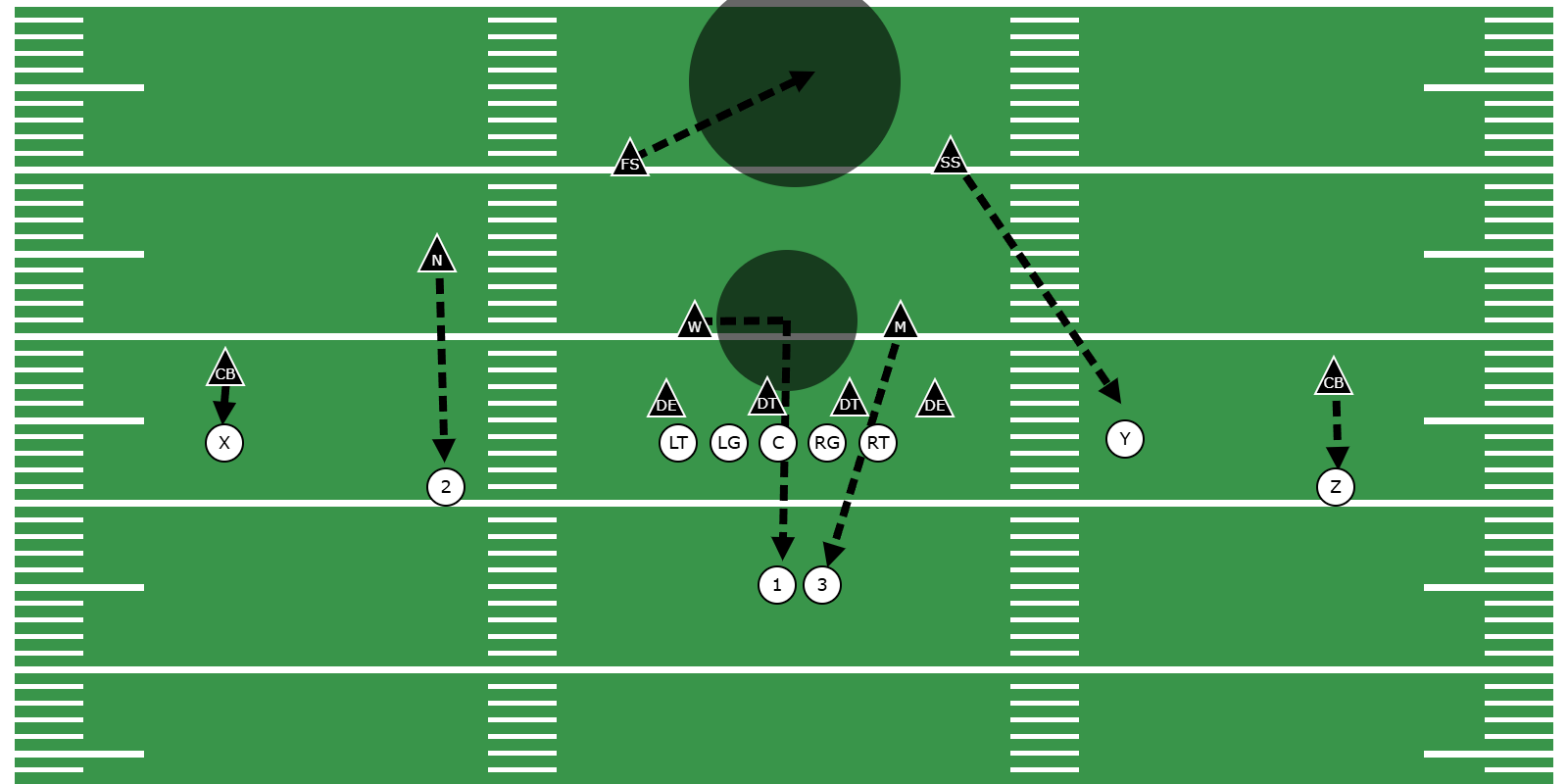
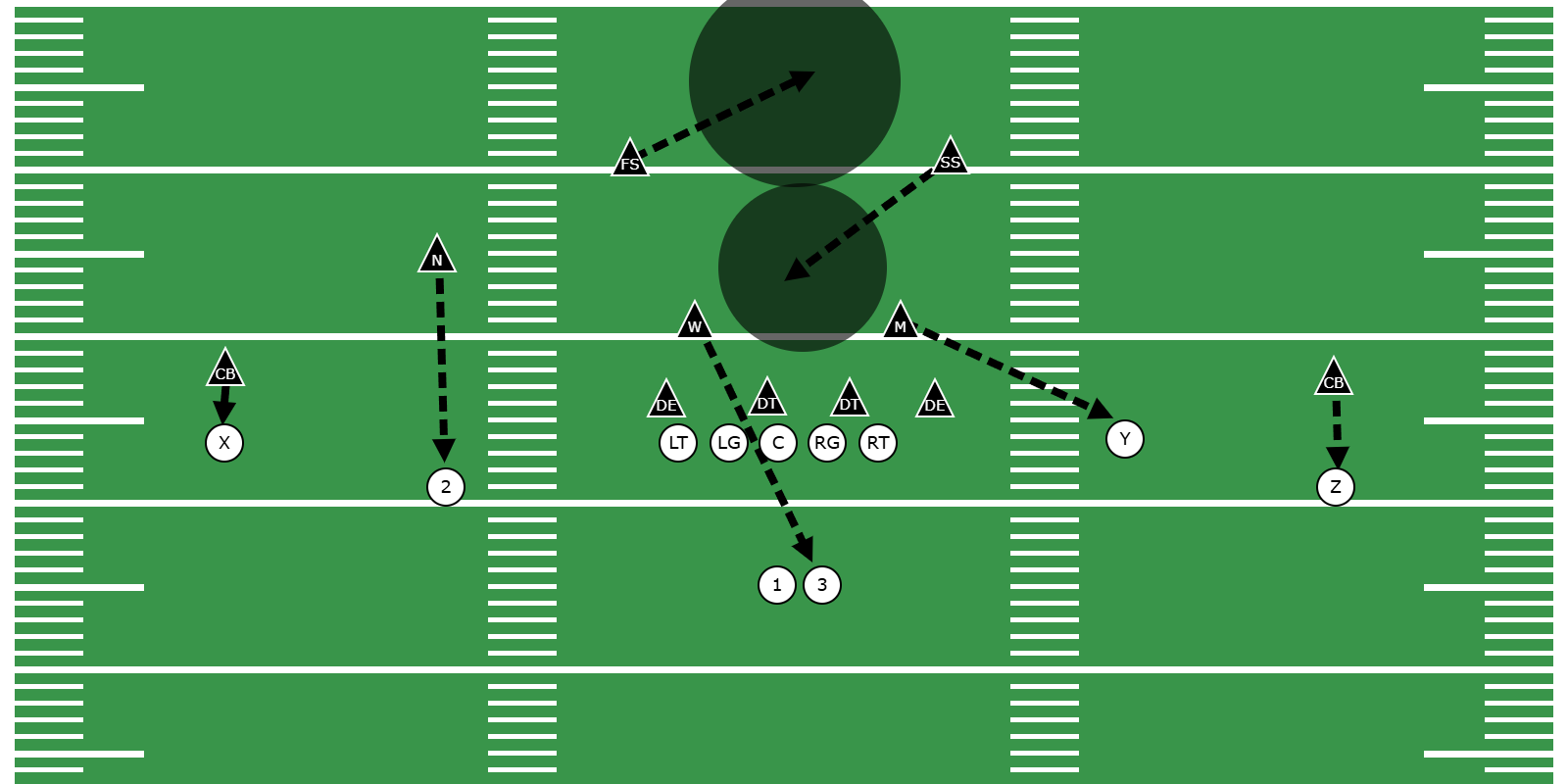
Cover 1 Robber keeps the single-high safety and man coverage structure but assigns an additional defender as the robber.
Instead of covering a specific receiver man-to-man or rushing the quarterback, the robber reads the developing pass play and looks for opportunities to break on routes entering his area.
The robber is especially dangerous against throws breaking toward the middle because the quarterback may see the receiver gain separation from his man defender without immediately recognizing the free defender waiting inside.
The Basic Structure
The exact structure depends on defensive personnel, formation, and coaching terminology, but a typical Cover 1 Robber call includes:
- One deep middle safety.
- Man coverage on the offense’s eligible receivers.
- One underneath robber defender.
- A pass rush from the remaining defenders.
- Defined leverage rules designed to work with the available help.
From a 4-2-5 defense, the robber might be a safety, nickel defender, or linebacker depending on the offensive formation and matchup plan.
The position name is less important than the responsibility. The robber needs enough awareness and movement ability to read the play, overlap routes, and tackle effectively in space.
The Deep Safety’s Responsibility
The post safety still performs the essential Cover 1 job: protect the deep middle and stay deeper than the deepest threat.
The presence of a robber does not change that responsibility.
The post safety should not become overly aggressive simply because another defender is helping underneath. His job remains preventing explosive vertical plays and providing deep help to the man defenders.
Useful coaching rules include:
- Stay deeper than the deepest receiver.
- Maintain middle-of-field leverage.
- Read the quarterback without abandoning vertical threats.
- Do not chase underneath routes that belong to the robber.
- Break downhill only when the throw declares and the deep threat is controlled.
The post safety and robber should complement each other rather than attack the same route.
The Robber’s Responsibility
The robber is the defining player in the coverage.
His job is to read the quarterback and route development from an underneath position, then attack throws entering his area.
Depending on the defensive system, the robber may be coached to:
- Look for slants.
- Cut crossing routes.
- Sit underneath dig routes.
- Help on inside-breaking routes.
- Read the quarterback’s eyes.
- Collision or disrupt receivers entering the middle.
- Rally to short completions.
- Add to the run fit when the play declares run.
The robber should not simply wander toward whichever receiver appears open.
He needs a defined landmark, key, or progression so the rest of the defense knows where help will exist.
Who Plays the Robber?
Different defenses use different players.
Safety
A safety can rotate down from a two-high pre-snap shell and become the robber after the snap. This can disguise the coverage and place an athletic defensive back underneath.
Nickel Defender
Against spread formations, a nickel defender may be used as the robber if another defender can handle his normal matchup.
Linebacker
A linebacker can play the robber role, particularly against offenses that attack the middle with tight ends and crossing routes. The linebacker must have enough range to affect passing windows.
The best choice depends on personnel. Coaches should choose a player who understands route development, tackles reliably, and can react without guessing.
Man-Coverage Responsibilities
The remaining coverage defenders play man-to-man.
They must understand that the robber is help, not an excuse to abandon technique.
Man defenders still need to:
- Identify their assignment before the snap.
- Maintain the called leverage.
- Stay attached through vertical routes.
- Navigate crossing traffic.
- Handle motion according to the defensive rules.
- Finish with sound tackling.
The robber cannot help every defender on every route.
A receiver running away from the robber’s area may effectively be isolated in man coverage.
Leverage in Cover 1 Robber
Cover 1 Robber becomes more effective when leverage rules intentionally direct routes toward help.
The defense has two important help defenders:
- The post safety provides deep-middle help.
- The robber provides underneath-middle help.
That structure can allow man defenders to play aggressively based on where those defenders are located.
However, youth coaches should avoid creating a different leverage rule for every formation.
A simple system should answer:
- Who is my man?
- Where is my deep help?
- Where is my underneath help?
- Which release am I trying to deny?
- What changes if my receiver motions?
When defenders understand those answers, the coverage begins functioning as a coordinated system instead of five separate man-to-man matchups.
Why Defenses Use Cover 1 Robber
The coverage is designed to preserve the advantages of Cover 1 while adding a defender specifically positioned to attack common man-beating routes.
Help Against Inside Routes
Slants, digs, and crossers frequently attack man coverage. The robber can close those windows from inside.
Quarterback Deception
A quarterback may believe a receiver has won his individual matchup only to discover the robber breaking into the throwing lane.
Strong Middle-of-Field Presence
With a post safety deep and robber underneath, the defense places defenders at two levels through the middle.
Run Support
The robber is positioned closer to the line of scrimmage than the post safety and can become an additional run defender once the play declares.
Coverage Variation
A defense that already plays Cover 1 can add Cover 1 Robber without completely changing its man-coverage foundation.
Strengths of Cover 1 Robber
Cover 1 Robber can be particularly effective against offenses that repeatedly attack the middle.
Its strengths include:
- Help against slants and digs.
- An extra defender against crossing routes.
- Deep-middle protection from the post safety.
- Potential to disguise the robber before the snap.
- Aggressive man coverage on outside receivers.
- An underneath defender available to tackle short completions.
- Useful support against quarterback tendencies.
The coverage becomes especially valuable when the coaching staff has identified where a quarterback prefers to throw.
Weaknesses of Cover 1 Robber
Adding the robber improves one part of Cover 1 but does not eliminate the weaknesses of man coverage.
Reduced Pass Rush
If the robber would otherwise have rushed the quarterback, the defense may be sending fewer rushers than it would in standard Cover 1.
Outside Matchups
The robber is primarily positioned to affect interior routes. Outside receivers may still have favorable one-on-one matchups.
Routes Away From the Robber
Out routes, fades, corners, and other routes breaking away from underneath-middle help can isolate defenders.
Play-Action Manipulation
An undisciplined robber can step too aggressively toward run action and vacate the exact passing window he is supposed to protect.
Quarterback Eye Manipulation
Experienced quarterbacks may move the robber with their eyes before throwing elsewhere.
Bunch and Stack Formations
Man defenders still need answers for traffic created by condensed formations.
Try The Interactive Playbook Tool: Cover 1 Robber
Draw your own Cover 1 Robber concept based play diagram right here using our embedded interactive play designer demo:
GET STARTED: To get started simply click on any of the player icons in the diagram.
Start drawing your own plays like this and build your playbook with CoachYouths Playbook Designer.
Cover 1 Robber Against Common Offensive Concepts
Slants
The robber can sit inside the throwing window and make the quarterback hesitate before throwing a slant.
Man defenders still need to maintain leverage because the robber may be occupied by another route.
Dig Routes
Intermediate digs are excellent robber targets. A receiver may appear open after crossing the face of his man defender, but the robber can break underneath the route.
Mesh
The robber can help disrupt crossing routes through the middle, but man defenders still need practiced rules for navigating traffic.
Shallow Cross
The robber can collision, overlap, or tackle the shallow receiver depending on the defensive rules. He must avoid chasing so far that he vacates more dangerous intermediate windows.
Four Verticals
The robber has less influence against vertical routes that quickly leave his underneath area. The post safety and man defenders become critical.
Flood and Out-Breaking Concepts
Routes breaking toward the sideline can move away from the robber’s help, placing greater stress on individual matchups.
Reading the Quarterback
The robber often has more freedom to read the quarterback than the man defenders.
That freedom must still be coached carefully.
Young players frequently interpret “read the quarterback” as “stare at the quarterback and chase the first thing you see.” That creates false steps and opens passing lanes.
A more disciplined robber progression can be:
- Align at the assigned landmark.
- Read the quarterback’s initial setup.
- See the route distribution developing in front of you.
- Maintain position underneath the most dangerous inside threat.
- Break decisively when the quarterback commits to the throw.
The robber should react to evidence, not guess.
Disguising the Robber
One advantage of Cover 1 Robber is the ability to disguise which defender will become the robber.
The defense may initially show:
- A two-high safety shell.
- A normal Cover 1 alignment.
- Pressure from the eventual robber.
- A different underneath rotation.
After the snap, one safety can rotate deep while another defender settles into the robber position.
For youth football, disguise should remain secondary to execution.
If rotating late causes defenders to miss assignments, align where players can execute correctly and worry about disguise later.
Cover 1 Robber Against Motion
Motion can stress the man assignments and reveal coverage.
The defense needs a clear rule for whether defenders:
- Travel with their assigned receiver.
- Exchange assignments.
- Bump the coverage.
- Check to another call.
The robber’s responsibility should also remain clear after motion.
A motioning receiver should not cause the robber to accidentally become a man defender unless the defensive call specifically requires that adjustment.
Cover 1 Robber Against Bunch and Stack Formations
Bunch and stack formations create natural traffic against man coverage.
The robber can help inside, but he does not solve the release problem by himself.
The defense still needs a plan such as:
- Locking individual matchups.
- Banjoing two receivers.
- Using switch rules.
- Staggering defensive alignments.
- Checking into another coverage.
The most important requirement is that every defender understands the adjustment before the snap.
Cover 1 Robber and the Run Game
The robber can become an effective run-support player because he begins closer to the line of scrimmage than the deep safety.
Once he confirms run, he can:
- Fit an open gap.
- Replace a linebacker displaced by action.
- Pursue from inside-out.
- Help defend quarterback runs.
- Clean up cutback lanes.
However, the robber must confirm run before attacking aggressively.
Play-action is specifically designed to make underneath defenders step forward and create passing space behind them.
Coaching Cover 1 Robber in Youth Football
Cover 1 Robber should generally be installed after basic Cover 1.
Players should already understand:
- Man assignments.
- Basic leverage.
- The deep safety’s role.
- Motion rules.
- Running back releases.
- Man-coverage tackling.
Then add the robber as a new layer.
A useful progression is:
- Review standard Cover 1.
- Identify the robber.
- Establish the robber’s alignment and landmark.
- Teach the robber which routes he is looking to affect.
- Run basic slant and dig combinations.
- Add shallow crossers.
- Add play-action.
- Add motion.
- Practice bunch or stack adjustments.
- Run complete team periods.
This allows most defenders to continue playing familiar Cover 1 rules while one player learns the additional responsibility.
A Simple Robber Drill
A useful practice drill can involve:
- One quarterback.
- Two or three receivers.
- Their man defenders.
- One robber.
Have the receivers alternate among slants, digs, shallow crosses, and vertical routes.
The robber begins at his normal landmark and reads the quarterback while seeing the routes develop.
Grade the robber on:
- Initial patience.
- Proper depth.
- Recognition.
- Break angle.
- Ball disruption.
- Tackling position.
The goal is not interceptions on every repetition. The goal is disciplined positioning that makes middle-of-field throws difficult.
Common Youth Football Mistakes
The Robber Chases the First Receiver
The robber abandons his landmark and follows a shallow route across the field, opening a dig behind him.
The Robber Bites on Play Action
Aggressive run support creates an easy passing window directly behind the robber.
The Post Safety Comes Down Too Far
The safety sees the robber attacking underneath and joins him, leaving nobody protecting the deep middle.
Man Defenders Depend Too Much on Help
Defenders intentionally allow separation because they assume the robber or safety will make the play.
Confusion About Who Is Free
If players do not clearly understand who is playing man and who is the robber, an eligible receiver can be left uncovered.
Poor Communication Against Motion
Motion changes the offensive distribution, but defenders fail to reset their assignments.
When to Call Cover 1 Robber
Cover 1 Robber can be a strong choice when:
- The offense frequently throws slants.
- The quarterback favors dig routes.
- Mesh and crossing concepts are common.
- The defense wants man coverage with both deep and underneath help.
- The quarterback repeatedly throws to the middle.
- The defense wants an extra interior run-support player.
- The offense has a specific inside receiver the defense wants to discourage.
It may be less attractive when the offense has major advantages on outside one-on-one routes or consistently attacks the sidelines away from the robber.
Cover 1 Robber vs. Cover 1
The basic difference is the underneath free defender.
Cover 1: Man coverage underneath with one deep middle safety. Remaining defenders can rush or perform other assignments.
Cover 1 Robber: Man coverage with the same deep middle safety plus a defender assigned to rob underneath routes.
Cover 1 may provide more pressure flexibility. Cover 1 Robber sacrifices some of that flexibility to strengthen the underneath middle.
Cover 1 Robber vs. Cover 1 Rat
The terms robber and rat are not completely standardized across football. Some coaching systems use them almost interchangeably, while others assign distinct landmarks, keys, or responsibilities.
For a defensive playbook, the terminology should be defined explicitly rather than assuming every coach or player understands the same meaning.
A useful distinction is to treat the robber as a defender actively reading and cutting inside-breaking routes, while a rat may be defined as an underneath middle helper with more specific responsibility for crossers or quarterback-related threats. The exact distinction should follow the defense’s terminology.
The important coaching principle is consistency: players must know exactly what the word means in their own system.
Key Coaching Points
- Install standard Cover 1 before adding the robber variation.
- Keep one safety deeper than the deepest threat.
- Give the robber a defined alignment and key.
- Teach the robber to read rather than guess.
- Use the robber to discourage inside-breaking routes.
- Do not allow man defenders to depend completely on help.
- Maintain clear leverage rules.
- Practice play-action discipline.
- Establish motion and bunch adjustments.
- Make sure every eligible receiver is still accounted for.
- Teach the robber to become a run defender only after confirming run.
- Keep youth terminology consistent and simple.
Final Thoughts
Cover 1 Robber adds an important underneath element to a traditional Cover 1 structure. The defense still challenges eligible receivers with man coverage and protects the deep middle with a post safety, but the robber gives the defense an additional player who can attack the routes that frequently cause problems for man coverage.
The concept is most effective when the robber understands exactly where his help is needed. A disciplined robber can close slant and dig windows, disrupt crossing routes, discourage quarterbacks from throwing into the middle, and still contribute to the run defense.
For youth coaches, the best approach is to build Cover 1 Robber from an already dependable Cover 1 foundation. Keep the man assignments intact, protect the deep middle, give the robber a simple and specific job, and practice the offensive concepts that are most likely to challenge him. That creates a coverage variation with a real tactical purpose rather than simply adding another name to the defensive playbook.
Related Articles
Published by CoachYouths Staff on 08/25/2026
You are NOT currently logged in, you may login or signup for FREE at any time: